Results by title
149 books match the query 'Modernity' and 5 start with e

Empty Moments
Cinema, Modernity, and DriftLeo Charney
Duke University Press, 1998
Empty Moments creates a catalytic dialogue among those who, at the time of the invention of film, attempted to define the experience of the fleeting present. Interspersing philosophical discussions with stylistically innovative prose, Charney mingles Proust’s conception of time/memory with Cubism’s attempt to interpret time through perspective and Surrealism’s exploration of subliminal representations of the present. Other topics include Husserl’s insistence that the present can only be fantasy or fabrication and the focus on impossibility, imperfection, and loss in Kelvin’s laws of thermodynamics. Ultimately, Charney’s work hints at parallels among such examples, the advent and popularity of cinema, and early film theory.
A book with a structural modernity of its own, Empty Moments will appeal to those interested in cinema and its history, as well as to other historians, philosophers, literary, and cultural scholars of modernity.
Encompassing Others
The Magic of Modernity in MelanesiaEdward LiPuma
University of Michigan Press, 2001
Focusing on the Maring people of Highland New Guinea and on the Westerners who interacted with them, Edward LiPuma presents issues from the perspectives of both sides. We hear the voice of the Anglican priest from San Francisco as well as the most powerful Maring shamans. Further, the book seeks to develop a theory of generations that helps explain how change accelerates and societies take on new directions across generations.
Theoretical, descriptive, but almost entirely free of jargon, this book is intended for all those who are interested in how the West's encompassment of other peoples influences how these others conceive of their past, imagine their future, and experience the present. It will have wide appeal for anthropologists and others concerned with colonialism, globalization, and the formation of the nation-state.
Edward LiPuma is Professor and Chair, Department of Anthropology, University of Miami.
Equestrian Cultures
Horses, Human Society, and the Discourse of ModernityEdited by Kristen Guest and Monica Mattfeld
University of Chicago Press, 2019
Kristen Guest and Monica Mattfeld place the modern period front and center in this collection, illuminating the largely untold story of how the horse has responded to the accelerated pace of modernity. The book’s contributors explore equine cultures across the globe, drawing from numerous interdisciplinary sources to show how horses have unexpectedly influenced such distinctively modern fields as photography, anthropology, and feminist theory. Equestrian Cultures boldly steps forward to redefine our view of the most recent developments in our long history of equine partnership and sets the course for future examinations of this still-strong bond.
Ethnological Imagination
A Cross-Cultural Critique Of ModernityFuyuki Kurasawa
University of Minnesota Press, 2004
A significant intervention in contemporary debates about cross-cultural understanding
Fuyuki Kurasawa unearths what he terms “the ethnological imagination,” a substantial countercurrent of thought that interprets and contests Western modernity’s existing social order through comparison and contrast to a non-Western other. Accordingly, Kurasawa traces and critiques, through this prism of cultural alterity, the writings of some of the key architects of this way of thinking: Jean-Jacques Rousseau, Karl Marx, Max Weber, Émile Durkheim, Claude Lévi-Strauss, and Michel Foucault.
In the work of these thinkers, Kurasawa finds little justification for two of the most prevalent claims about social theory: the wholesale “postmodern” dismissal of the social-theoretical enterprise because of its supposedly intractable ethnocentrism and imperialism, or, on the other hand, the traditionalist and historicist revival of a canon stripped of its intercultural foundations. Rather, Kurasawa’s book defends a cultural perspective that eschews both the false universalism of “end of history” scenarios and the radical particularism embodied in the vision of “the clash of civilizations.” It contends that the ethnological imagination can invigorate critical social theory by informing its response to an increasingly multicultural world—a response that calls for a reconsideration of the identity and boundaries of the West as well of modernity itself.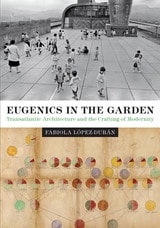
Eugenics in the Garden
Transatlantic Architecture and the Crafting of ModernityBy Fabiola López-Durán
University of Texas Press, 2018
Winner, Robert Motherwell Book Award, Outstanding Book on Modernism in the Arts, The Dedalus Foundation, 2019
As Latin American elites strove to modernize their cities at the turn of the twentieth century, they eagerly adopted the eugenic theory that improvements to the physical environment would lead to improvements in the human race. Based on Jean-Baptiste Lamarck’s theory of the “inheritance of acquired characteristics,” this strain of eugenics empowered a utopian project that made race, gender, class, and the built environment the critical instruments of modernity and progress.
Through a transnational and interdisciplinary lens, Eugenics in the Garden reveals how eugenics, fueled by a fear of social degeneration in France, spread from the realms of medical science to architecture and urban planning, becoming a critical instrument in the crafting of modernity in the new Latin world. Journeying back and forth between France, Brazil, and Argentina, Fabiola López-Durán uncovers the complicity of physicians and architects on both sides of the Atlantic, who participated in a global strategy of social engineering, legitimized by the authority of science. In doing so, she reveals the ideological trajectory of one of the most celebrated architects of the twentieth century, Le Corbusier, who deployed architecture in what he saw as the perfecting and whitening of man. The first in-depth interrogation of eugenics’ influence on the construction of the modern built environment, Eugenics in the Garden convincingly demonstrates that race was the main tool in the geopolitics of space, and that racism was, and remains, an ideology of progress.