Results by title
52 books match the query 'Nature in literature' and 5 start with e

Ecofeminist Literary Criticism
Theory, Interpretation, PedagogyEdited by Greta Gaard and Patrick D. Murphy
University of Illinois Press, 1998
Ecofeminism is a practical movement for social change that discerns interconnections among all forms of oppression: the exploitation of nature, the oppression of women, class exploitation, racism, colonialism. Against binary divisions such as self/other, culture/nature, man/woman, humans/animals, and white/non-white, ecofeminist theory asserts that human identity is shaped by more fluid relationships and by an acknowledgment of both connection and difference.
Once considered the province of philosophy and women's studies, ecofeminism in recent years has been incorporated into a broader spectrum of academic discourse. Ecofeminist Literary Criticism assembles some of the most insightful advocates of this perspective to illuminate ecofeminism as a valuable component of literary criticism.
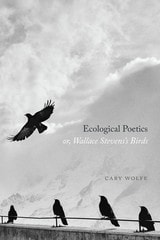
Ecological Poetics; or, Wallace Stevens’s Birds
Cary Wolfe
University of Chicago Press, 2020
Stevens, Wolfe argues, is an ecological poet in the sense that his places, worlds, and environments are co-created by the life forms that inhabit them. Wolfe argues for a “nonrepresentational” conception of ecopoetics, showing how Stevens’s poems reward study alongside theories of system, environment, and observation derived from a multitude of sources, from Ralph Waldo Emerson and Niklas Luhmann to Jacques Derrida and Stuart Kauffman. Ecological Poetics is an ambitious interdisciplinary undertaking involving literary criticism, contemporary philosophy, and theoretical biology.
Ecopoetry
Critical IntroductionScott Bryson
University of Utah Press, 2002
The burgeoning field of ecocriticism is beginning to address the work of such ecopoets as Gary Snyder, Mary Oliver, W. S. Merwin, and Wendell Berry, among others, whose poems increasingly deal with ecological and environmental issues. Ecopoetry: A Critical Introduction assembles previously unpublished contributions from many of the most important scholars in the field as they discuss the historical and crosscultural roots of ecopoetry, while expanding the boundaries to include such themes as genocide and extinction, the lesbian body, and post colonialism. This volume gathers these necessary voices in the emerging conversation regarding poetry’s place in the environmental debate.
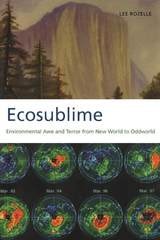
Ecosublime
Environmental Awe and Terror from New World to OddworldLee Rozelle
University of Alabama Press, 2006
Explores 19th-century, modern, postmodern, and millennial texts as they portray the changing ecological face of America
Lee Rozelle probes the metaphor of environmental catastrophe in American literature of the last 150 years. In each instance, Rozelle finds evidence that the ecosublime--nature experienced as an instance of wonder and fear--profoundly reflects spiritual and political responses to the natural world, America’s increasingly anti-ecological trajectory, and the ascendance of a post-natural landscape.
In the 19th century, Rozelle argues, Isabella Bird and Edgar Allan Poe represented the western wilderness as culturally constructed and idealized landscapes. Gardens, forests, and frontiers are conceptual frameworks that either misrepresent or uphold ecological space. Modernists like Nathanael West and William Carlos Williams, on the other hand, portray urban space as either wastelands or mythical urban gardens. A chapter on Charles W. Chesnutt and Rebecca Harding Davis analyzes a new breed of literary eco-advocate, educating and shocking mainstream readers through depictions of ecological disaster. A later chapter probes the writings of Edward Abbey and the Unabomber Manifesto to delve into the sublime dimensions of environmental activism, monkey-wrenching, and eco-terrorism.
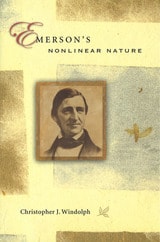
Emerson's Nonlinear Nature
Christopher J. Windolph
University of Missouri Press, 2007
In this provocative study, Christopher Windolph analyzes Emersonian naturalism from the standpoint of nonlinearity, offering new ways of reading and thinking about Emerson’s stance toward naturalism and the influence of science on his thought. Drawing on ideas in perspective theory, architecture, and nonlinear dynamics to argue that Emerson’s natural philosophy follows from his analysis of the development of organic forms, Windolph breaks new ground in Emerson studies by exploring how considerations of shape and the act of seeing underpin all of Emerson’s theories about nature.
Bringing to his study a focused attention to the history of Western science and philosophy, Windolph reexamines Emerson’s understanding of how the act of seeing occurs and of the eye’s ability to see through appearances to organizing principles, showing how Emerson’s naturalism extends beyond the narrow confines of traditional linear science. Through extensive readings of Emerson’s journals, essays, and lectures, Windolph shows that Emerson was an empirical idealist who integrated a scientific approach to nature with an exploration of nonlinear principles, revealing him to be more prescient in his writings about certain recent developments in scientific thought than has been realized.
This work makes a major contribution to the ongoing study of Emerson and science, expanding Emerson’s role as a major American philosopher while rebutting those who see him primarily as a rhetorician or poetic propagandist. Emerson’s Nonlinear Nature opens new ways of thinking about Emerson’s work in its nineteenth-century contexts, reassesses his reception in twentieth-century criticism, and makes a strong case for his continuing relevance in the century ahead.