Results by title
65 books match the query 'Netherlands' and 5 start with e
Eating in Theory
Annemarie Mol
Duke University Press, 2021
Een spiering uitwerpen om een kabeljauw te vangen
How and why the Dutch fished for cod 1818-1911Overgaard Christine
Amsterdam University Press, 2015
Ethics by Committee
A History of Reasoning Together about Medicine, Science, Society, and the StateNoortje Jacobs
University of Chicago Press, 2022
Ethics boards have become obligatory passage points in today’s medical science, and we forget how novel they really are. The use of humans in experiments is an age-old practice that records show goes back to at least the third century BC, and it has been popular as a practice since the early modern period. Yet in most countries around the world, hardly any formal checks and balances existed to govern the communal oversight of experiments involving human subjects until at least the 1960s. Ethics by Committee traces the rise of ethics boards for human experimentation in the second half of the twentieth century.
Using the Netherlands as a case study, historian Noortje Jacobs shows how the authority of physicians to make decisions about clinical research in this period gave way in most developed nations to formal mechanisms of communal decision-making that served to regiment the behavior of individual researchers. This historically unprecedented change in scientific governance came out of the growing international wariness of medical research in the decades after World War II and was meant to solidify a new way of reasoning together in liberal democracies about medicine and science. But what reasoning together meant, and who was invited to participate, changed drastically over time. In detailing this history, Jacobs shows that research ethics committees were originally intended not only to make human experimentation more ethical but also to raise its epistemic quality and intensify the use of new clinical research methods. By examining complex negotiations over the appropriate governance of human subjects research, Ethics by Committee is an important contribution to our understanding of the randomized controlled trial and the history of research ethics and bioethics more generally.
Etty Hillesum and the Flow of Presence
A Voegelinian AnalysisMeins G. S. Coetsier
University of Missouri Press, 2008
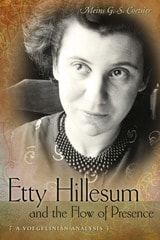
Although she died cruelly at Auschwitz at the age of twenty-nine, Etty Hillesum left a lasting legacy of mystical thought in her letters and diaries. Hillesum was a complex and powerful witness to the openness of the human spirit to the call of God, even under the most harrowing circumstances. Her life was as much shaped by Hitler’s regime as was that of philosopher Eric Voegelin, and as Meins Coetsier reveals, her thought lends itself to interpretation from a uniquely Voegelinian perspective.
Etty Hillesum and the Flow of Presence analyzes the life and writings of Hillesum from the standpoint of Voegelin’s views on consciousness—especially his philosophy of luminous participation in the transcendent ground of being. Through a careful reading of her letters and diaries, Coetsier reveals the inner development of Hillesum’s mystically grounded resistance to Nazism as he guides readers through the symbolism of her spiritual journey, making effective use of Voegelin’s analytics of experience and symbolization to trace her path to spiritual truth.
Intertwining the lives, works, and visions of these two mystical thinkers, Coetsier demonstrates his mastery of both Voegelin’s philosophy and Hillesum’s Dutch-language materials. He shows how mystical attunement to the “flow of presence”—Voegelin’s designation for human responsiveness to the divine—is the key to the development of Hillesum’s life and writings. He displays a special affinity for the suffering and grace-filled transformation that she underwent as she approached the end of her life and gained insight into the ultimate purpose of each individual’s contribution to the well-being and maintenance of the human spirit.
Retrieving one of the lesser-known but most compelling figures of the Holocaust, Etty Hillesum and the Flow of Presence is an original contribution to both Voegelin and Hillesum scholarship that reflects these writers’ strong valuation of the human person. It presents Hillesum’s life and work in an original and provocative context, shedding new light on her experiences and their symbolizations while further broadening the application of Voegelin’s thought
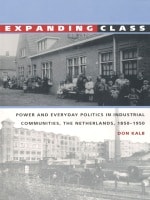
Expanding Class
Power and Everyday Politics in Industrial Communities, The Netherlands 1850–1950Don Kalb
Duke University Press, 1998
Expanding Class compares Brabant’s quaint central shoemaking district to its electrical boomtown Eindhoven, home of the enormous Philips Corporation. It introduces the concept of "flexible familism," a sociological phenomenon in which family daughters were employed to facilitate a cheap and ample labor force. Industrialists manipulated and fostered flexible familism to ensure the discipline and loyalty of the working-class community. By using the industrial Netherlands as a paradigm, Kalb reveals new and productive ways to examine class construction and the development of labor history in other countries over the past thirty years, steering a path between the two schools of thought—cultural and economic—that have dominated labor history discussions in recent years.