Results by title
74 books match the query 'Oral history' and 4 start with e
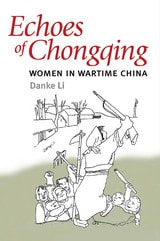
Echoes of Chongqing
Women in Wartime ChinaDanke Li
University of Illinois Press, 2010
This collection of annotated oral histories records the personal stories of twenty Chinese women who lived in the wartime capital of Chongqing during China's War of Resistance against Japan during World War II. By presenting women's remembrances of the war, this study examines the interplay between oral history and traditional historical narrative, public discourse, and private memories. The women interviewed came from differing social, economic, and educational backgrounds and experienced the war in a variety of ways, some of them active in the communist resistance and others trying to support families or pursue educations in the face of wartime upheaval. Their stories demonstrate that the War of Resistance had two faces: one presented by official propaganda and characterized by an upbeat unified front against Japan, the other a record of invisible private stories and a sobering national experience of death and suffering. The accounts of how women coped, worked, and lived during the war years in the Chongqing region recast historical understanding of the roles played by ordinary people in wartime and give women a public voice and face that, until now, have been missing from scholarship on the war.
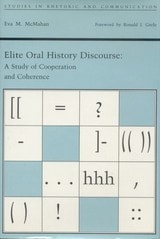
Elite Oral History Discourse
A Study of Cooperation and CoherenceEva M. McMahan
University of Alabama Press, 1989
Over the past thirty years, oral history has found increasing favor among social scientists and humanists, with scholars “rediscovering” the oral interview as a valuable method for obtaining information about the daily realities and historical consciousness of people, their histories, and their culture. One primary issue is the question of how the communicative performances of the interviewer and narrator jointly influence the interview. Using methods of conversation/discourse analysis, the author describes the collaborative processes that enable interviewers and narrators to interact successfully in the interview context.
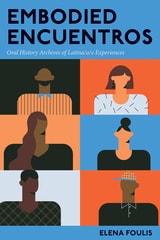
Embodied Encuentros
Oral History Archives of Latina/o/e ExperiencesElena Foulis
The Ohio State University Press, 2026
In Embodied Encuentros, Elena Foulis offers a practical guide for completing ethical fieldwork in Latina/o/e communities, emphasizing equitable and culturally sustaining practices for gathering oral histories. In her critical decolonial model, Foulis centers the agency of the people within these communities while considering the diversity and complexity of their experiences. In doing so, she advocates for the importance of building oral history archives that challenge our understandings of Latina/o/e peoples.
Foulis provides a conceptual framework for building on community knowledge that considers language, cultural practices, gender, and race. She suggests ways to involve students in ethical research; collect evolving oral histories; employ a language justice approach that acknowledges linguistic oppression, translanguaging, and bilingualism as essential aspects of this community; and consider the importance of digital archives for the creation of multimedia projects that foster community pláticas. Grounded in both theoretical approaches and a feminist ethics praxis, Embodied Encuentros ultimately outlines an important model for doing collaborative, ethical research—not only within Latina/o/e communities but within other minoritized communities as well.
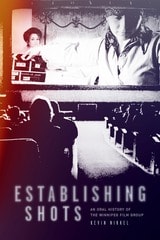
Establishing Shots
An Oral History of the Winnipeg Film GroupKevin Nikkel
University of Manitoba Press, 2023