Results by title
74 books match the query 'Paleontology' and 7 start with e
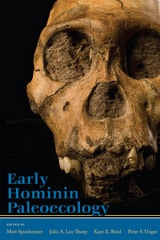
Early Hominin Paleoecology
Matt Sponhiemer, Julia A Lee-Thorp, Kaye E. Reed, Peter Ungar
University Press of Colorado, 2013
An introduction to the multidisciplinary field of hominin paleoecology for advanced undergraduate students and beginning graduate students, Early Hominin Paleoecology offers an up-to-date review of the relevant literature, exploring new research and synthesizing old and new ideas.
Recent advances in the field and the laboratory are not only improving our understanding of human evolution but are also transforming it. Given the increasing specialization of the individual fields of study in hominin paleontology, communicating research results and data is difficult, especially to a broad audience of graduate students, advanced undergraduates, and the interested public. Early Hominin Paleoecology provides a good working knowledge of the subject while also presenting a solid grounding in the sundry ways this knowledge has been constructed. The book is divided into three sections—climate and environment (with a particular focus on the latter), adaptation and behavior, and modern analogs and models—and features contributors from various fields of study, including archaeology, primatology, paleoclimatology, sedimentology, and geochemistry.
Early Hominin Paleoecology is an accessible introduction into this fascinating and ever-evolving field and will be essential to any student interested in pursuing research in human paleoecology.
Additional Contributors:
David Braun
Beth Christensen
David J. Daegling
Crag Feibel
Fred E. Grine
Clifford Jolly
Naomi E. Levin
Mark A. Maslin
John Mitani
Jay Quade
Amy L. Rector
Jeanne Sept
Lillian M. Spencer
Mark Teaford
Carol V. Ward
Katy E. Wilson
[more]
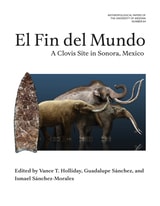
El Fin del Mundo
A Clovis Site in Sonora, MexicoVance T. Holliday, Guadalupe Sánchez, and Ismael Sánchez-Morales
University of Arizona Press, 2024
In a remote desert corner of Sonora, Mexico, the site of El Fin del Mundo offers the first recorded evidence of Paleoindian interactions with gomphotheres, an extinct species related to elephants. The Clovis occupation of North America is the oldest generally accepted and well-documented archaeological assemblage on the continent. This site in Sonora, Mexico, is the northernmost dated late Pleistocene gomphothere and the youngest in North America. It is the first documented intact buried Clovis site outside of the United States, the first in situ Paleoindian site in northwestern Mexico, and the first documented evidence of Clovis gomphothere hunting in North America. The site also includes an associated upland Clovis campsite. This volume also describes a paleontological bone bed below the Clovis level, which includes a rare association of mastodon, mammoth, and gomphothere.
El Fin del Mundo presents and synthesizes the archaeological, geological, paleontological, and paleoenvironmental records of an important Clovis site.
Contributors
Joaquín Arroyo-Cabrales
Jordan Bright
James K. Feathers
Edmund P. Gaines
Thanairi Gamez
Gregory W. L. Hodgins
Vance T. Holliday
Susan M. Mentzer
Carmen Isela Ortega-Rosas
Manuel R. Palacios-Fest
Guadalupe Sánchez
Ismael Sánchez-Morales
Kayla B. Worthey
Kristen Wroth
[more]

Evolution and Environment in Tropical America
Edited by Jeremy B. C. Jackson, Ann F. Budd, and Anthony G. Coates
University of Chicago Press, 1996
How were the tropical Americas formed? This ambitious volume draws on extensive, multidisciplinary research to develop new views of the geological formation of the isthmus linking North and South America and of the major environmental changes that reshaped the Neotropics to create its present-day marine and terrestrial ecosystems.
Recent discoveries show that dramatic changes in climate and ocean circulation can occur very quickly, and that ecological communities respond just as rapidly. Abrupt changes in the composition of fossil assemblages, formerly dismissed as artifacts of a poor fossil record, now are seen as accurate records of swift changes in the composition of ocean communities.
The twenty-four contributors use current work in paleontology, geology, oceanography, anthropology, ecology, and evolution to paint this challenging portrait of rapid environmental and evolutionary change. Their conclusions argue for a revision of existing interpretations of the fossil record and the processes—including invading Eurasian peoples—that have produced it.
[more]
Evolutionary Paleobiology
Edited by David Jablonski, Douglas H. Erwin, and Jere H. Lipps
University of Chicago Press, 1996
Representing the state of the art in evolutionary paleobiology, this book provides a much-needed overview of this rapidly changing field. An influx of ideas and techniques both from other areas of biology and from within paleobiology itself have resulted in numerous recent advances, including increased recognition of the relationships between ecological and evolutionary theory, renewed vigor in the study of ecological communities over geologic timescales, increased understanding of biogeographical patterns, and new mathematical approaches to studying the form and structure of plants and animals.
Contributors to this volume—a veritable who's who of eminent researchers—present the results of original research and new theoretical developments, and provide directions for future studies. Individually wide ranging, these papers all share a debt to the work of James W. Valentine, one of the founders of modern evolutionary paleobiology. This volume's unified approach to the study of life on earth will be a major contribution to paleobiology, evolution, and ecology.
Contributors to this volume—a veritable who's who of eminent researchers—present the results of original research and new theoretical developments, and provide directions for future studies. Individually wide ranging, these papers all share a debt to the work of James W. Valentine, one of the founders of modern evolutionary paleobiology. This volume's unified approach to the study of life on earth will be a major contribution to paleobiology, evolution, and ecology.
[more]
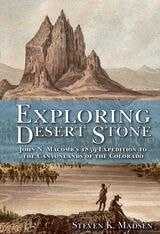
Exploring Desert Stone
John N. Macomb's 1859 Expedition to the Canyonlands of the ColoradoSteven K. Madsen
Utah State University Press, 2022
The confluence of the Green and Colorado Rivers, now in Canyonlands National Park, near popular tourist destination Moab, still cannot be reached or viewed easily. Much of the surrounding region remained remote and rarely visited for decades after settlement of other parts of the West. The first U.S. government expedition to explore the canyon country and the Four Corners area was led by John Macomb of the army's topographical engineers.
The soldiers and scientists followed in part the Old Spanish Trail, whose location they documented and verified. Seeking to find the confluence of the Colorado and the Green and looking for alternative routes into Utah, which was of particular interest in the wake of the Utah War, they produced a substantial documentary record, most of which is published for the first time in this volume. Theirs is also the first detailed map of the region, and it is published in Exploring Desert Stone, as well.
The soldiers and scientists followed in part the Old Spanish Trail, whose location they documented and verified. Seeking to find the confluence of the Colorado and the Green and looking for alternative routes into Utah, which was of particular interest in the wake of the Utah War, they produced a substantial documentary record, most of which is published for the first time in this volume. Theirs is also the first detailed map of the region, and it is published in Exploring Desert Stone, as well.
[more]
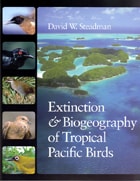
Extinction and Biogeography of Tropical Pacific Birds
David W. Steadman
University of Chicago Press, 2006
Sprinkled across the tropical Pacific, the innumerable islands of Oceania are home to some of the most unique bird communities on the planet, and they sustain species found nowhere else on earth. Many of the birds that live in this region are endangered, however; many more have become extinct as a result of human activity, in both recent and prehistoric times.
Reconstructing the avian world in the same way archeologists re-create ancient human societies, David Steadman—a leading authority on tropical Pacific avian paleontology—has spent the past two decades in the field, digging through layers of soil in search of the bones that serve as clues to the ancient past of island bird communities. His years of indefatigable research and analysis are the foundation for Extinction and Biogeography of Tropical Pacific Birds, a monumental study of the landbirds of tropical Pacific islands—especially those from Fiji eastward to Easter Island—and an intricate history of the patterns and processes of island biology over time.
Using information gleaned from prehistoric specimens, Steadman reconstructs the birdlife of tropical Pacific islands as it existed before the arrival of humans and in so doing corrects the assumption that small, remote islands were unable to support rich assemblages of plants and animals. Easter Island, for example, though devoid of wildlife today, was the world’s richest seabird habitat before Polynesians arrived more than a millennium ago. The forests of less isolated islands in the Pacific likewise teemed with megapodes, rails, pigeons, parrots, kingfishers, and songbirds at first human contact.
By synthesizing data from the distant past, Steadman hopes to inform present conservation programs. Grounded in geology, paleontology, and archeology, but biological at its core, Extinction and Biogeography of Tropical Pacific Birds is an exceptional work of unparalleled scholarship that will stimulate creative discussions of terrestrial life on oceanic islands for years to come.
[more]
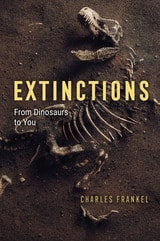
Extinctions
From Dinosaurs to YouCharles Frankel
University of Chicago Press, 2024
A compelling answer to an important question: Can past mass extinctions teach us how to avoid future planetary disaster?
On its face, the story of mass extinction on Earth is one of unavoidable disaster. Asteroid smashes into planet; goodbye dinosaurs. Planetwide crises seem to be beyond our ability to affect or evade. Extinctions argues that geological history tells an instructive story, one that offers important signs for us to consider. When the asteroid struck, Charles Frankel explains, it set off a wave of cataclysms that wore away at the global ecosystem until it all fell apart. What if there had been a way to slow or even turn back these tides? Frankel believes that the answer to this question holds the key to human survival.
Human history, from the massacre of Ice Age megafauna to today’s industrial climate change, has brought the planet through another series of cataclysmic events. But the history of mass extinction together with the latest climate research, Frankel maintains, shows us a way out. If we curb our destructive habits, particularly our drive to kill and consume other species, and work instead to conserve what biodiversity remains, the Earth might yet recover. Rather than await decisive disaster, Frankel argues that we must instead take action to reimagine what it means to be human. As he eloquently explains, geological history reminds us that life is not eternal; we can disappear, or we can become something new and continue our evolutionary adventure.
[more]