Results by title
194 books match the query 'People' and 5 start with e

Elder Brother and the Law of the People
Contemporary Kinship and Cowessess First NationRobert Alexander Innes
University of Manitoba Press, 2013
Enemies of the People
The Destruction of Soviet Literary, Theater, and FKatherine Bliss Eaton
Northwestern University Press, 2002
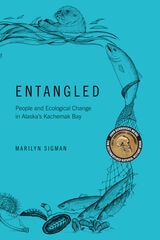
Entangled
People and Ecological Change in Alaska's Kachemak BayMarilyn Sigman
University of Alaska Press, 2018
Kachemak Bay is a place where people and the living resources they depend on have ebbed and flowed for thousands of years. The forces of the earth are dynamic here: they can change in an instant, shaking the ground beneath your feet or overturning kayaks in a rushing wave. Glaciers have advanced and receded over centuries. The climate, like the ocean, has shifted from warmer to colder and back again in a matter of decades. The ocean food web has been shuffled from bottom to top again and again.
In Entangled, Sigman contemplates the patterns of people staying and leaving, of settlement and displacement, nesting her own journey to Kachemak Bay within diasporas of her Jewish ancestors and of ancient peoples from Asia to the southern coast of Alaska. Along the way she weaves in scientific facts about the region as well as the stories told by Alaska’s indigenous peoples. It is a rhapsodic introduction to this stunning region and a siren call to protect the land’s natural resources in the face of a warming, changing world.
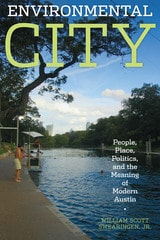
Environmental City
People, Place, Politics, and the Meaning of Modern AustinBy William Scott Swearingen, Jr.
University of Texas Press, 2010
As Austin grew from a college and government town of the 1950s into the sprawling city of 2010, two ideas of Austin as a place came into conflict. Many who promoted the ideology of growth believed Austin would be defined by economic output, money, and wealth. But many others thought Austin was instead defined by its quality of life. Because the natural environment contributed so much to Austin's quality of life, a social movement that wanted to preserve the city's environment became the leading edge of a larger movement that wanted to retain a unique sense of place. The "environmental movement" in Austin became the political and symbolic arm of the more general movement for place.
This is a history of the environmental movement in Austin—how it began; what it did; and how it promoted ideas about the relationships between people, cities, and the environment. It is also about a deeper movement to retain a sense of place that is Austin, and how that deeper movement continues to shape the way Austin is built today. The city it helped to create is now on the forefront of national efforts to rethink how we build our cities, reduce global warming, and find ways that humans and the environment can coexist in a big city.
Ethnicity in Michigan
Issues and PeopleJack Glazier
Michigan State University Press, 2001
As the introductory volume in the series Discovering the Peoples of Michigan, Ethnicity in Michigan outlines the processes of migration, as well as the rich relationship between ethnic groups and the trajectories of historical and social change in Michigan. On both state and local levels, issues of identity, race, politics, and shared history inform community development. Jack Glazier and Arthur Helweg provide a substantive general and theoretical overview of the various ethnic groups in Michigan, and of the ways in which immigrants both respond to and shape Michigan's particular regional character.