Results by title
283 books match the query 'Phenomenology' and 11 start with e
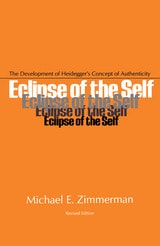
Eclipse of the Self
The Development of Heidegger’s Concept of AuthenticityMichael E. Zimmerman
Ohio University Press, 1986
Although it is sometimes said that Martin Heidegger’s later philosophy no longer concerned itself with the theme of authenticity so crucial to Being and Time (1927), this book argues that his interest in authenticity was always strong.
After leaving the seminary to become a philosophy student, Heidegger began to “de–mythologize” religious themes for his own philosophical purposes. Like the Christian notion of faith, Heidegger’s notion of authenticity involves relinquishing the egotistical self–understanding which blocks our openness for possibilities. Yet authenticity as “resoluteness” includes an element of voluntarism foreign to the idea of faith. Heidegger’s brief engagement with National Socialism (1933–1934) helped him to re–think the Nietzschean concept of will which had influenced his early views on authenticity. Although part of the meaning of resoluteness is to allow things to be revealed, it also suggests that an individual can somehow will to be authentic. After about 1936, Heidegger emphasized that an individual can only be released from egoism (inauthenticity) by a power which transcends him. The abiding theological issue concerning the efficacy of works as against the saving power of grace finds expression in the distinction between resoluteness and releasement.
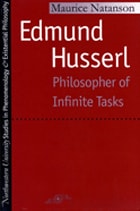
Edmund Husserl
Philosopher of Infinite TasksMaurice Natanson
Northwestern University Press, 1973
The product of many years of reflection on phenomenology, this book is a comprehensive and creative introduction to the philosophy of Edmund Husserl. Natanson uses Husserl's later work as a clue to the meaning of his entire intellectual career, showing how his earlier methodological work evolved into the search for transcendental roots and developed into a philosophy of the life-world. Phenomenology, for Natanson, emerges as a philosophy of origin, a transcendental discipline concerned with consciousness, history, and world rather than with introspection and traditional metaphysical warfare.
Embodiments
From the Body to the Body PoliticJames R. Mensch
Northwestern University Press, 2009
Mensch begins his inquiry by developing a philosophical anthropology based on this concept. He then applies the results of his investigation to the relations of power, authority, freedom, and sovereignty in public life. This involves confronting a line of interpretation, stretching from Hobbes to Agamben, which sees violence as both initiating and preserving the social contract. To contest this interpretation, Mensch argues against its presupposition, which is to equate freedom with sovereignty over others. He does so by understanding political freedom in terms of embodiment—in particular, in terms of the finitude and interdependence that our embodiment entails. Freedom, conceived in these terms, is understood as the gift of others. As a function of our dependence on others, it cannot exist apart from them. To show how public space and civil society presuppose this interdependence is the singular accomplishment of Embodiments. It accomplishes a phenomenological grounding for a new type of political philosophy.

Emerging Trends in Continental Philosophy
Edited by Todd May
University of Chicago Press, 2010
From Kant to Kierkegaard, from Hegel to Heidegger, continental philosophers have indelibly shaped the trajectory of Western thought since the eighteenth century. Although much has been written about these monumental thinkers, students and scholars lack a definitive guide to the entire scope of the continental tradition. The most comprehensive reference work to date, this eight-volume History of Continental Philosophy will both encapsulate the subject and reorient our understanding of it. Beginning with an overview of Kant’s philosophy and its initial reception, the History traces the evolution of continental philosophy through major figures as well as movements such as existentialism, phenomenology, hermeneutics, and poststructuralism. The final volume outlines the current state of the field, bringing the work of both historical and modern thinkers to bear on such contemporary topics as feminism, globalization, and the environment. Throughout, the volumes examine important philosophical figures and developments in their historical, political, and cultural contexts.
The first reference of its kind, A History of Continental Philosophy has been written and edited by internationally recognized experts with a commitment to explaining complex thinkers, texts, and movements in rigorous yet jargon-free essays suitable for both undergraduates and seasoned specialists. These volumes also elucidate ongoing debates about the nature of continental and analytic philosophy, surveying the distinctive, sometimes overlapping characteristics and approaches of each tradition. Featuring helpful overviews of major topics and plotting road maps to their underlying contexts, A History of Continental Philosophy is destined to be the resource of first and last resort for students and scholars alike.
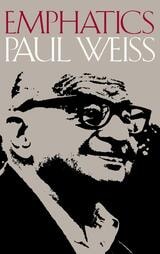
Emphatics
Paul Weiss
Vanderbilt University Press, 2000
Brilliant in every respect, Emphatics rewrites Weiss's systematic ontology in new terms. Not only are the lineaments of the system reexamined, but this book floods the reader with new perspectives and insights on relationship, signs, truth, particularity, space-time causality, education, mind-body issues, Being and other ultimate philosophical categories, and good and evil.
Weiss engages the various objections to his position in a series of question-and-answer epilogues at the end of each chapter that allow the reader to follow step-by-step a great philosophical mind at work. He takes his critics seriously, grapples with their objections, and answers them honestly. His discourse creatively revisits age-old questions and in reimagining new answers establishes the continuing relevance of philosophy as an academic discipline.
Encounters and Dialogues with Martin Heidegger, 1929-1976
Heinrich Wiegand Petzet
University of Chicago Press, 1993
A well-known art historian and an intimate friend of Heidegger's, Heinrich Wiegand Petzet provides a rich portrait of Heidegger that is part memoir, part biography, and part cultural history. By recounting chronologically a series of encounters between the two friends from their meeting in 1929 until the philosopher's death in 1976, as well as between Heidegger and other contemporaries, Petzet reveals not only new aspects of Heidegger's thought and attitudes toward the historical and intellectual events of his time but also the greater cultural and social context in which he articulated his thought.
Expanding Hermeneutics
Visualism in ScienceDon Ihde
Northwestern University Press, 1999
Experience and Empiricism
Hegel, Hume, and the Early DeleuzeRussell Ford
Northwestern University Press, 2023
A clarifying examination of Gilles Deleuze’s first book shows how he would later transform the problem of immanence into the problem of difference
Despite the wide reception Gilles Deleuze has received across the humanities, research on his early work has remained scant. Experience and Empiricism remedies that gap with a detailed study of Deleuze’s first book, Empiricism and Subjectivity, which is devoted to the philosophical project of David Hume. Russell Ford argues that this work is poorly understood when read simply as a stand-alone study on Hume. Its significance only becomes apparent within the context of a larger problematic that dominated, and continues to inform, modern European philosophy: the conceptual constitution of a purely immanent account of existence. While the importance of this debate is recognized in contemporary scholarship, its genealogy—including Deleuze’s place within it—has been underappreciated. This book shows how Deleuze directly engages in an ongoing debate between his teachers Jean Wahl and Jean Hyppolite over experience and empiricism, an intervention that restages the famous encounter between rationalism and empiricism that yielded Kant’s critical philosophy. What, Deleuze effectively asks, might have happened had Hume been the one roused from his empirical dogmatic slumber by the rationalist challenge of Kant?
Experience and Judgment
Edmund Husserl
Northwestern University Press, 1973

Exploring Phenomenology
A Guide to the Field & Its LiteratureDavid Stewart
Ohio University Press, 1990
Existential philosophy has perhaps captured the public imagination more completely than any other philosophical movement in the twentieth century. But less is known about the phenomenological method lying behind existentialism. In this solid introduction to phenomenological philosophy, authors David Stewart and Algis Mickunas show that phenomenology is neither new nor bizarre but is a contemporary way of raising afresh the major problems of philosophy that have dominated the traditions of Western thought. The authors carefully lead the reader trough the maze of terminology, explaining the major problems phenomenology has treated and showing how these are a consistent extension of the traditional concerns of philosophy.
In concise, uncluttered, and straightforward terms, the history, development, and contemporary status of phenomenology is explained with a copiously annotated bibliography following each chapter. Nothing in print combines the extensive introductory materials with a guide to the massive literature that has been produced by phenomenological and existential studies.
Exploring the World of Human Practice
Readings in and about the Philosophy of Aurel KolnaiZoltán Balázs
Central European University Press, 2005