Results by title
68 books match the query 'Philosophical anthropology' and 4 start with e

Eating Is an English Word
Annemarie Mol
Duke University Press, 2024
Eating is generally understood as a human need that people satisfy in diverse ways. Eating, however, is also an English word. Other languages, using other words, order reality differently: they may fuse eating with breathing, or distinguish chupar from comer. Anthropologists flag such differences by leaving a few of their words untranslated, but what language do we think in? This isn’t necessarily English. We may be linguistically closer to those whose practices we study: them. Against this background, Eating Is an English Word argues that social scientists should let go of the dream of universal concepts. Our analytical terms had better vary. Annemarie Mol and her coauthors exemplify this in a series of material semiotic inquiries into eating practices. They employ terms like lekker, tasting with fingers, chupar, schmecka, gustar, and settling on an okay meal to explore appreciative modes of valuing. Welcome, then, to spirited stories about satisfied stomachs, love for a lamb, juicy fruit treats, and companionable lunches and dinners.
[more]

Elements for an Anthropology of Technology
Pierre Lemonnier
University of Michigan Press, 1992
Renowned anthropologist Pierre Lemonnier presents a refreshing new look at the anthropology of technology: one that will be of great interest to ethnologists and archaeologists alike.
[more]
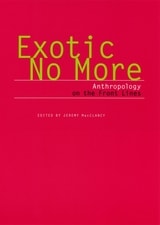
Exotic No More
Anthropology on the Front LinesEdited by Jeremy MacClancy
University of Chicago Press, 2002
Since its founding in the nineteenth century, social anthropology has been seen as the study of exotic peoples in faraway places. But today more and more anthropologists are dedicating themselves not just to observing but to understanding and helping solve social problems wherever they occur—in international aid organizations, British TV studios, American hospitals, or racist enclaves in Eastern Europe, for example.
In Exotic No More, an initiative of the Royal Anthropological Institute, some of today's most respected anthropologists demonstrate, in clear, unpretentious prose, the tremendous contributions that anthropology can make to contemporary society. They cover issues ranging from fundamentalism to forced migration, child labor to crack dealing, human rights to hunger, ethnicity to environmentalism, intellectual property rights to international capitalisms. But Exotic No More is more than a litany of gloom and doom; the essays also explore topics usually associated with leisure or "high" culture, including the media, visual arts, tourism, and music. Each author uses specific examples from their fieldwork to illustrate their discussions, and 62 photographs enliven the text.
Throughout the book, the contributors highlight anthropology's commitment to taking people seriously on their own terms, paying close attention to what they are saying and doing, and trying to understand how they see the world and why. Sometimes this bottom-up perspective makes the strange familiar, but it can also make the familiar strange, exposing the cultural basis of seemingly "natural" behaviors and challenging us to rethink some of our most cherished ideas—about gender, "free" markets, "race," and "refugees," among many others.
Contributors:
William O. Beeman
Philippe Bourgois
John Chernoff
E. Valentine Daniel
Alex de Waal
Judith Ennew
James Fairhead
Sarah Franklin
Michael Gilsenan
Faye Ginsburg
Alma Gottlieb
Christopher Hann
Faye V. Harrison
Richard Jenkins
Melissa Leach
Margaret Lock
Jeremy MacClancy
Jonathan Mazower
Ellen Messer
A. David Napier
Nancy Scheper-Hughes
Jane Schneider
Parker Shipton
Christopher B. Steiner
[more]
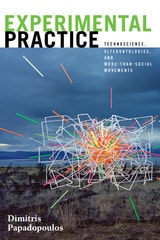
Experimental Practice
Technoscience, Alterontologies, and More-Than-Social MovementsDimitris Papadopoulos
Duke University Press, 2018
In Experimental Practice Dimitris Papadopoulos explores the potential for building new forms of political and social movements through the reconfiguration of the material conditions of existence. Rather than targeting existing institutions in demands for social justice, Papadopoulos calls for the creation of alternative ontologies of everyday life that would transform the meanings of politics and justice. Inextricably linked to technoscience, these “alterontologies”—which Papadopoulos examines in a variety of contexts, from AIDS activism and the financialization of life to hacker communities and neuroscience—form the basis of ways of life that would embrace the more-than-social interdependence of the human and nonhuman worlds. Speaking to a matrix of concerns about politics and justice, social movements, matter and ontology, everyday practice, technoscience, the production of knowledge, and the human and nonhuman, Papadopoulos suggests that the development of alterontologies would create more efficacious political and social organizing.
[more]