Results by title
210 books match the query 'Philosophy, Theory & Social Aspects' and 11 start with e
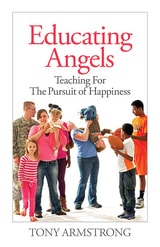
Educating Angels
Teaching for the Pursuit of HappinessTony Armstrong, Ph.D
Parkhurst Brothers, Inc., 2013
School reform and accountability tests have been hotly debated for decades, but the goal of reform and accountability has not. Most agree that the main problem with contemporary education is that it fails to adequately prepare students with the “21st century skills” needed to find jobs and promote national competitiveness in the global economy. Tony Armstrong challenges both the morality and the consequences of pushing this purpose of education. He says it is immoral because it neglects our children’s deepest aspiration—happiness—and treats them as mere cogs in the economic machine. Dr. Armstrong shows how methods of well-being based on happiness research—mindfulness, gratitude, perspective—can greatly improve kids’ chances to feel better in the present and to live happier lives in the future. And the kindergarten-through-college “happiness pedagogy” he presents would also be a superior way to teach those “21st century skills.”
[more]
Educating Intuition
Robin M. Hogarth
University of Chicago Press, 2001
Every day we make intuitive decisions—from the mundane choice of what clothes to wear to more important issues such as which new car "feels right" or which person would be "good" for a particular job. To varying degrees, logic plays a role in these decisions, but at a certain point all of us rely on intuition, our sixth sense. Is this the right way to decide? Should we trust our gut feelings? When intuition conflicts with logic, what should we do?
In Educating Intuition, Robin M. Hogarth lays bare this mysterious process so fundamental to daily life by offering the first comprehensive overview of what the science of psychology can tell us about intuition—where it comes from, how it works, whether we can trust it. From this literature and his own research, Hogarth finds that intuition is a normal and important component of thought that has its roots in processes of tacit learning. Environment, attention, experience, expertise, and the success of the scientific method all form part of Hogarth's perspective on intuition, leading him to the surprising—but natural—conclusion that we can educate our sixth sense. To this end he offers concrete suggestions and exercises to help readers develop their intuitive skills and habits for learning the "right" lessons from experience.
Artfully and accessibly combining cognitive science, the latest research in psychology, and Hogarth's own observations, Educating Intuition eschews the vague approach to the topic that has become commonplace and provides instead a wholly engaging and practical guide to enhancing our intuitive skills.
[more]
Education and Equality
Danielle Allen
University of Chicago Press, 2016
American education as we know it today—guaranteed by the state to serve every child in the country—is still less than a hundred years old. It’s no wonder we haven’t agreed yet as to exactly what role education should play in our society. In these Tanner Lectures, Danielle Allen brings us much closer, examining the ideological impasse between vocational and humanistic approaches that has plagued educational discourse, offering a compelling proposal to finally resolve the dispute.
Allen argues that education plays a crucial role in the cultivation of political and social equality and economic fairness, but that we have lost sight of exactly what that role is and should be. Drawing on thinkers such as John Rawls and Hannah Arendt, she sketches out a humanistic baseline that re-links education to equality, showing how doing so can help us reframe policy questions. From there, she turns to civic education, showing that we must reorient education’s trajectory toward readying students for lives as democratic citizens. Deepened by commentaries from leading thinkers Tommie Shelby, Marcelo Suárez-Orozco, Michael Rebell, and Quiara Alegría Hudes that touch on issues ranging from globalization to law to linguistic empowerment, this book offers a critical clarification of just how important education is to democratic life, as well as a stirring defense of the humanities.
Allen argues that education plays a crucial role in the cultivation of political and social equality and economic fairness, but that we have lost sight of exactly what that role is and should be. Drawing on thinkers such as John Rawls and Hannah Arendt, she sketches out a humanistic baseline that re-links education to equality, showing how doing so can help us reframe policy questions. From there, she turns to civic education, showing that we must reorient education’s trajectory toward readying students for lives as democratic citizens. Deepened by commentaries from leading thinkers Tommie Shelby, Marcelo Suárez-Orozco, Michael Rebell, and Quiara Alegría Hudes that touch on issues ranging from globalization to law to linguistic empowerment, this book offers a critical clarification of just how important education is to democratic life, as well as a stirring defense of the humanities.
[more]

Education and the Creative Potential
E. Torrance
University of Minnesota Press, 1963
Education and the Creative Potential was first published in 1963. Minnesota Archive Editions uses digital technology to make long-unavailable books once again accessible, and are published unaltered from the original University of Minnesota Press editions.Modern School Practices Series, Number 5How can we identify creative children? What makes them different from other youngsters, and what happens to them in today’s schools? How can we improve our schools to make the most of our creative potential? Dr. Torrance, a leading educational psychologist, discussed such challenging questions and proposes challenges in the schools which will give children a better chance to learn and think creatively. He summarizes much of what is known about the conditions which nurture or inhibit creative growth and reports on a series of original, exploratory studies concerned with the problems of testing creative ability or potentiality and the influence of various factors on the development of creativity.This book is recommended by the National Council of Teachers of English as a standard reference for high school English classrooms and departments.
[more]
Education and the Cult of Efficiency
Raymond E. Callahan
University of Chicago Press, 1964
Raymond Callahan's lively study exposes the alarming lengths to which school administrators went, particularly in the period from 1910 to 1930, in sacrificing educational goals to the demands of business procedures. He suggests that even today the question still asked is: "How can we operate our schools?" Society has not yet learned to ask: "How can we provide an excellent education for our children?"
[more]
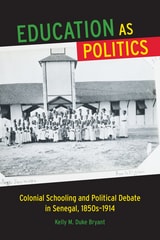
Education as Politics
Colonial Schooling and Political Debate in Senegal, 1850s–1914Kelly M. Duke Bryant
University of Wisconsin Press, 2015
In 1914, Blaise Diagne was elected as Senegal’s first black African representative to the National Assembly in France. Education as Politics reinterprets the origins and significance of this momentous election, showing how colonial schools had helped reshape African power and politics during the preceding decades and how they prepared the way for Diagne’s victory.
Kelly M. Duke Bryant demonstrates the critical impact of colonial schooling on Senegalese politics by examining the response to it by Africans from a variety of backgrounds and statuses—including rural chiefs, Islamic teachers, and educated young urbanites. For those Africans who chose to engage with them, the French schools in Senegal provided a new source of patronage, a potentially beneficial connection to the bureaucratizing colonial state, a basis for claims to authority or power, or an arena in which to debate pressing issues like the future of Qur’anic schooling and the increasing racism of urban society under colonial rule.
Based on evidence from archives in Senegal and France, and on interviews Duke Bryant conducted in Senegal, she demonstrates that colonial schooling remade African politics during this period of transition to French rule, creating political spaces that were at once African and colonial, and ultimately allowing Diagne to claim election victory.
[more]
Education in a New Society
Renewing the Sociology of EducationEdited by Jal Mehta and Scott Davies
University of Chicago Press, 2018
In recent decades, sociology of education has been dominated by quantitative analyses of race, class, and gender gaps in educational achievement. And while there’s no question that such work is important, it leaves a lot of other fruitful areas of inquiry unstudied. This book takes that problem seriously, considering the way the field has developed since the 1960s and arguing powerfully for its renewal.
The sociology of education, the contributors show, largely works with themes, concepts, and theories that were generated decades ago, even as both the actual world of education and the discipline of sociology have changed considerably. The moment has come, they argue, to break free of the past and begin asking new questions and developing new programs of empirical study. Both rallying cry and road map, Education in a New Society will galvanize the field.
The sociology of education, the contributors show, largely works with themes, concepts, and theories that were generated decades ago, even as both the actual world of education and the discipline of sociology have changed considerably. The moment has come, they argue, to break free of the past and begin asking new questions and developing new programs of empirical study. Both rallying cry and road map, Education in a New Society will galvanize the field.
[more]
Education, Justice, and Democracy
Edited by Danielle Allen and Rob Reich
University of Chicago Press, 2013
Education is a contested topic, and not just politically. For years scholars have approached it from two different points of view: one empirical, focused on explanations for student and school success and failure, and the other philosophical, focused on education’s value and purpose within the larger society. Rarely have these separate approaches been brought into the same conversation. Education, Justice, and Democracy does just that, offering an intensive discussion by highly respected scholars across empirical and philosophical disciplines.
The contributors explore how the institutions and practices of education can support democracy, by creating the conditions for equal citizenship and egalitarian empowerment, and how they can advance justice, by securing social mobility and cultivating the talents and interests of every individual. Then the authors evaluate constraints on achieving the goals of democracy and justice in the educational arena and identify strategies that we can employ to work through or around those constraints. More than a thorough compendium on a timely and contested topic, Education, Justice, and Democracy exhibits an entirely new, more deeply composed way of thinking about education as a whole and its importance to a good society.
[more]
Educational Goods
Values, Evidence, and Decision-MakingHarry Brighouse, Helen F. Ladd, Susanna Loeb, and Adam Swift
University of Chicago Press, 2018
We spend a lot of time arguing about how schools might be improved. But we rarely take a step back to ask what we as a society should be looking for from education—what exactly should those who make decisions be trying to achieve?
In Educational Goods, two philosophers and two social scientists address this very question. They begin by broadening the language for talking about educational policy: “educational goods” are the knowledge, skills, and attitudes that children develop for their own benefit and that of others; “childhood goods” are the valuable experiences and freedoms that make childhood a distinct phase of life. Balancing those, and understanding that not all of them can be measured through traditional methods, is a key first step. From there, they show how to think clearly about how those goods are distributed and propose a method for combining values and evidence to reach decisions. They conclude by showing the method in action, offering detailed accounts of how it might be applied in school finance, accountability, and choice. The result is a reimagining of our decision making about schools, one that will sharpen our thinking on familiar debates and push us toward better outcomes.
In Educational Goods, two philosophers and two social scientists address this very question. They begin by broadening the language for talking about educational policy: “educational goods” are the knowledge, skills, and attitudes that children develop for their own benefit and that of others; “childhood goods” are the valuable experiences and freedoms that make childhood a distinct phase of life. Balancing those, and understanding that not all of them can be measured through traditional methods, is a key first step. From there, they show how to think clearly about how those goods are distributed and propose a method for combining values and evidence to reach decisions. They conclude by showing the method in action, offering detailed accounts of how it might be applied in school finance, accountability, and choice. The result is a reimagining of our decision making about schools, one that will sharpen our thinking on familiar debates and push us toward better outcomes.
[more]
Empowering Education
Critical Teaching for Social ChangeIra Shor
University of Chicago Press, 1992
Ira Shor is a pioneer in the field of critical education who for over twenty years has been experimenting with learning methods. His work creatively adapts the ideas of Brazilian educator Paulo Freire for North American classrooms. In Empowering Education Shor offers a comprehensive theory and practice for critical pedagogy.
For Shor, empowering education is a student-centered, critical and democratic pedagogy for studying any subject matter and for self and social change. It takes shape as a dialogue in which teachers and students mutually investigate everyday themes, social issues, and academic knowledge. Through dialogue and problem-posing, students become active agents of their learning. This book shows how students can develop as critical thinkers, inspired learners, skilled workers, and involved citizens.
Shor carefully analyzes obstacles to and resources for empowering education, suggesting ways for teachers to transform traditional approaches into critical and democratic ones. He offers many examples and applications for the elementary grades through college and adult education.
[more]
Engaging Young People in Civic Life
James Youniss
Vanderbilt University Press, 2009
The myth of generations of disengaged youth has been shattered by increases in youth turnout in the 2004, 2006, and 2008 primaries. Young Americans are responsive to effective outreach efforts, and this collection addresses how to best provide opportunities for enhancing civic learning and forming lasting civic identities.
The thirteen original essays are based on research in schools and in settings beyond the schoolyard where civic life is experienced. One focus is on programs for those schools in poor communities that tend to overlook civic education. Another chapter reports on how two city governments—Hampton, Virginia, and San Francisco—have invited youth to participate on boards and in agencies. A cluster of chapters focuses on the civic education programs in Canada and Western Europe, where, as in the United States, immigration and income inequality raise challenges to civic life.
The thirteen original essays are based on research in schools and in settings beyond the schoolyard where civic life is experienced. One focus is on programs for those schools in poor communities that tend to overlook civic education. Another chapter reports on how two city governments—Hampton, Virginia, and San Francisco—have invited youth to participate on boards and in agencies. A cluster of chapters focuses on the civic education programs in Canada and Western Europe, where, as in the United States, immigration and income inequality raise challenges to civic life.
[more]