Results by title
108 books match the query 'Play' and 3 start with e
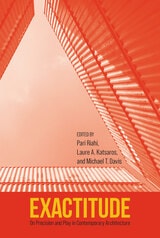
Exactitude
On Precision and Play in Contemporary ArchitectureEdited by Pari Riahi, Laure Katsaros, and Michael T. Davis
University of Massachusetts Press, 2022
Precision is necessary in the field of architecture, and new technologies have increased demands for accuracy, particularly when the smallest errors can have outsized consequences. However, the importance of precision, or exactitude, has not received the consideration it merits. While themes of sustainability, performance, and formal innovation have been at the forefront of architectural scholarship for the past twenty years, this book moves beyond these concerns to explore the theoretical and practical demands exactitude makes on architecture as a field.
The eleven essays collected here investigate the possibilities and shortcomings of exactitude and delve into current debates about the state of contemporary architecture as both a technological craft and artistic creation. Featuring new work by leading theorists, historians, editors, architects, and scholars, this volume brings theory and practice into insightful and productive conversations. In addition to the editors, contributors include Mark Wigley, Alejandro Zaera-Polo, Eric Höweler, Christopher Benfey, Sunil Bald, Ada Tolla and Giuseppe Lignano with Thomas de Monchaux, Alicia Imperiale, Francesca Hughes, Teresa Stoppani, and Cynthia Davidson.
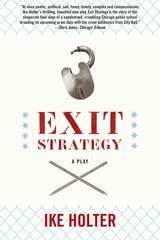
Exit Strategy
A PlayIke Holter
Northwestern University Press, 2018
Drawing from the headlines, Exit Strategy is set in Chicago and tells the story of a fictional public high school slated for closure at the end of the year. Despite funding cuts, bureaucrats run amok, apathy, and a rodent infestation, a small, multiracial group of teachers launch a last-minute effort to save the school, and put their careers, futures, and safety in the hands of a fast-talking administrator who may be in over his head. The tenuous situation also raises fears and anxieties among students, and within the volcanic neighborhood that is home to the school.
Holter has said that Exit Strategy was inspired by the 2013 mass closure of forty-nine Chicago public schools, which displaced nearly 12,000 children—the majority of directly impacted students were African American and Latinx. Hailed as "riveting," "sharp," and "richly metaphoric" by critics, the play indicts how we educate our children in big American cities, and shows why gaps between haves and have-nots continue to grow.
Exit Strategy is one of seven plays in Ike Holter's cycle of works set in Chicago or Chicago-inspired neighborhoods.
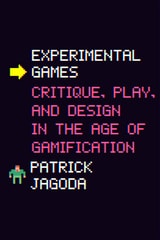
Experimental Games
Critique, Play, and Design in the Age of GamificationPatrick Jagoda
University of Chicago Press, 2020
Drawing from his own experience as a game designer, Patrick Jagoda argues that games need not be synonymous with gamification. He studies experimental games that intervene in the neoliberal project from the inside out, examining a broad variety of mainstream and independent games, including StarCraft, Candy Crush Saga, Stardew Valley, Dys4ia, Braid, and Undertale. Beyond a diagnosis of gamification, Jagoda imagines ways that games can be experimental—not only in the sense of problem solving, but also the more nuanced notion of problem making that embraces the complexities of our digital present. The result is a game-changing book on the sociopolitical potential of this form of mass entertainment.