Results by title
557 books match the query 'Poems' and 11 start with e
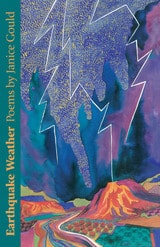
Earthquake Weather
PoemsJanice Gould
University of Arizona Press, 1996
Showing a steady courage in the midst of this alienation, her words are also stark testimony to the struggle of an individual caught in social and emotional contexts defined by others. In Earthquake Weather, as in an evolving friendship, Gould opens herself to the reader in stages. "I did not know how lonely I was / till we began to talk," she writes in an opening section, setting the introspective tone of what’s to come. She begins with a focus on those universal truths that both bind us and isolate us from each other: the pain of loss, the finality of death, our longing to see beneath the surface of things. Next, the poet turns to her growing-up years during the Vietnam War and the civil rights movement. She describes a family in turmoil and an Indian heritage that, oddly, was one of the factors that made her feel most disconnected from other people. And she writes poignantly about her increasing alienation from prescribed sexual roles. "What’s wrong with me? / Where do I belong? Why / am I here? Why can’t I / hold on?" Finally, as in a trusting friendship, Gould offers the reader vivid word portraits of relationships in her life—women she has loved and who have loved her.
Erotic and deeply personal, these poems serve as both a reconciliation and affirmation of her individuality. "Yet would you deny / that between women desire exists / that in our friendship a delicate / and erotic strand of fire unites us?" The poems in this book, says critic Toby Langen, are most powerful for their "courageous drawing on experience and feelings." They will speak to many general readers as well as anyone interested in questions of gender and identity, including students of literature, lesbian/women’s studies, social/cultural studies, or American Indian studies.
Ecstasy of Regret
PoemsDannye Powell
University of Arkansas Press, 2002
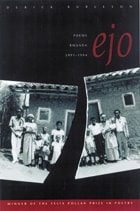
Ejo
Poems, Rwanda, 1991–1994Derick Burleson
University of Wisconsin Press, 2000
In 1994 the worst episode of genocide since the Holocaust of the Second World War ravaged the Central African country of Rwanda. Derick Burleson lived there and taught at the National University during the two years leading up to the genocide. The poems in this collection explore the cataclysm in a variety of forms and voices through the culture, myths, and customs he absorbed during this time. Ejo, meaning "yesterday and tomorrow" in Kinyarwandan, celebrates in language both lyrical and austere the lives of the friends Burleson made in Rwanda, those who survived to tell their own stories, and those whose voices were silenced.
Ends of the Earth
PoemsKate Partridge
University of Alaska Press, 2017
While the poems turn an inquisitive, contemporary lens to the subject of Alaska, elements throughout the book are influenced by twentieth-century writers like Elizabeth Bishop and Marianne Moore. The manuscript also combines personal experience with collaged material from the Epic of Gilgamesh, Walt Whitman's notebooks, and other classic sources, to investigate the ideas of love, isolation, and location. Through humor and observation, Partridge takes a new look at what it means to live in urban Alaska and the world at large.
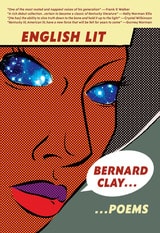
English Lit
PoemsBernard Clay
Ohio University Press, 2021
Autobiographical poetry from one of Kentucky’s rising Affrilachian literary stars.
Bernard Clay’s autobiographical poetry debut, English Lit, juxtaposes the roots of Black male identity against an urban and rural Kentucky landscape. Hailed as one of the most authentic voices of his generation, Clay artfully renders coming-of-age in the predominately Black West End of Louisville, Kentucky. Balancing the spirited grit of a farmer and the careful lyricism of a poet, English Lit is a triumph of new Affrilachian—African American and Appalachian—literature.
Enter Dark Stranger
PoemsWilliam Trowbridge
University of Arkansas Press, 1989
The world of William Trowbridge is one preoccupied with loss, with the fall from some possibility of grace that all who are born must bear. In the title poem of Trowbridge’s first full-length collection the poet calls our attention to movies, to Shane in particular. He asks us to identify, not with Shane, the lonely knight on a nameless quest, but with the much more lonely, and real, Jack Palance, the Prince of Darkness.
Trowbridge favors the villain, the outcast, the imperfect, the sinner, the alienated: King Kong, the Frog Prince, Frankenstein’s monster.
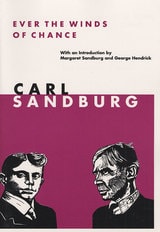
Ever the Winds of Chance
POEMSCarl Sandburg
University of Illinois Press, 1983
Ever the Winds of Chance opens in 1898 when the twenty-year-old Sandburg, recently returned from the Spanish-American war, enrolls at Lombard College in his native Galesburg, Illinois. Sandburg writes about his job at the fire station; his teachers, inspired or otherwise; his classmates and their camaraderie; his observations on great literary works and writers; and his own writings for the school newspaper, literary review, and yearbook and for the Galesburg Mail. But he also includes much about life between school years and after college, recounting his various brief careers as a fireman, salesman of stereoscopic views, advertising copywriter, vagabond, "jailbird," and budding poet and socialist. Together these reminiscences provide an intimate look at the formative years of a preeminent figure in American letters.
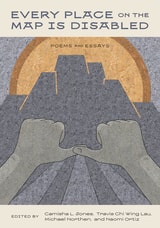
Every Place on the Map Is Disabled
Poems and EssaysCamisha L. Jones, Michael Northen, Naomi Ortiz, and Travis Chi Wing Lau
Northwestern University Press, 2026
An anthology of poems and essays by and celebrating Disabled writers
Declaring that Disabled people exist, innovate, thrive, and persevere, Every Place on the Map Is Disabled imagines the world we deserve. Its contributors spotlight the wisdom Disabled people embody from living within and navigating the economic and medical systems, communities, and families that often oppress their existence. This anthology is an intersectional compass pointing to the creative ways Disabled people build bridges to each other through Disability poetics and perspectives.
The contributing poets write about love, resistance, loss, pain, beauty, and culture. They capture tender and life-affirming moments where one Disabled person recognizes themself in another. The essays illustrate how Disability poetics suggest avenues for embracing the full spectrum of disability experiences. Every Place on the Map Is Disabled offers students, scholars, members of disability communities, and any reader a direction for paving a wider path toward a collective survival.
Everything That Hurt Us Becomes a Ghost
PoemsSage Ravenwood
Gallaudet University Press, 2023
Ex-Voto
Poems of Adélia PradoAdélia Prado
Tupelo Press, 2013
Extravagant Rescues
PoemsBrett Foster; foreword by Jeffrey Galbraith
Northwestern University Press, 2019
The poems ask questions with hymnlike couplets, in a language of the gospel of empathy. We are allowed to rethink our choices, question and be wary of our machinery, and, in the end, with metaphors that channel feelings of loss, humor, and compassion, we are reminded “to come, and dream, with eyes wide open / and set within the vessels of our waking selves, / of ever more intricate schemes, extravagant rescues.”