Results by title
139 books match the query 'Poets, American' and 4 start with e
Elizabeth Bishop and Her Art
Lloyd Schwartz and Sybil P. Estess, Editors
University of Michigan Press, 1983
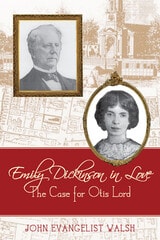
Emily Dickinson in Love
The Case for Otis LordWalsh, John Evangelist
Rutgers University Press, 2012
From the award-winning author of Poe the Detective: The Curious Circumstances Behind "The Mystery of Marie Roget" comes a compelling argument for the identity of Emily Dickinson’s true love
Proud of my broken heart
Since thou didst break it,
Proud of the pain I
Did not feel till thee . . .
Those words were written by Emily Dickinson to a married man. Who was he?
For a century or more the identity of Emily Dickinson’s mysterious “Master” has been eagerly sought, especially since three letters from her to him were found and published in 1955. In Emily Dickinson in Love, John Evangelist Walsh provides the first book-length treatment of this fascinating subject, offering a solution based wholly on documented facts and the poet’s own writings.
Crafting the affair as a love story of rare appeal, and writing with exquisite attention to detail, in Part I Walsh reveals and meticulously proves the Master to be Otis Lord, a friend of the poet’s father and a man of some reputation in law and politics. Part II portrays the full dimensions of their thirty-year romance, most of it clandestine, including a series of secret meetings in Boston.
After uncovering and confirming the Master’s identity, Walsh fits that information into known events of Emily’s life to make sense of facts long known but little understood—Emily’s decision to dress always in white, for instance, or her extreme withdrawal from a normal existence when she had previously been an active, outgoing friend to many men and women.
In a lengthy section of Notes and Sources, Walsh presents his proofs in abundant detail, demonstrating that the evidence favors one man so irresistibly that there is left no room for doubt. Each reader will decide if he has truly succeeded in making the case for Otis Lord.

Ever the Winds of Chance
POEMSCarl Sandburg
University of Illinois Press, 1983
Ever the Winds of Chance opens in 1898 when the twenty-year-old Sandburg, recently returned from the Spanish-American war, enrolls at Lombard College in his native Galesburg, Illinois. Sandburg writes about his job at the fire station; his teachers, inspired or otherwise; his classmates and their camaraderie; his observations on great literary works and writers; and his own writings for the school newspaper, literary review, and yearbook and for the Galesburg Mail. But he also includes much about life between school years and after college, recounting his various brief careers as a fireman, salesman of stereoscopic views, advertising copywriter, vagabond, "jailbird," and budding poet and socialist. Together these reminiscences provide an intimate look at the formative years of a preeminent figure in American letters.

Ezra Pound and Margaret Cravens
A Tragic Friendship, 1910–1912Omar Pound and Robert Spoo, editors
Duke University Press, 1988
Pound was deeply affected by her death, as was the poet H. D., who had recently come to know her. Pound's letters to Cravens, extensively annotated, are published here for the first time; her suicide note to him is also included. Ezra Pound and Margaret Cravens contains photographs and previously unpublished material by Pound and H.D., as well as an excerpt from H.D.'s autobiographical novel Asphodel, in which Cravens figures prominently. This portrait of a friendship provides insight into the literary achievements of Pound and H.D. and tells the unknown story of Margaret Cravens's tragic life.