Results by title
355 books match the query 'Political and social views' and 8 start with e
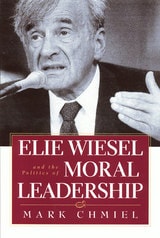
Elie Wiesel and the Politics of Moral Leadership
Mark Chmiel
Temple University Press, 2001
Mark Chmiel's thoroughly researched and penetrating study is the first book to examine both Wiesel's practice of solidarity with suffering people and his silence before Israeli and American power. Drawing on Edward Herman and Noam Chomsky's studies on "worthy and unworthy victims," the author analyzes Wiesel's initiatives of Jewish and universal solidarity with groups ranging from Holocaust survivors and Russian Jews to Vietnamese boat people and Kosovar refugees.
Chmiel also critically engages Wiesel's long-standing defense of the State of Israel as well as his confrontations and collaborations with the U.S. government, including the birth of the U.S. Holocaust Memorial Museum, the 1985 Bitburg affair with President Reagan, and U.S. intervention in the Balkans.
Throughout, the author probes the nuances and ambiguities of Wiesel's human rights activism and shows the various uses to which his Holocaust discourse has been put, both in the Middle East conflict and in issues involving U.S. foreign policy.
Elie Wiesel and the Politics of Moral Leadership provides a provocative view of one of the most acclaimed moralists in recent American history and raises important questions about what it means to be a responsible intellectual in the United States.

Elizabeth Bishop
Kim Fortuny
University Press of Colorado, 2003
Emerson and the Defense of Equality
Greg Garvey
University of Massachusetts Press, 2025
Arguing for equality as the necessary foundation of liberty
During Ralph Waldo Emerson’s lifetime, the idea of universal human equality was under intensive assault. Repeatedly—in contexts ranging from slavery, to marriage, to politics and workers’ rights—Americans of the time were being told that equality was an obsolete ideal and that the future would belong to those who accepted the hard truth that liberty lies not in egalitarian values but in hierarchies of domination and submission. Greg Garvey’s Emerson and the Defense of Equality focuses on Emerson as a real-time defender of equality during the antebellum culture wars.
In contrast to studies that treat individual liberty as Emerson’s primary concern, Garvey argues that Emerson’s works define a broad and sustained defense of equality as the necessary foundation of liberty. When read as part of a debate about equality, Emerson’s Nature is a treatise on individuality and the common weal; his anti-slavery speeches and English Traits advance evolutionary theories to rebut polygenesist arguments for white supremacy; the essays “Love” and “Domestic Life” challenge gender spheres and explore equality in marriage, friendship, and citizenship. As Emerson speculates on the future, “Politics” and “The Young American” anticipate a “beneficent socialism” in which human rights will always have priority over property rights. In his career-long effort to defend a threatened ideal, Emerson develops an aspirational vision of society that understands equality to be a fundamental aspect of liberty.
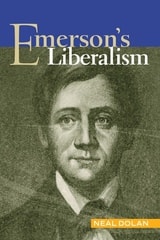
Emerson’s Liberalism
Neal Dolan
University of Wisconsin Press, 2009
Neal Dolan offers the first comprehensive and historically informed exposition of all of Ralph Waldo Emerson’s writings as a contribution to the theory and practice of liberal culture. Rather than projecting twentieth-century viewpoints onto the past, he restores Emerson’s great body of work to the classical liberal contexts that most decisively shaped its general political-cultural outlook—the libertarian-liberalism of John Locke, the Scottish Enlightenment, the American founders, and the American Whigs.
In addition to in-depth consideration of Emerson’s journals and lectures, Dolan provides original commentary on many of Emerson’s most celebrated published works, including Nature, the “Divinity School Address,” “History,” “Compensation,” “Experience,” the political addresses of the early 1840s, “An Address . . . on . . . The Emancipation of the Negroes in the British West Indies,” Representative Men, English Traits, and The Conduct of Life. He considers Emerson’s distinctive elaborations of foundational liberal values—progress, reason, work, property, limited government, rights, civil society, liberty, commerce, and empiricism. And he argues that Emerson’s ideas are a morally bracing and spiritually inspiring resource for the ongoing sustenance of American culture and civilization, reminding us of the depth, breadth, and strength of our common liberal inheritance.

Essays on Kant's Political Philosophy
Edited by Howard Lloyd Williams
University of Chicago Press, 1992
overshadowed by his compatriots Hegel and Marx. With his
strong defense of the rights of the person and his deep
insight into the strengths and weaknesses of modern society
Kant, possibly more than any other political thinker,
anticipated the problems of the late twentieth century.
Kant's political philosophy, wedded as it is to rights,
reform and gradual progress, is emerging from the shadows
cast by Hegelian and Marxist thinking about the state.
In this volume, thirteen distinguished contributors from the
United States, Canada, Britain, and Germany cast light on
important aspects of Kant's liberal thinking. Key topics
covered include Kant's liberal reformism, his relation with
Hegel, his attitude to women, the use of reason, revolution,
Kant's optimism and his moral and legal rigorism.
Howard Williams is a reader in political theory in the
Department of International Politics, University College of
Wales, Aberystwyth. His previous publications include
Kant's Political Philosophy, Concepts of
Ideology, and Hegel, Heraclitus, and Marx's
Dialectic.
Every Intellectual's Big Brother
George Orwell's Literary SiblingsBy John Rodden
University of Texas Press, 2006
George Orwell has been embraced, adopted, and co-opted by everyone from the far left to the neoconservatives. Each succeeding generation of Anglo-American intellectuals has felt compelled to engage the life, work, and cultural afterlife of Orwell, who is considered by many to have been the foremost political writer of the twentieth century. Every Intellectual's Big Brother explores the ways in which numerous disparate groups, Orwell's intellectual "siblings," have adapted their views of Orwell to fit their own agendas and how in doing so they have changed our perceptions of Orwell himself. By examining the politics of literary reception as a dimension of cultural history, John Rodden gives us a better understanding of Orwell's unique and enduring role in Anglo-American intellectual life.
In Part One, Rodden opens the book with a section titled "Their Orwell, Left and Right," which focuses on Orwell's reception by several important literary circles of the latter half of the twentieth century. Beginning with Orwell's own contemporaries, Rodden addresses the ways various intellectual groups of the 1950s responded to Orwell. Rodden then moves on in Part Two to what he calls the "Orwell Confraternity Today," those contemporary intellectuals who have, in various ways, identified themselves with or reacted against Orwell. The author concludes by examining how Orwell's status as an object of admiration and detraction has complicated the way in which he has been perceived by readers since his death.
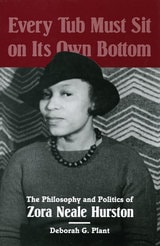
Every Tub Must Sit on Its Own Bottom
The Philosophy and Politics of Zora Neale HurstonDeborah G. Plant
University of Illinois Press, 1995
needed at this point in the evolving critical assessment of Hurston. It
is a paradigm for the study of individual African American women writers."
-- Alice Deck, University of Illinois at Urbana-Champaign
In a ground-breaking study
of Zora Neale Hurston, Deborah Plant takes issue with current notions
of Hurston as a feminist and earlier impressions of her as an intellectual
lightweight who disregarded serious issues of race in American culture.
Instead, Plant calls Hurston a "writer of resistance" who challenged
the politics of domination both in her life and in her work. One of the
great geniuses of the Harlem Renaissance, Hurston stands out as a strong
voice for African-American women. Her anthropological inquiries as well
as her evocative prose provide today's readers with a rich history of
African American folk culture, a folk culture through which Hurston expressed
her personal and political strategy of resistance and self-empowerment.
Through readings of Hurston's
fiction and autobiographical writings, Plant offers one of the first book-length
discussions of Hurston's personal philosophy of individualism and self-preservation.
From a discussion of Hurston's preacher father and influential mother,
whose guiding philosophy is reflected in the title of this book, to the
influence of Spinoza and Nietzsche, Plant puts into perspective the driving
forces behind Hurston's powerful prose.
This fresh look at one of
the most important writers of the twentieth century is sure to shape future
study of Hurston and her work.
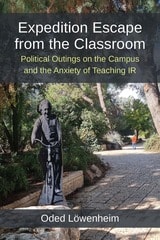
Expedition Escape from the Classroom
Political Outings on the Campus and the Anxiety of Teaching IROded Löwenheim
University of Michigan Press, 2024
Expedition Escape from the Classroom offers a unique narrative where teaching and its inherent challenges intersect with the intricacies of global politics, history, and identity. While recounting his academic experiment, Löwenheim grapples with the changing landscape of academia in a neoliberal age, while illustrating how personal vulnerabilities can transform into powerful tools for growth, exploration, and enlightenment. Whether you’re an educator, student, or just a curious reader, Expedition Escape from the Classroom promises a journey of reflection, critical thinking, and profound revelations.