Results by title
213 books match the query 'Political parties' and 4 start with e
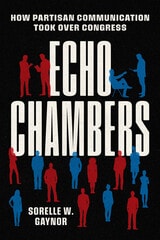
Echo Chambers
How Partisan Communication Took Over CongressSoRelle W. Gaynor
University of Chicago Press, 2027
An incisive analysis of how congressional communication with constituents has changed and what this means for representation and polarization.
Members of Congress have a duty to talk to their constituents back home about what’s going on in Washington. But today, the average politician lacks the time, resources, and knowledge necessary to coherently explain the bills and legislative actions up for debate. Therefore, they turn to those who hold the keys to the chamber: party leaders.
Consequently, Congress is now more reliant than ever on its leaders’ partisan talking points, and constituents hear more about nationalized political battles rather than the local issues affecting their districts. Drawing on large-scale text analysis, campaign expenditures, and congressional district data, as well as in-depth interviews, Echo Chambers examines how partisan communication took over Congress, the key differences in that messaging across parties and chambers, and what these combined forces mean for US citizens today.

Eckhardt
There Once Was a Congressman from TexasBy Gary A. Keith
University of Texas Press, 2007
Runner-up, Violet Crown Award, Writer's League of Texas, 2008
Renowned for his "brilliant legislative mind" and political oratory—as well as for bicycling to Congress in a rumpled white linen suit and bow tie—U.S. Congressman Bob Eckhardt was a force to reckon with in Texas and national politics from the 1940s until 1980. A liberal Democrat who successfully championed progressive causes, from workers' rights to consumer protection to environmental preservation and energy conservation, Eckhardt won the respect of opponents as well as allies. Columnist Jack Anderson praised him as one of the most effective members of Congress, where Eckhardt was a national leader and mentor to younger congressmen such as Al Gore.
In this biography of Robert Christian Eckhardt (1913-2001), Gary A. Keith tells the story of Eckhardt's colorful life and career within the context of the changing political landscape of Texas and the rise of the New Right and the two-party state. He begins with Eckhardt's German-American family heritage and then traces his progression from labor lawyer, political organizer, and cofounder of the progressive Texas Observer magazine to Texas state legislator and U.S. congressman. Keith describes many of Eckhardt's legislative battles and victories, including the passage of the Open Beaches Act and the creation of the Big Thicket National Preserve, the struggle to limit presidential war-making ability through the War Powers Act, and the hard fight to shape President Carter's energy policy, as well as Eckhardt's work in Texas to tax the oil and gas industry.
The only thorough recounting of the life of a memorable, important, and flamboyant man, Eckhardt also recalls the last great era of progressive politics in the twentieth century and the key players who strove to make Texas and the United States a more just, inclusive society.

Elections and Political Order in Russia
Peter Lentini
Central European University Press, 1995
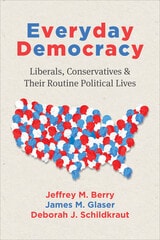
Everyday Democracy
Liberals, Conservatives, and Their Routine Political LivesJeffrey M. Berry, James M. Glaser and Deborah J. Schildkraut
University of Chicago Press, 2025
How the everyday habits and attitudes of ordinary liberals and conservatives shape the health of American democracy.
In Everyday Democracy, Jeffrey M. Berry, James M. Glaser, and Deborah J. Schildkraut study Americans’ views of several manifestations of “everyday democracy,” which they define as the attitudes, behaviors, and processes that people experience in daily life and their routine considerations of politics and community. Examples include engaging in dialogue with political opponents and giving politicians license to compromise. Ordinary political moments like these constitute much of politics, and they can lay the foundation that shapes if, when, and how crisis moments unfold.
Paying particular attention to the role of ideology in shaping how Americans emulate daily democratic ideals, this book considers such questions as: How do liberals and conservatives support different aspects of democratic practice, and are there ideological asymmetries between the two groups? If and when asymmetries emerge, what factors might explain them? The authors consider what their findings mean for the health of American democracy broadly.