Results by title
99 books match the query 'Politics and culture' and 3 start with e
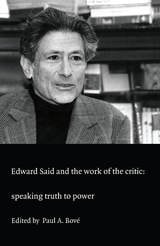
Edward Said and the Work of the Critic
Speaking Truth to PowerPaul A. Bové, ed.
Duke University Press, 2000
In two separate interviews, Said himself comments on a variety of topics, among them the response of the American Jewish community to his political efforts in the Middle East. Yet even as the Palestinian struggle finds a central place in his work, it is essential—as the contributors demonstrate—to see that this struggle rests on and gives power to his general "critique of colonizers" and is not simply the outgrowth of a local nationalism. Perhaps more than any other person in the United States, Said has changed how the U.S. media and American intellectuals must think about and represent Palestinians, Islam, and the Middle East. Most importantly, this change arises not as a result of political action but out of a potent humanism—a breadth of knowledge and insight that has nourished many fields of inquiry. Originally a special issue of boundary 2, the book includes new articles on minority culture and on orientalism in music, as well as an interview with Said by Jacqueline Rose.
Supporting the claim that the last third of the twentieth century can be called the "Age of Said," this collection will enlighten and engage students in virtually any field of humanistic study.
Contributors. Jonathan Arac, Paul A. Bové, Terry Cochran, Barbara Harlow, Kojin Karatani, Rashid I. Khalidi, Sabu Kohsu, Ralph Locke, Mustapha Marrouchi, Jim Merod, W. J. T. Mitchell, Aamir R. Mufti, Jacqueline Rose, Edward W. Said, Gayatri Chakravorty Spivak, Lindsay Waters
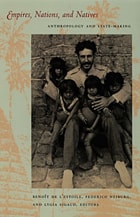
Empires, Nations, and Natives
Anthropology and State-MakingBenoît de L Estoile, Federico Neiburg and Lygia Sigaud, eds.
Duke University Press, 2005
The contributors—social and cultural anthropologists from the Americas and Europe—report on both historical and contemporary processes. Moving beyond controversies that cast the relationship between scholarship and politics in binary terms of complicity or autonomy, they bring into focus a dynamic process in which states, anthropological knowledge, and population groups themselves are mutually constructed. Such a reflexive endeavor is an essential contribution to a critical anthropological understanding of a changing world.
Contributors: Alban Bensa, Marcio Goldman, Adam Kuper, Benoît de L’Estoile, Claudio Lomnitz, David Mills, Federico Neiburg, João Pacheco de Oliveira, Jorge Pantaleón, Omar Ribeiro Thomaz, Lygia Sigaud, Antonio Carlos de Souza Lima, Florence Weber
Exile and Cultural Hegemony
Spanish Intellectuals in Mexico, 1939-1975Sebastiaan Faber
Vanderbilt University Press, 2002
The first study of its kind to place the exiles' ideological evolution in a broad historical context, Exile and Cultural Hegemony takes into account developments in both Spanish and Mexican politics from the early 1930s through the 1970s. Faber pays particular attention to the intellectuals' persistent nationalism and misplaced illusions of pan-Hispanist grandeur, which included awkward and ironic overlaps with the rhetoric employed by their enemies on the Francoist right. This embrace of nationalism, together with the intellectuals' dependence on the increasingly authoritarian Mexican regime and the international climate of the Cold War, eventually caused them to abandon the Gramscian ideal of the intellectual as political activist in favor of a more liberal, apolitical stance preferred by, among others, the Spanish philosopher Jose Ortega y Gasset.
With its comprehensive approach to topics integral to Spanish culture, both students of and those with a general interest in twentieth-century Spanish literature, history, or culture will find Exile and Cultural Hegemony a fascinating and groundbreaking work.