Results by title
88 books match the query 'Population' and 4 start with e
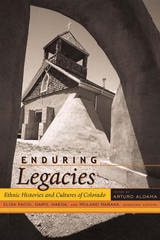
Enduring Legacies
Ethnic Histories and Cultures of ColoradoArturo J. Aldama
University Press of Colorado, 2011
Traditional accounts of Colorado's history often reflect an Anglocentric perspective that begins with the 1859 Pikes Peak Gold Rush and Colorado's establishment as a state in 1876. Enduring Legacies expands the study of Colorado's past and present by adopting a borderlands perspective that emphasizes the multiplicity of peoples who have inhabited this region.
Addressing the dearth of scholarship on the varied communities within Colorado-a zone in which collisions structured by forces of race, nation, class, gender, and sexuality inevitably lead to the transformation of cultures and the emergence of new identities-this volume is the first to bring together comparative scholarship on historical and contemporary issues that span groups from Chicanas and Chicanos to African Americans to Asian Americans.
This book will be relevant to students, academics, and general readers interested in Colorado history and ethnic studies.
[more]
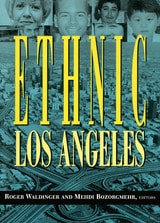
Ethnic Los Angeles
Roger Waldinger
Russell Sage Foundation, 1996
Since 1965 more immigrants have come to Los Angeles than anywhere else in the United States. These newcomers have rapidly and profoundly transformed the city's ethnic makeup and sparked heated debate over their impact on the region's troubled economy. Ethnic Los Angeles presents a multi-investigator study of L.A.'s immigrant population, exploring the scope, characteristics, and consequences of ethnic transition in the nation's second most populous urban center. Using the wealth of information contained in the U.S. censuses of 1970, 1980, and 1990, essays on each of L.A.'s major ethnic groups tell who the immigrants are, where they come from, the skills they bring and their sources of employment, and the nature of their families and social networks. The contributors explain the history of legislation and economic change that made the city a magnet for immigration, and compare the progress of new immigrants to those of previous eras. Recent immigrants to Los Angeles follow no uniform course of adaptation, nor do they simply assimilate into the mainstream society. Instead, they have entered into distinct niches at both the high and low ends of the economic spectrum. While Asians and Middle Easterners have thrived within the medical and technical professions, low-skill newcomers from Central America provide cheap labor in light manufacturing industries. As Ethnic Los Angeles makes clear, the city's future will depend both on how well its economy accommodates its diverse population, and on how that population adapts to economic changes. The more prosperous immigrants arrived already possessed of advanced educations and skills, but what does the future hold for less-skilled newcomers? Will their children be able to advance socially and economically, as the children of previous immigrants once did? The contributors examine the effect of racial discrimination, both in favoring low-skilled immigrant job seekers over African Americans, and in preventing the more successful immigrants and native-born ethnic groups from achieving full economic parity with whites. Ethnic Los Angeles is an illuminating portrait of a city whose unprecedented changes are sure to be replicated in other urban areas as new concentrations of immigrants develop. Backed by detailed demographic information and insightful analyses, this volume engages all of the issues that are central to today's debates about immigration, ethnicity, and economic opportunity in a post-industrial urban society.
[more]
Evolution and the Machinery of Chance
Philosophy, Probability, and Scientific Practice in BiologyMarshall Abrams
University of Chicago Press, 2023
An innovative view of the role of fitness concepts in evolutionary theory.
Natural selection is one of the factors responsible for changes in biological populations. Some traits or organisms are fitter than others, and natural selection occurs when there are changes in the distribution of traits in populations because of fitness differences. Many philosophers of biology insist that a trait’s fitness should be defined as an average of the fitnesses of individual members of the population that have the trait.
Marshall Abrams argues convincingly against this widespread approach. As he shows, it conflicts with the roles that fitness is supposed to play in evolutionary theory and with the ways that evolutionary biologists use fitness concepts in empirical research. The assumption that a causal kind of fitness is fundamentally a property of actual individuals has resulted in unnecessary philosophical puzzles and years of debate. Abrams came to see that the fitnesses of traits that are the basis of natural selection cannot be defined in terms of the fitnesses of actual members of populations, as philosophers of biology often claim. Rather, it is an overall population-environment system—not actual, particular organisms living in particular environmental conditions—that is the basis of trait fitnesses. Abrams argues that by distinguishing different classes of fitness concepts and the roles they play in the practice of evolutionary biology, we can see that evolutionary biologists’ diverse uses of fitness concepts make sense together and are consistent with the idea that fitness differences cause evolution.
Abrams’s insight has broad significance, for it provides a general framework for thinking about the metaphysics of biological evolution and its relations to empirical research. As such, it is a game-changing book for philosophers of biology, biologists who want deeper insight into the nature of evolution, and anyone interested in the applied philosophy of probability.
[more]
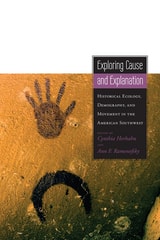
Exploring Cause and Explanation
Historical Ecology, Demography, and Movement in the American SouthwestCynthia L. Herhahn
University Press of Colorado, 2016
This 13th biennial volume of the Southwest Symposium highlights three distinct archaeological themes—historical ecology, demography, and movement—tied together through the consideration of the knowledge tools of cause and explanation. These tools focus discussion on how and why questions, facilitate assessing past and current knowledge of the Pueblo Southwest, and provide unexpected bridges across the three themes. For instance, people are ultimately the source of the movement of artifacts, but that statement is inadequate for explaining how artifact movement occurred or even why, at a regional scale, different kinds of movement are implicated at different times. Answering such questions can easily incorporate questions about changes in climate or in population density or size.
Each thematic section is introduced by an established author who sets the framework for the chapters that follow. Some contributors adopt regional perspectives in which both classical regions (the central San Juan or lower Chama basins) and peripheral zones (the Alamosa basin or the upper San Juan) are represented. Chapters are also broad temporally, ranging from the Younger Dryas Climatic interval (the Clovis-Folsom transition) to the Protohistoric Pueblo world and the eighteenth-century ethnogenesis of a unique Hispanic identity in northern New Mexico. Others consider methodological issues, including the burden of chronic health afflictions at the level of the community and advances in estimating absolute population size. Whether emphasizing time, space, or methodology, the authors address the processes, steps, and interactions that affect current understanding of change or stability of cultural traditions.
Exploring Cause and Explanation considers themes of perennial interest but demonstrates that archaeological knowledge in the Southwest continues to expand in directions that could not have been predicted fifty years ago.
Contributors: Kirk C. Anderson, Jesse A. M. Ballenger, Jeffery Clark, J. Andrew Darling, B. Sunday Eiselt, Mark D. Elson, Mostafa Fayek, Jeffrey R. Ferguson, Severin Fowles, Cynthia Herhahn, Vance T. Holliday, Sharon Hull, Deborah L. Huntley, Emily Lena Jones, Kathryn Kamp, Jeremy Kulisheck, Karl W. Laumbach, Toni S. Laumbach, Stephen H. Lekson, Virginia T. McLemore, Frances Joan Mathien, Michael H. Ort, Scott G. Ortman, Mary Ownby, Mary M. Prasciunas, Ann F. Ramenofsky, Erik Simpson, Ann L. W. Stodder, Ronald H. Towner
[more]