Results by title
156 books match the query 'Psychotherapy' and 6 start with e
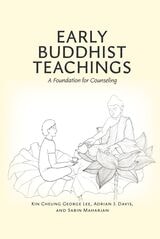
Early Buddhist Teachings
A Foundation for CounselingKin Cheung George Lee, Adrian J. Davis, and Sabin Maharjan
Hong Kong University Press, 2025
As mindfulness and meditation become mainstream therapeutic tools, their deep Buddhist roots are often stripped away and limit their effectiveness for clients from Buddhist cultural backgrounds. Early Buddhist Teachings: A Theoretical Foundation for Counseling restores these practices to their original context, offering a culturally congruent counseling model grounded in Pali scriptures and core Buddhist principles.
This informative volume explores key Buddhist concepts including dependent co-arising, non-self, and impermanence, and places them in conversation with Western psychological theories. Supplemented with practical assessment tools and intervention techniques, this work provides mental health professionals with a new framework for integrating Buddhist teachings into counseling.
For therapists, students, and counselors seeking to expand their approach, Early Buddhist Teachings offers a vital resource at the intersection of Buddhism and psychotherapy, offering a more holistic and effective model of mental health care.

Economizing Mind, 1870–2015
When Economics and Psychology Met . . . or Didn’tMarina Bianchi and Neil De Marchi, special issue editors
Duke University Press, 2016
Economists and psychologists share an interest in explaining how people make the choices that they do. However, economists have tended to stress individual rationality, shaped by economic motives and expressed in formal logical or mathematical models, while psychologists have preferred to identify influences through experimentation. In recent decades, behavioral economics has bridged the two fields and challenged the traditional economic assumption that individuals choose rationally. The essays collected here provide a longer view and reflect on episodic contact between psychology and economics beginning in the late nineteenth century. They help explain why meaningful, sustained joint inquiry eluded both disciplines for so long and usefully complement the recent inclination of researchers in each field to find inadequacy in the other.
Contributors: Marina Bianchi, Simon J. Cook, Neil De Marchi, José Edwards, Tiziana Foresti, Craufurd D. Goodwin, Judy L. Klein, Harro Maas, Ivan Moscati, John Staddon, Andrej Svorenčík
Egocracy
Marx, Freud and LacanSonia Arribas and Howard Rouse
Diaphanes, 2011
Embracing the Void
Rethinking the Origin of the SacredRichard Boothby
Northwestern University Press, 2023
A radical reinterpretation of the origin of religion through a psychoanalytic theorization of the unknown
Renowned psychoanalytic philosopher Richard Boothby puts forward a novel theory of religion inspired by Jacques Lacan’s theory of das Ding, the disquieting, inaccessible dimension of fellow human beings. This notion of an unfathomable excess, originally encountered in the figure of the mother, led Lacan to break with Freud’s formulation of the Oedipus complex and underlies Lacan’s distinctive conception of unconscious dynamics. Leaning on this account, Boothby shows how our sense of the sacred arises from our relation to what we do not know.
Embracing the Void lays out the range of Freud’s attempts at a psychoanalytic theory of religion and then sketches the rough contours of Lacan’s contrasting approach. From there, Boothby offers the theoretical tools for interpreting the religious impulse and analyzes key religious traditions, from ancient Greek polytheism to Judaism and Christianity, and from Hinduism and Buddhism to Islam, finally turning to modern capitalist culture and the seductive deity that dominates it—money. Lucid, accessible, and compelling, the book provides a cogent intervention in one of the psychoanalytic tradition’s most contentious topics and offers a new approach to our understanding of religion.
Emotion
A Comprehensive Phenomenology of Theories and Their Meanings for TherapyJames Hillman
Northwestern University Press, 1962
As James Hillman writes in his new preface to this sweeping study, he intends nothing less than "to vitalize a standard topic of academic psychology by making the theory of emotion as crucial as is emotion itself in our lives." Hillman offers an informative and readable survey of a range of theories of emotion, focusing on the twentieth century but moving also from Greek thought to early Christianity to nineteenth-century German physiology. The work challenges readers to rethink our concepts and thereby to re-experience emotional phenomena.
Hillman's study contributes to today's renewed interest in the history of the body. Furthermore, his understanding of emotions in terms of epiphany makes a stimulating contribution to phenomenology. It is equally thought-provoking for the therapist, the philosopher, the intellectual historian, and the general reader.

Extimacy
Nadia Bou Ali; Surti Singh
Northwestern University Press, 2024
Bringing together theorists and practitioners of psychoanalysis to interrogate Lacan’s notion of extimité
In 1960, Jacques Lacan coined the neologism extimité (extimacy) to denote a structure of subjectivity in which the most intimate, internal core is already external, thus complicating the traditional philosophical dualisms and binaries that have informed traditional notions of subjectivity. This collection is the first sustained interrogation of the concept of extimacy, comprising contributions on various topics by leading and emerging philosophers and scholars of psychoanalytic theory from around the world. This international collection also includes key perspectives from practicing psychoanalysts and presents a variety of critical inquiries into the concept of extimacy for application in multiple disciplines beyond philosophy and in an array of methodological and thematic frameworks.