Results by title
81 books match the query 'Publishing' and 3 start with e
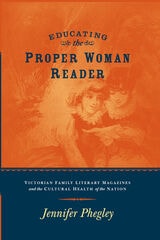
EDUCATING THE PROPER WOMAN READER
VICTORIAN FAMILY LITERARY MAGAZINES & CULTURAL HEALTH OF THE NATIONJennifer Phegley
The Ohio State University Press, 2004
Jennifer Phegley presents an examination of four mid-Victorian magazines that middle-class women read widely. Educating the Proper Woman Reader reevaluates prevailing assumptions about the vexed relationship between nineteenth-century women readers and literary critics.
While many scholars have explored the ways nineteenth-century critics expressed their anxiety about the dangers of women’s unregulated and implicitly uncritical reading practices, which were believed to threaten the sanctity of the home and the cultural status of the nation, Phegley argues that family literary magazines revolutionized the position of women as consumers of print by characterizing them as educated readers and able critics. Her analysis of images of influential women readers (in Harper’s), intellectual women readers (in The Cornhill), independent women readers (in Belgravia), and proto-feminist women readers/critics (in Victoria) indicates that women played a significant role in determining the boundaries of literary culture within these magazines. She argues that these publications supported women’s reading choices, inviting them to define literary culture rather than to consume it passively.
Not only does this book revise our understanding of nineteenth-century attitudes toward women readers, but it also takes a fresh look at the transatlantic context of literary production. Further, Phegley demonstrates the role these publications played in improving cultural literacy among women of the middle classes as well as the interplay between fiction and essays of the time by writers such as Mary Braddon, Charles Dickens, George Eliot, Elizabeth Gaskell, G. H. Lewes, Harriet Martineau, Margaret Oliphant, George Sala, William Thackeray, and Anthony Trollope.
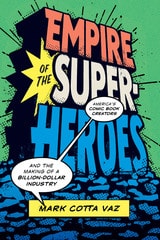
Empire of the Superheroes
America’s Comic Book Creators and the Making of a Billion-Dollar IndustryBy Mark Cotta Vaz
University of Texas Press, 2021
Superman may be faster than a speeding bullet, but even he can't outrun copyright law. Since the dawn of the pulp hero in the 1930s, publishers and authors have fought over the privilege of making money off of comics, and the authors and artists usually have lost. Jerry Siegel and Joe Shuster, the creators of Superman, got all of $130 for the rights to the hero.
In Empire of the Superheroes, Mark Cotta Vaz argues that licensing and litigation do as much as any ink-stained creator to shape the mythology of comic characters. Vaz reveals just how precarious life was for the legends of the industry. Siegel and Shuster—and their heirs—spent seventy years battling lawyers to regain rights to Superman. Jack Kirby and Joe Simon were cheated out of their interest in Captain America, and Kirby's children brought a case against Marvel to the doorstep of the Supreme Court. To make matters worse, the infant comics medium was nearly strangled in its crib by censorship and moral condemnation. For the writers and illustrators now celebrated as visionaries, the "golden age" of comics felt more like hard times.
The fantastical characters that now earn Hollywood billions have all-too-human roots. Empire of the Superheroes digs them up, detailing the creative martyrdom at the heart of a pop-culture powerhouse.
Explanation Points
Publishing in Rhetoric and CompositionJohn R Gallagher
Utah State University Press, 2019
Rhetoric and composition is a uniquely democratic field, made of a group of scholars who, rather than competing with one another, lift each other up and work together to move the field forward. This lively, engaging, story-anchored book offers advice from a range of authors—including emeritus faculty, prolific authors, and early career researchers. Organized by various stages in the writing and publishing process, Explanation Points presents the advice shared between colleagues, passed along from professor to student, or offered online in abbreviated tweets and updates.
The best advice book on writing and publishing in the field, Explanation Points is a useful resource for rhetoric and composition scholars including faculty, graduate students, and advanced undergraduate students; writing center administrators, staff, and consultants; graduate pratica and seminars; writing workshop classes; and editors, associate editors, assistant editors, and other academic journal staff.
Contributors:
Tim Amidon, Chris Anson, Nancy G. Barron, Ellen Barton, Michael Baumann, Steve Bernhardt, Kristine L. Blair, David Blakesley, Lynn Z. Bloom, Marcia Bost, James Brown, Amber Buck, Rebecca Burnett, Joyce Carter, Kate Comer, Janice Cools, Marilyn Cooper, Craig Cotich, Ellen Cushman, Gabriel Cutrufello, Courtney Danforth, Sid Dobrin, William Duffy, Norbert Elliot, Jessica Enoch, Doug Eyman, Michael Faris, Jenn Fishman, Linda Flower, Brenda Glasscot, Laura Gonzales, Jeffrey T. Grabill, Laurie Gries, Bump Halbritter, Joseph Harris, Byron Hawk, Douglas Hesse, Troy Hicks, Bruce Horner, Asao Inoue, Darin L. Jensen, Erin Jensen, Johndan Johnson-Eilola, Gesa E. Kirsch, Sarah Kornfield, Ashanka Kumari, Christina M. LaVecchia, Donna LeCourt, Barbara L’Eplattenier, Heather Lettner-Rust, Justin Lewis, Julie Lindquist, Tara Lockhart, Andrea Abernethy Lunsford, Katie Manthey, Lisa Mastrangelo, Ben McCorkle, Heidi McKee, Cruz Medina, Laura R. Micciche, Holly Middleton, Lilian Mina, Janine Morris, Joan Mullin, Kim Hensley Owens, Jason Palmeri, Mike Palmquist, Steve Parks, Juli Parrish, Staci Perryman-Clark, Mya Poe, Jacqueline Rhodes, Jeff Rice, Jim Ridolfo, Shirley K Rose, Stuart A. Selber, Jody Shipka, Naomi Silver, Ryan Skinnell, Trixie Long Smith, Kyle Stedman, Patrick Sullivan, Carrie Strand Tebeau, Christie Toth, John Trimbur, Chris Warnick, Kathleen Blake Yancey