Results by title
119 books match the query 'Race in literature' and 3 start with e
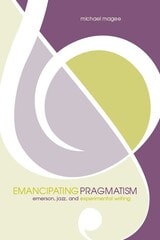
Emancipating Pragmatism
Emerson, Jazz, and Experimental WritingMichael Magee
University of Alabama Press, 2004
A radical rereading of Emerson that posits African- American culture, literature, and jazz as the very continuation and embodiment of pragmatic thought and democratic tradition
Emancipating Pragmatism is a radical rereading of Emerson that posits African- American culture, literature, and jazz as the embodiment of pragmatic thought and democratic tradition. It traces Emerson's philosophical legacy through the 19th and 20th centuries to discover how Emersonian thought continues to inform issues of race, aesthetics, and poetic discourse.
Emerson’s pragmatism derives from his abolitionism, Michael Magee argues, and any pragmatic thought that aspires toward democracy cannot ignore and must reckon with its racial roots. Magee looks at the ties between pragmatism and African-American culture as they manifest themselves in key texts and movements, such as William Carlos Williams’s poetry; Ralph Ellison’s discourse in Invisible Man and Juneteenth and his essays on jazz; the poetic works of Robert Creeley, Amiri Baraka, and Frank O'Hara; as well as the “new jazz” being forged at clubs like The Five Spot in New York.
Ultimately, Magee calls into question traditional maps of pragmatist lineage and ties pragmatism to the avant-garde American tradition.

Entitled to the Pedestal
Place, Race, and Progress in White Southern Women’s Writing, 1920–1945Nghana tamu Lewis
University of Iowa Press, 2007
In this searching study, Nghana Lewis offers a close reading of the works and private correspondences, essays, and lectures of five southern white women writers: Julia Peterkin, Gwen Bristow, Caroline Gordon, Willa Cather, and Lillian Smith. At the core of this work is a sophisticated reexamination of the myth of southern white womanhood.
Lewis overturns the conventional argument that white women were passive and pedestal-bound. Instead, she argues that these figures were complicit in the day-to-day dynamics of power and authorship and stood to gain much from these arrangements at the expense of others.
At the same time that her examination of southern mythology explodes received wisdom, it is also a journey of self-discovery. As Lewis writes in her preface, “As a proud daughter of the South, I have always been acutely aware of the region’s rich cultural heritage, folks, and foodstuffs. How could I not be? I was born and reared in Lafayette, Louisiana, where an infant’s first words are not ‘da-da’ and ‘ma-ma’ but ‘crawfish boil’ and ‘fais-do-do.’ . . . I have also always been keenly familiar with its volatile history.” Where these conflicting images—and specifically the role of white southern women as catalysts, vindicators, abettors, and antagonists—meet forms the crux of this study. As such, this study of the South by a daughter of the South offers a distinctive perspective that illuminates the texts in novel and provocative ways.
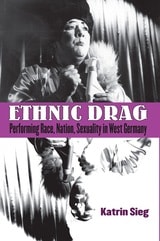
Ethnic Drag
Performing Race, Nation, Sexuality in West GermanyKatrin Sieg
University of Michigan Press, 2002
Using engaging case studies, Ethnic Drag traces the classical and travestied traditions of Jewish impersonation from the eighteenth century onward to construct a pre-history of postwar ethnic drag. It examines how, shortly after World War II, mass culture and popular practices facilitated the repression and refashioning of Nazi racial precepts. During a time when American occupation authorities insisted on remembrance and redress for the Holocaust, the Wild West emerged as a displaced theater of the racial imagination, where the roles of victim, avenger, and perpetrator of genocide were reassigned.
Ethnic Drag is an accessible and sophisticated, critical and entertaining book that examines the phenomenon of cultural masquerade in order to examine racial feeling, thought, and behavior in postwar German culture. Contributing to considerations of drag in postcolonial, feminist, and queer scholarships, this book will be of interest to people in German studies, theater performance, ethnic studies, and women's/queer studies.
Katrin Sieg is Associate Professor, Department of German and Center for German and European Studies, Georgetown University.