Results by title
151 books match the query 'Radicalism' and 3 start with e
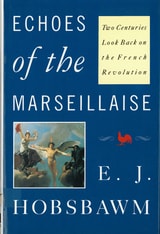
Echoes of the Marseillaise
Two Centuries Look Back on the French RevolutionHobsbawm, Eric
Rutgers University Press, 1990
"The French Revolution," writes Hobsbawm, "gave peoples the sense that history could be changed by their action ... [and] demonstrated the power of the common people in a manner which no subsequent government has ever allowed itself to forget."
We can learn a great deal from studying the French Revolution itself, but we can also learn from studying the ways in which scholars have interpreted the French Revolution, and from the ways their views have changed. For over a century following the Revolution, commentators and scholars spoke of it in glowing terms. But in the past three decades, revisionist historians have become skeptical. Eric Hobsbawm reiterates the centrality of the Revolution for history on a global basis. He argues that those who wrote about the Revolution in the nineteenth century were convinced it had changed their lives dramatically, improving the economy and the lot of peasants. They saw the Revolution as a prototype of of the bourgeois revolution, enabling the middle class to gain power from the ruling class of aristocrats. Many believed proletarian revolutions would inevitably follow. In the years between 1917 and the 1960s, Marxists continued to use the French Revolution as a point of reference, paying increasing attention to the social and economic factors in the Revolution, not only to the political factors. In the 1970s and 1980s, many historians began to argue that the Revolution achieved modest results at disproportionate costs. Hobsbawm argues that this massive historiographical reaction against the centrality of the Revolution reflects the personal politics of those contemporary historians for whom Marxism and communism are now out of favor. They are, he maintains, wrong. The Revolution transformed the world permanently and introduced forces that continue to transform it.
[more]
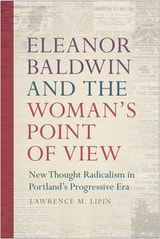
Eleanor Baldwin and the Woman's Point of View
New Thought Radicalism in Portland’s Progressive EraLawrence M. Lipin
Oregon State University Press, 2017
Eleanor Baldwin and the Woman’s Point of View is an intellectual biography of a long-forgotten radical female journalist in Portland, whose daily women’s columns provide a window into the breadth of intellectual radicalism in Progressive Era journalism. Baldwin was one of an early generation of female journalists who were hired to lure female readers to the daily newspaper’s department store advertisements. Instead of catering to the demands of consumerism, Baldwin quickly brought an anti-capitalist, antiracist agenda to her column, “The Woman’s Point of View." She eschewed household hints and instead focused on the immorality of capitalists and imperialists while emphasizing the need for women to become independent and productive citizens.
A century before the Occupy movement and the Women’s March, Baldwin spoke truth to power. Imbued with a New Thought spirituality that presumed progressive thought could directly affect material reality, she wrote to move history forward. And yet, the trajectory of history proved as hard to forecast then as now. While her personal story seems to embody a modern progressivism, blending abolition with labor reform and anti-banker activism—positions from which she never wavered—her path grew more complicated as times changed in the aftermath of World War I, when she would advocate on behalf of both the Bolsheviks and the Ku Klux Klan.
In this deeply researched and nuanced account of Eleanor Baldwin’s intellectual journey, historian Larry Lipin reveals how even the most dedicated radical can be overcome by unforeseen events. Eleanor Baldwin and the Woman’s Point of View restores a missing chapter in Portland’s Progressive Era history and rescues this passionate, intriguing, and quixotic character from undeserved obscurity.
[more]

Elinor Ostrom's Rules for Radicals
Cooperative Alternatives Beyond Markets and StatesDerek Wall
Pluto Press, 2017
Elinor Ostrom was both a groundbreaking thinker and one of the foremost economists of our age. The first and only woman to win the Nobel Prize for Economics, her revolutionary theorizing of the commons opened the way for non-capitalist economic alternatives on a massive scale. And yet, astonishingly, most modern radicals know little about her.
Elinor Ostrom's Rules for Radicals fixes that injustice, revealing the indispensability of her work on green politics, alternative economics, and radical democracy. Derek Wall’s analysis of her theses addresses some of the common misconceptions of her work and reveals her strong commitment to a radical ideological framework. This helpful guide will engage scholars and activists across a range of disciplines, including political economy, political science, and ecology, as well as those keen to implement her work in practice. As activists continue to reject traditional models of centralized power, Ostrom’s theories will become even more crucial in creating economies that exist beyond markets and states.
Elinor Ostrom's Rules for Radicals fixes that injustice, revealing the indispensability of her work on green politics, alternative economics, and radical democracy. Derek Wall’s analysis of her theses addresses some of the common misconceptions of her work and reveals her strong commitment to a radical ideological framework. This helpful guide will engage scholars and activists across a range of disciplines, including political economy, political science, and ecology, as well as those keen to implement her work in practice. As activists continue to reject traditional models of centralized power, Ostrom’s theories will become even more crucial in creating economies that exist beyond markets and states.
[more]