Results by title
54 books match the query 'Reader' and 3 start with e
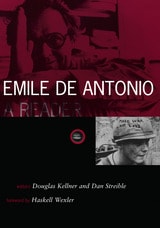
Emile De Antonio
A ReaderDouglas Kellner
University of Minnesota Press, 2000
An absorbing collection of writings by and about an American original.
Innovative documentary filmmaker; friend of Andy Warhol, John Cage, Jasper Johns, Robert Rauschenberg, and other leading figures of the New York art world; radical leftist critic of the Establishment; and legendary bon vivant: Emile de Antonio (1919-1989) was a larger-than-life personality and a key figure in the development of postwar American cinema. The films de Antonio made between 1963 and 1989—including Point of Order, Rush to Judgment, In the Year of the Pig, Painters Painting, and Millhouse: A White Comedy—revolutionized the documentary format and inspired a generation of artists and filmmakers. A decade after his death, his cinematic legacy—ranging from the brilliantly edited compilation of the 1954 Army-McCarthy hearings that helped construct Senator Joseph McCarthy’s reputation as a rogue demagogue (Point of Order) to a meditative juxtaposition of documents about F.B.I. director J. Edgar Hoover and intimate footage drawn from the filmmaker’s own life (Mr. Hoover and I)-remains unparalleled in American documentary film.
Emile de Antonio: A Reader is the first full-length volume devoted to this major American filmmaker. It collects interviews with and writings by de Antonio; reviews and other critical material that detail the genesis, production history, and reception of his films; a comprehensive filmography; and an in-depth biographical essay. Offering a long-overdue assessment of de Antonio’s career, this indispensable book also makes a significant contribution to our understanding of American independent cinema at its most politically engaged.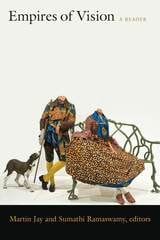
Empires of Vision
A ReaderMartin Jay and Sumathi Ramaswamy, eds.
Duke University Press, 2014
Contributors. Jordanna Bailkin, Roger Benjamin, Daniela Bleichmar, Zeynep Çelik, David Ciarlo, Natasha Eaton, Simon Gikandi, Serge Gruzinski, James L. Hevia, Martin Jay, Brian Larkin, Olu Oguibe, Ricardo Padrón, Christopher Pinney, Sumathi Ramaswamy, Benjamin Schmidt, Terry Smith, Robert Stam, Eric A. Stein, Nicholas Thomas, Krista A. Thompson
Everyday English 1500-1700
A ReaderBridget Cusack, Editor
University of Michigan Press, 1998
This unique source book of essential documents designed for courses on Early Modern English is designed as a teaching text with full guidance to each text, including glossary, explanatory and background notes, and suggested topics for linguistic evaluation. Everyday English takes an up-to-the-minute approach by focusing on language as it was used and spoken at the time.
This wide-ranging collection for the first time makes available to students a corpus of examples of the ordinary, nonstandard language of the man and woman in the street, coming from areas as diverse as England, Scotland, and America. The emphasis throughout is on providing as much assistance as possible to the reader to aid understanding and appreciation of both the linguistic features and the everyday lifestyles of the time.
"The only book a really conscientious teacher of the history and structure of Early Modern English would use for source texts." --Roger Lass, University of Cape Town
Bridget Cusack was lecturer in English Language, University of Edinburgh.