Results by title
145 books match the query 'Refugees' and 11 start with e
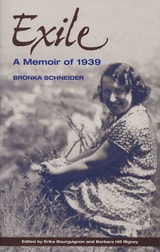
EXILE
A MEMOIR OF 1939Bronka Schneider Edited with forewords by Erika Bourguignon and Barbara Hill Rigney
The Ohio State University Press, 1998
Bronka Schneider and her husband, Joseph, were two of the thirty thousand Austrian Jews admitted as refugees to Great Britain between March 1938 and 2 September 1939. It was not until 1960, however, that Schneider wrote her memoir about the year she spent as a housekeeper, with Joseph as a butler, in a Scottish castle.
Schneider tells of daily encounters—with her employers, the English lady and her husband, a retired British civil servant who had spent many years in India; the village locals; other refugees; and a family of evacuees from the slums of Glasgow.
The editors have divided this memoir into chapters, adding headlines from the London Times as epigraphs. These headlines, reporting the escalating events of World War II, are in stark contrast to daily activities of the residents of this isolated region of Scotland. A commentary by Erika Bourguignon provides historical, political, and cultural background of this period.
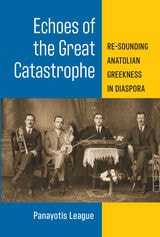
Echoes of the Great Catastrophe
Re-Sounding Anatolian Greekness in DiasporaPanayotis League
University of Michigan Press, 2021
Echoes of the Great Catastrophe: Re-sounding Anatolian Greekness in Diaspora explores the legacy of the Great Catastrophe—the death and expulsion from Turkey of 1.5 million Greek Christians following the Greco-Turkish War of 1919–1922—through the music and dance practices of Greek refugees and their descendants over the last one hundred years. The book draws extensively on original ethnographic research conducted in Greece (on the island of Lesvos in particular) and in the Greater Boston area, as well as on the author’s lifetime immersion in the North American Greek diaspora. Through analysis of handwritten music manuscripts, homemade audio recordings, and contemporary live performances, the book traces the routes of repertoire and style over generations and back and forth across the Atlantic Ocean, investigating the ways that the particular musical traditions of the Anatolian Greek community have contributed to their understanding of their place in the global Greek diaspora and the wider post-Ottoman world. Alternating between fine-grained musicological analysis and engaging narrative prose, it fills a lacuna in scholarship on the transnational Greek experience.
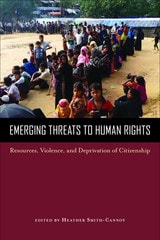
Emerging Threats to Human Rights
Resources, Violence, and Deprivation of CitizenshipHeather Smith-Cannoy
Temple University Press, 2019
As widespread environmental degradation threatens the basic human rights of a large proportion of the world’s population, we are also confronting the worst migration crisis in the modern era. Emerging Threats to Human Rights searches among the interrelated causes of these overlapping crises. The editor and contributors to this timely anthology assess how environmental resources, state violence, and the deprivation of nationality/citizenship are linked to gain a better understanding of how human rights abuses intersect with patterns of migration.
As some refugees flee violence at home, they arrive in an asylum country only to experience violence at the hands of the native population. Likewise, those denied citizenship rights in their country become vulnerable to human traffickers and other rights violations when they flee.
Bringing together scholars of resource dilemmas, violence, and citizenship as well as lawyers and human rights practitioners, Emerging Threats to Human Rights begins by identifying the core causes of human rights violations confronting our world today. Chapters also consider whether and to what extent these emerging threats to human rights serve as drivers of displacement.
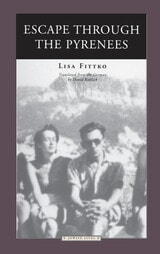
Escape Through the Pyrenees
Lisa Fittko
Northwestern University Press, 2000
Escape Via Berlin
Eluding Franco In Hitler's EuropeJose Antonio Aguirre
University of Nevada Press, 1991
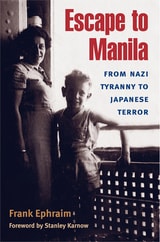
Escape to Manila
From Nazi Tyranny to Japanese TerrorFrank Ephraim. Foreword by Stanley A. Karnow
University of Illinois Press, 2002
A harrowing account of Jewish refugees in the Philippines
With the rise of Nazism in the 1930s more than a thousand European Jews sought refuge in the Philippines, joining the small Jewish population of Manila. When the Japanese invaded the islands in 1941, the peaceful existence of the barely settled Jews filled with the kinds of uncertainties and oppression they thought they had left behind.
In this book Frank Ephraim, who fled to Manila with his parents, gathers the testimonies of thirty-six refugees, who describe the difficult journey to Manila, the lives they built there upon their arrival, and the events surrounding the Japanese invasion. Combining these accounts with historical and archival records, Manila newspapers, and U.S. government documents, Ephraim constructs a detailed account of this little-known chapter of world history.
Ethnic Origins
The Adaptation of Cambodian and Hmong Refugees in Four American CitiesJeremy Hein
Russell Sage Foundation, 2006
Europe and Its Shadows
Coloniality after EmpireHamid Dabashi
Pluto Press, 2019
Frantz Fanon’s assessment that 'Europe is literally the creation of the Third World' is still true today; but in more than one sense for the colonial has always been embedded in the capital, and the capital within the colonial. As the condition of coloniality shifts, so have the dividing lines between coloniser and colonised, and this shift calls for a reappraisal of our understanding of nationalism, xenophobia and sectarianism as the dangerous indices of the emerging worlds.
As the far-right populists captivate minds across Europe and Brexit upsets the balance of power in the European Union, this book, from a major scholar of postcolonial thought, is a timely and transformative intervention.
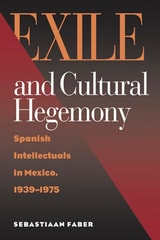
Exile and Cultural Hegemony
Spanish Intellectuals in Mexico, 1939-1975Sebastiaan Faber
Vanderbilt University Press, 2002
The first study of its kind to place the exiles' ideological evolution in a broad historical context, Exile and Cultural Hegemony takes into account developments in both Spanish and Mexican politics from the early 1930s through the 1970s. Faber pays particular attention to the intellectuals' persistent nationalism and misplaced illusions of pan-Hispanist grandeur, which included awkward and ironic overlaps with the rhetoric employed by their enemies on the Francoist right. This embrace of nationalism, together with the intellectuals' dependence on the increasingly authoritarian Mexican regime and the international climate of the Cold War, eventually caused them to abandon the Gramscian ideal of the intellectual as political activist in favor of a more liberal, apolitical stance preferred by, among others, the Spanish philosopher Jose Ortega y Gasset.
With its comprehensive approach to topics integral to Spanish culture, both students of and those with a general interest in twentieth-century Spanish literature, history, or culture will find Exile and Cultural Hegemony a fascinating and groundbreaking work.
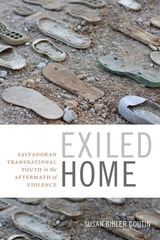
Exiled Home
Salvadoran Transnational Youth in the Aftermath of ViolenceSusan Bibler Coutin
Duke University Press, 2016
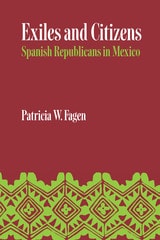
Exiles and Citizens
Spanish Republicans in MexicoBy Patrcia W. Fagen
University of Texas Press, 1973
At the end of the Spanish civil war, Mexico was the only country to offer open refuge to the thousands of Republican emigrés who fled from Spain in 1939–1940. Exiles and Citizens is a study of these political exiles, especially those with intellectual and professional backgrounds and ambitions. It focuses on their adjustment to Mexico, on their continued ties to Spain, and on their impact on Mexican development.
The critical dilemma faced by the Spanish exiles was that, despite having fought for their political and social ideals in Spain, they forfeited in exile their active role in Spanish history. In Mexico they found a political and social system that seemed to include many of the ideals that had inspired the Spanish Republic; moreover, they were able to incorporate themselves economically, professionally, and intellectually into Mexican national life. Yet, because they were not native-born citizens, they had little or no creative part to play in the politics of their adopted country.
For Mexico, the impact of the refugees from Spain was enormous. Integrated from the first into nearly all intellectual, professional, and cultural fields, their skills proved an important catalyst to Mexican development. Yet, outside these fields, Mexico was never an effective "melting pot." The Republicans themselves were divided in their loyalties, and the Mexicans, from the beginning, were reluctant to encourage the full participation of their guests in national affairs.
Two goals were shared by most of the exiles: to ensure that the world would remember the liberal, creative, and open Spain they had created and thus reject Franco; to show their gratitude by working for the benefit and progress of Mexico. These goals, although frequently contradictory, sustained the emigration and gave meaning to exile. The refugees tried to maintain their identity by coming together in formal and informal associations that were intended either to act on behalf of the homeland or to re-create the Spanish Republican structures and values in exile. To maintain a Spanish identity, however, proved difficult, and for the second and third generations in Mexico, the initial goals had already lost their meaning. For them, economic and professional, as well as familial, ties were strongly Mexican.
Spanish Republicans in Mexico represented a fairly rare phenomenon: a large group of skilled, relatively well educated immigrants to a country where persons of their attainments and status were not numerous. Moreover, as political exiles, they approached the problems of acculturation differently from economic emigrants. Patricia Fagen's study thus offers a further understanding of an important exile community and the characteristics that set it apart from other examples of immigrant experiences. In addition, the study sheds new light on the intellectual history of Mexico and the far-reaching effects of the Spanish civil war.