Results by title
79 books match the query 'Religion and science' and 7 start with e
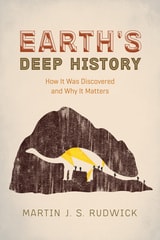
Earth's Deep History
How It Was Discovered and Why It MattersMartin J. S. Rudwick
University of Chicago Press, 2014
Rudwick begins in the seventeenth century with Archbishop James Ussher, who famously dated the creation of the cosmos to 4004 BC. His narrative later turns to the crucial period of the late eighteenth and early nineteenth centuries, when inquisitive intellectuals, who came to call themselves “geologists,” began to interpret rocks and fossils, mountains and volcanoes, as natural archives of Earth’s history. He then shows how this geological evidence was used—and is still being used—to reconstruct a history of the Earth that is as varied and unpredictable as human history itself. Along the way, Rudwick rejects the popular view of this story as a conflict between science and religion and shows how the modern scientific account of the Earth’s deep history retains strong roots in Judaeo-Christian ideas.
Extensively illustrated, Earth’s Deep History is an engaging and impressive capstone to Rudwick’s distinguished career. Though the story of the Earth is inconceivable in length, Rudwick moves with grace from the earliest imaginings of our planet’s deep past to today’s scientific discoveries, proving that this is a tale at once timeless and timely.
Einstein, Polanyi, and the Laws of Nature
Lydia Jaeger
Templeton Press, 2010
What is the relationship between religious belief and the study of nature, between theology and science? This is the fundamental preoccupation of the three different studies in Einstein, Polanyi, and the Laws of Nature.
By exploring the highly original yet little-known thought of Michael Polanyi, Jaeger highlights the inherent personal investment in any quest for knowledge, including the scientific enterprise, thus raising the question of the objectivity of human knowledge. Considered to be the most incredible mind of the twentieth century, Albert Einstein saw scientific research as the fruit of the “cosmic religion.” His response to the question of the relationship between faith and science also receives the close analysis it deserves. Finally, Jaeger is interested in science’s propensity to use the concept of laws of nature, an idea also found in the Bible. She paves the way for interdisciplinary dialogue by examining the similarities and differences.
The synthesis of these three complementary studies brings out the collaboration between belief and knowledge, thus establishing a bridge between two noble human activities: faith and scientific research. It will interest all serious followers of the ongoing science and religion dialogue.
Enriching Our Vision of Reality
Theology and the Natural Sciences in DialogueAlister McGrath
Templeton Press, 2017
“It’s a pleasure to read an introduction to science and Christian belief that is both erudite and accessible. McGrath’s new book is rich with personal examples, biographies of famous scientists and theologians, and effective refutations of their detractors. This invitation to move forward from a bifurcated to an expansive view of reality is recommended for all who seek an ‘integrated understanding’ of science and Christian faith.” —Philip Clayton, editor of The Oxford Handbook of Religion and Science
In this exceptional volume, leading theologian Alister McGrath writes for scientists with an interest in theology, and Christians and theologians who are aware of the importance of the natural sciences. A scene-setting chapter explores the importance of the human quest for intelligibility. The focus then moves to three leading figures who have stimulated discussion about the relationship between science and theology in recent years: Charles Coulson, an Oxford professor of theoretical chemistry who was also a prominent Methodist lay preacher; Thomas F. Torrance, perhaps the finest British theologian of the twentieth-century; and John Polkinghorne, a theoretical physicist and theologian.
The final section of the book features six “parallel conversations” between science and theology, which lay the groundwork for the kind of enriched vision of reality the author hopes to encourage. Here, we are inspired to enjoy individual aspects of nature while seeking to interpret them in the light of deeper revelations about our gloriously strange universe.
Envisioning Nature, Science, and Religion
Jim Proctor
Templeton Press, 2009
Contemporary scholarship has given rise to several modes of understanding biophysical and human nature, each entangled with related notions of science and religion. Envisioning Nature, Science, and Religion represents the culmination of three years of collaboration by an international group of fourteen natural scientists, social scientists, humanists, and theologians. The result is an intellectually stimulating volume that explores how the ideas of nature pertain to science and religion.
Envisioning Nature, Science, and Religion offers a blend of scholarly rigor and readable prose that will be appreciated by anyone engaged in the fields of religion, philosophy, and the natural sciences.
Evidence Of Purpose
Scientists Discover The CreatorJohn Marks Templeton
Templeton Press, 1996
Evolution
The Disguised Friend of Faith?Arthur Peacocke
Templeton Press, 2004
Arthur Peacocke, eminent priest-scientist, has collected thirteen of his essays for this volume. Previously published in various academic journals and edited books, the provocative essays expand upon the theme of the evolution of nature, humanity, and belief. They are grouped into three parts:
- Natural Evolution covers topics ranging from the implications of deterministic chaos; biological evolution and Christian theology; chance, potentiality, and God; complexity, emergence, and divine creativity.
- Humanity Evolving in the Presence of God, articulating God’s presence in and to the world as it is unveiled by the sciences; the chrysalis of the human; the nature and purpose of man in science and Christian theology.
- Theological Evolution—the Reshaping of Belief, dealing with science and the future of theology; public truth in religion; the incarnation of the self-expressive word of God; DNA; and the challenges and possibilities of western theism.
In the epilogue, Dr. Peacocke discusses wisdom in science and education, referring to Robert Grosseteste, a medieval scientist-theologian.
Expanding Humanitys Vision Of God
Robert Herrmann
Templeton Press, 2001
How has our understanding of our world and our place in the universe changed in recent decades through the momentous discoveries of science? Do recent developments in the philosophy of science, which place limitations on scientific knowing, provide a more level playing field? This collection of essays and sermons, which have not been readily available before, address these thought-provoking questions.
The John Templeton Foundation sponsored an essay and sermon contest to convey an expanded vision of God, one that is informed by recent discoveries of science on the nature of the universe and the place we have in the world. These selections are the winners of that competition.
The book is divided into three sections: “Contemporary Science Raising Theological Questions,” “New Visions of Theology,” and “Historical and Philosophical Perspectives on the Science-Religion Dialogue.” The essays cover such areas as physics, theology, cosmology, origins, and artificial intelligence.
“There is another way to conceive our life together. There is another way to conceive of our life in God, but it requires a different worldview—not a clockwork universe in which individuals function as discrete springs and gears, but one that looks more like a luminous web, in which the whole is far more than the parts. In this universe, there is no such thing as an individual apart from his or her relationships. Every interaction—between people and people, between people and things, between things and things—changes the face of history. Life on earth cannot be reduced to four sure-fire rules. It is an ever-unfolding mystery that defies precise prediction. Meanwhile, in this universe, there is no such thing as 'parts‚' The whole is the fundamental unit of reality.” —Barbara Brown Taylor, “Physics and Faith,”