Results by title
71 books match the query 'Revised Edition' and 6 start with e
Ecological and General Systems
An Introduction to Systems Ecology, Revised EditionHoward T. Odum
University Press of Colorado, 1994
First published as Systems Ecology in 1983, Ecological and General Systems proposes principles of self-organization and the designs that prevail by maximizing power and efficiency. Comparisons to fifty other systems languages are provided. Innovative presentations are given on earth homeostasis (Gaia); the inadequacy of presenting equations without network relationships and energy constraints; the alternative interpretation of high entropy complexity as adaptive structure; basic equations of ecological economics; and the energy basis of scientific hierarchy.
Part I introduces energetics, hierarchy, and systems modeling. Part II features design elements: intersections, autocatalytic modules, loops, series, parallel elements, and webs. Part III includes embodied energy, spectra of energy quality, temperature, complexity, spatial distribution, and diversity. Part IV discusses production, consumption, ecosystems, succession, economic systems, anthropological models, urban and regional models, global biogeochemistry, and the universe.

Elementary Classical Greek, Revised Edition
Frederick Williams
Southern Illinois University Press, 2004
Now in paperback for the first time, Elementary Classical Greek is a trusted handbook for learning the language that does not presuppose a knowledge of Latin. Based on the premise that average American students can learn the language, the lessons are thorough but not pedantic, simple but not superficial, and the textbook has been proven in the classroom and for independent learners.
Elementary Classical Greek stresses a clear and orderly presentation of the language, accompanied by individual sentences or short passages that illustrate grammar, give practice in reading, and help build vocabulary. Drawing on decades of experience teaching classical Greek, Frederick Williams presents a text in which grammatical explanations are clear, succinct, and correct and the selected readings are varied, interesting, and useful. Included in the nearly one-hundred reading passages are excerpts from Plato’s Ion and Republic, Aristophanes’s Clouds, and Paul’s first letter to the Corinthians.
The popular textbook is designed for a course meeting for two semesters. There are twenty-four lessons in all, with appendixes on prepositions, Greek numbers, and the Greek verb, plus Greek-English and English-Greek vocabularies, a grammatical index of subjects, and a list of Greek authors cited. Selected readings are presented first in simple, then more complex, language until the reader is led to the actual words of the ancient author—all within the same lesson. This elementary device helps bridge many of the difficult gaps between modern English and ancient Greek.
Enforcement at the EPA
High Stakes and Hard Choices, Revised EditionBy Joel A. Mintz
University of Texas Press, 2012
The only published work that treats the historical evolution of EPA enforcement, this book provides a candid inside glimpse of a crucial aspect of the work of an important federal agency. Based on 190 personal interviews with present and former enforcement officials at EPA, the U.S. Department of Justice, and key congressional staff members—along with extensive research among EPA documents and secondary sources—the book vividly recounts the often tumultuous history of EPA’s enforcement program. It also analyzes some important questions regarding EPA’s institutional relationships and the Agency’s working environment.
This revised and updated edition adds substantial new chapters examining EPA enforcement during the Clinton and George W. Bush administrations. Its treatment of issues of civil service decline and the applicability of captive agency theory is also new and original.
Environmental Politics and Policy in the West, Revised Edition
Zachary A. Smith
University Press of Colorado, 2007
Zachary A. Smith and John Freemuth bring together a roster of top scholars to explicate the issues noted above as well as other key questions in this new edition of Environmental Politics and Policy in the West, which was first published in 1993. This thoroughly revised and updated edition offers a comprehensive and current survey.
Contributors address the policy process as it affects western states, how bureaucracy and politics shape environmental dialogues in the West, how western states innovate environmental policies independently of Washington, and how and when science is involved (or ignored) in management of the West's federal lands. Experts in individual resource areas explore multifaceted issues such as the politics of dam removal and restoration, wildlife resource concerns, suburban sprawl and smart growth, the management of hard-rock mining, and the allocation of the West's tightly limited water resources. Contributors include: Leslie R. Alm, Carolyn D. Baber, Walter F. Baber, Robert V. Bartlett, Hugh Bartling, Matthew A. Cahn, R. McGreggor Cawley, Charles Davis, Sandra Davis, John C. Freemuth, Sheldon Kamieniecki, Matt Lindstrom, William R. Mangun, Denise McCain-Tharnstrom, Daniel McCool, Jaina L. Moan, and Zachary A. Smith.
Ethnographic Film
Revised EditionBy Karl G. Heider
University of Texas Press, 2006
From reviews of the first edition:
“Ethnographic Film can rightly be considered a film primer for anthropologists.”
—Choice
“This is an interesting and useful book about what it means to be ethnographic and how this might affect ethnographic filmmaking for the better. It obviously belongs in all departments of anthropology, and most ethnographic filmmakers will want to read it.”
—Ethnohistory
Even before Robert Flaherty released Nanook of the North in 1922, anthropologists were producing films about the lifeways of native peoples for a public audience, as well as for research and teaching. Ethnographic Film (1976) was one of the first books to provide a comprehensive introduction to this field of visual anthropology, and it quickly became the standard reference.
In this new edition, Karl G. Heider thoroughly updates Ethnographic Film to reflect developments in the field over the three decades since its publication, focusing on the work of four seminal filmmakers—Jean Rouch, John Marshall, Robert Gardner, and Timothy Asch. He begins with an introduction to ethnographic film and a history of the medium. He then considers many attributes of ethnographic film, including the crucial need to present "whole acts," "whole bodies," "whole interactions," and "whole people" to preserve the integrity of the cultural context. Heider also discusses numerous aspects of making ethnographic films, from ethics and finances to technical considerations such as film versus video and preserving the filmed record. He concludes with a look at using ethnographic film in teaching.
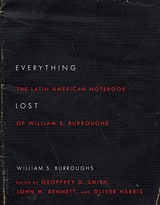
Everything Lost
The Latin American Notebook of William S. Burroughs, Revised EditionWilliam S. Burroughs, Edited by Geoffrey D. Smith, John M. Bennett, and Oliver Harris
The Ohio State University Press, 2017
In late summer 1953, as he returned to Mexico City after a seven-month expedition through the jungles of Ecuador, Colombia, and Peru, William Burroughs began a notebook of final reflections on his four years in Latin America. His first novel, Junkie, had just been published and he would soon be back in New York to meet Allen Ginsberg and together complete the manuscripts of what became The Yage Letters and Queer. Yet this notebook, the sole survivor from that period, reveals Burroughs not as a writer on the verge of success, but as a man staring down personal catastrophe and visions of looming cultural disaster.
Losses that will not let go of him haunt Burroughs throughout the notebook: “Bits of it keep floating back to me like memories of a daytime nightmare.” However, out of these dark reflections we see emerge vivid fragments of Burroughs’ fiction and, even more tellingly, unique, primary evidence for the remarkable ways in which his early manuscripts evolved. Assembled in facsimile and transcribed by Geoffrey D. Smith, John M. Bennett, and Burroughs scholar Oliver Harris, the notebook forces us to change the way we see both Burroughs and his writing at a turning point in his literary career.