Results by title
110 books match the query 'Romanticism' and 3 start with e
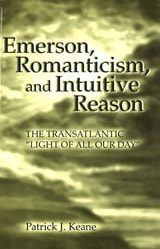
Emerson, Romanticism, and Intuitive Reason
The Transatlantic "Light of All Our Day"Patrick J. Keane
University of Missouri Press, 2005
Emerson, Romanticism, and Intuitive Reason is a comparative study in transatlantic Romanticism, focusing on Emerson’s part in the American dialogue with British Romanticism and, as filtered through Coleridge, German Idealist philosophy. The book’s guiding theme is the concept of intuitive Reason, which Emerson derived from Coleridge’s distinction between Understanding and Reason and which Emerson associated with that “light of all our day” in his favorite stanza of Wordsworth’s “Ode: Intimations of Immortality.” Intuitive Reason became the intellectual and emotional foundation of American Transcendentalism. That light radiated out to illuminate Emerson’s life and work, as well as the complex and often covert relationship of a writer who, however fiercely “self-reliant” and “original,” was deeply indebted to his transatlantic precursors.
The debt is intellectual and personal. Emerson’s supposed indifference to, or triumph over, repeated familial tragedy is often attributed to his Idealism—a complacent optimism that blinded him to any vision of the tragic. His “art of losing” may be better understood as a tribute to the “healing power,” the consolation in distress, which Emerson considered Wordsworth’s principal value. The second part of this book traces Emerson’s struggle—with the help of the “benignant influence” shed by that “light of all our day”—to confront and overcome personal tragedy, to attain the equilibrium epitomized in Wordsworth’s “Elegiac Stanzas”: “Not without hope we suffer and we mourn.”
As a study in what has been called “the paradox of originality,” the book should appeal to those interested in the Anglo-American Romantic tradition and the innovations of the individual talent—especially in the capacity of a writer such as Emerson not only to absorb his precursors but also to use them as a stimulus to his own creative power.
[more]

England in 1819
The Politics of Literary Culture and the Case of Romantic HistoricismJames Chandler
University of Chicago Press, 1998
Many of the writers from 1819, argues James Chandler, were acutely aware not only of their writing's place in history, but also of its place as history—a realization of a literary "spirit of the age" that resonates strongly with the current "return to history" in literary studies. Chandler explores the ties between Romantic and contemporary historicism and offers a series of cases of his own built around key texts from 1819.
"1819? At first sight, it might not seem a 'hot date'; but as James Chandler argues in his powerful book, it would be a mistake to overlook a year of such exceptional political conflagration and literary pyrotechnics in British history. Chandler's study is a wide-ranging, enormously ambitious, densely packed, closely argued work."—John Brewer, New Republic
"The book's largest argument, and the source of its considerable revelations, is that late twentieth-century practices of cultural history-writing have their roots in the peculiar Romantic historicism born in post-Waterloo Britain."—Jon Klancher, Times Literary Supplement
"A monumental work of scholarship."—Terry Eagleton, The Independent
[more]
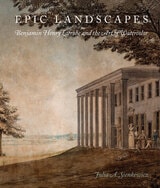
Epic Landscapes
Benjamin Henry Latrobe and the Art of WatercolorJulia Sienkewicz
University of Delaware Press, 2011
Epic Landscapes is the first study devoted to architect Benjamin Henry Latrobe’s substantial artistic oeuvre from 1795, when he set sail from Britain to Virginia, to late 1798, when he relocated to Pennsylvania. Thus, this book offers the only extended consideration of Latrobe’s Virginian watercolors, including a series of complex trompe l’oeil studies and three significant illustrated manuscripts. Though Latrobe’s architecture is well known, his watercolors have received little critical attention. Epic Landscapes rediscovers Latrobe’s watercolors as an ambitious body of work and reconsiders the close relationship between the visual and spatial sensibility of these images and his architectural designs. It also offers a fresh analysis of Latrobe within the context of creative practice in the Atlantic world at the end of the eighteenth century as he explored contemporary ideas concerning the form of art for Republican society and the social impacts of revolution.
Published by University of Delaware Press. Distributed worldwide by Rutgers University Press.
Published by University of Delaware Press. Distributed worldwide by Rutgers University Press.
[more]