Results by title
105 books match the query 'Self' and 3 start with e

Each One Another
The Self in Contemporary ArtRachel Haidu
University of Chicago Press, 2023
With Each One Another, Rachel Haidu argues that contemporary art can teach us how to understand ourselves as selves—how we come to feel oneness, to sense our own interiority, and to shift between the roles that connect us to strangers, those close to us, and past and future generations. Haidu looks to intergenerational pairings of artists to consider how three aesthetic vehicles––shape in painting, characters in film and video, and roles in dance––allow us to grasp selfhood. Better understandings of our selves, she argues, complement our thinking about identity and subjecthood.
She shows how Philip Guston’s figurative works explore shapes’ descriptive capacities and their ability to investigate history, while Amy Sillman’s paintings allow us to rethink expressivity and oneness. Analyzing a 2004 video by James Coleman, Haidu explores how we enter characters through their interior monologues, and she also looks at how a 2011 film by Steve McQueen positions a protagonist’s refusal to speak as an argument for our right to silence. In addition, Haidu examines how Anne Teresa de Keersmaeker’s distribution of roles across dancers invites us to appreciate formal structures that separate us from one another while Yvonne Rainer’s choreography shows how such formal structures also bring us together. Through these examples, Each One Another reveals how artworks allow us to understand oneness, interiority, and how we become fluid agents in the world, and it invites us to examine—critically and forgivingly—our attachments to selfhood.

Eclipse of the Self
The Development of Heidegger’s Concept of AuthenticityMichael E. Zimmerman
Ohio University Press, 1986
Although it is sometimes said that Martin Heidegger’s later philosophy no longer concerned itself with the theme of authenticity so crucial to Being and Time (1927), this book argues that his interest in authenticity was always strong.
After leaving the seminary to become a philosophy student, Heidegger began to “de–mythologize” religious themes for his own philosophical purposes. Like the Christian notion of faith, Heidegger’s notion of authenticity involves relinquishing the egotistical self–understanding which blocks our openness for possibilities. Yet authenticity as “resoluteness” includes an element of voluntarism foreign to the idea of faith. Heidegger’s brief engagement with National Socialism (1933–1934) helped him to re–think the Nietzschean concept of will which had influenced his early views on authenticity. Although part of the meaning of resoluteness is to allow things to be revealed, it also suggests that an individual can somehow will to be authentic. After about 1936, Heidegger emphasized that an individual can only be released from egoism (inauthenticity) by a power which transcends him. The abiding theological issue concerning the efficacy of works as against the saving power of grace finds expression in the distinction between resoluteness and releasement.
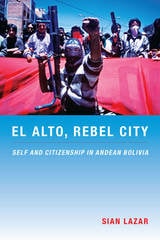
El Alto, Rebel City
Self and Citizenship in Andean BoliviaSian Lazar
Duke University Press, 2007
Drawing on ethnographic fieldwork conducted between 1997 and 2004, Lazar contends that in El Alto, citizenship is a set of practices defined by one’s participation in a range of associations, many of them collectivist in nature. Her argument challenges Western liberal notions of the citizen by suggesting that citizenship is not only individual and national but in many ways communitarian and distinctly local, constituted through different kinds of affiliations. Since in El Alto these affiliations most often emerge through people’s place of residence and their occupational ties, Lazar offers in-depth analyses of neighborhood associations and trade unions. In so doing, she describes how the city’s various collectivities mediate between the state and the individual. Collective organization in El Alto and the concept of citizenship underlying it are worthy of attention; they are the basis of the city’s formidable power to mobilize popular protest.