Results by title
59 books match the query 'Sex customs' and 3 start with e
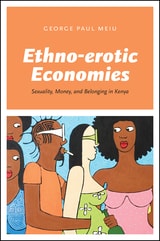
Ethno-erotic Economies
Sexuality, Money, and Belonging in KenyaGeorge Paul Meiu
University of Chicago Press, 2017
George Paul Meiu uses his deep familiarity with the communities these men come from to explore the long-term effects of markets of ethnic culture and sexuality on a wide range of aspects of life in rural Kenya, including kinship, ritual, gender, intimate affection, and conceptions of aging. What happens to these communities when young men return with such surprising wealth? And how do they use it to improve their social standing locally? By answering these questions, Ethno-erotic Economies offers a complex look at how intimacy and ethnicity come together to shape the pathways of global and local trade in the postcolonial world.
Ethnopornography
Sexuality, Colonialism, and Archival KnowledgePete Sigal, Zeb Tortorici, and Neil L. Whitehead, editors
Duke University Press, 2020
Contributors. Joseph A. Boone, Pernille Ipsen, Sidra Lawrence, Beatrix McBride, Mireille Miller-Young, Bryan Pitts, Helen Pringle, Pete Sigal, Zeb Tortorici, Neil L. Whitehead
Evolutionary Rhetoric
Sex, Science, and Free Love in Nineteenth-Century FeminismWendy Hayden
Southern Illinois University Press, 2013
In Evolutionary Rhetoric, scholar Wendy Hayden provides a comprehensive examination of the relationship between scientific and feminist rhetorics in free-love feminism, studying the movement from its inception in the 1850s to its dark turn toward eugenics in the early 1900s. Hayden organizes her provocative study by scientific discipline—evolution, physiology, bacteriology, embryology, and heredity. Each chapter explores how free-love feminists adopted the evidence of that discipline in their arguments for increased sex education, women’s sexual rights, reproductive freedom, and the abolition of a marriage system that repressed the rights and the sexuality of women.
Hayden takes our conventional understanding of the relationship between nineteenth-century feminism and science and expands it. The author provides examples of the powerful words of free-love feminists to show exactly how these exceptional women used science as a rhetorical platform to promote feminist, and often radical, social reforms.
Considering why the free-love movement has not yet been studied, Hayden also discusses how the recovery of this movement may impact larger goals in the recovery of women’s rhetoric. This important and timely study of a long-forgotten movement adds to our understanding of the complexities of the history of feminism.