Results by title
56 books match the query 'Slave trade' and 4 start with e

Economic Change in Precolonial Africa
Supplementary EvidencePhilip D. Curtin
University of Wisconsin Press, 0
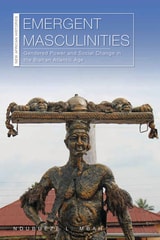
Emergent Masculinities
Gendered Power and Social Change in the Biafran Atlantic AgeNdubueze L. Mbah
Ohio University Press, 2019
In Emergent Masculinities, Ndubueze L. Mbah argues that the Bight of Biafra region’s Atlanticization—or the interaction between regional processes and Atlantic forces such as the slave trade, colonialism, and Christianization—between 1750 and 1920 transformed gender into the primary mode of social differentiation in the region. He incorporates over 250 oral narratives of men and women across a range of social roles and professions with material culture practices, performance traditions, slave ship data, colonial records, and more to reveal how Africans channeled the socioeconomic forces of the Atlantic world through their local ideologies and practices. The gendered struggles over the means of social reproduction conditioned the Bight of Biafra region’s participation in Atlantic systems of production and exchange, and defined the demography of the region’s forced diaspora. By looking at male and female constructions of masculinity and sexuality as major indexes of social change, Emergent Masculinities transforms our understanding of the role of gender in precolonial Africa and fills a major gap in our knowledge of a broader set of theoretical and comparative issues linked to the slave trade and the African diaspora.
Eurafricans in Western Africa
Commerce, Social Status, Gender, and Religious Observance from the Sixteenth to the Eighteenth CenturyGeorge E. Brooks
Ohio University Press, 2003
Eurafricans in Western Africa traces the rich social and commercial history of western Africa. The most comprehensive study to date, it begins prior to the sixteenth century when huge profits made by middlemen on trade in North African slaves, salt, gold, pepper, and numerous other commodities prompted Portuguese reconnaissance voyages along the coast of western Africa. From Senegal to Sierra Leone, Portuguese, including “New Christians” who reverted to Judaism while living in western Africa, thrived where riverine and caravan networks linked many African groups.
Portuguese and their Luso-African descendants contended with French, Dutch, and English rivals for trade in gold, ivory, slaves, cotton textiles, iron bars, cowhides, and other African products. As the Atlantic slave trade increased, French and Franco-Africans and English and Anglo-Africans supplanted Portuguese and Luso-Africans in many African places of trade.
Eurafricans in Western Africa follows the changes that took root in the eighteenth century when French and British colonial officials introduced European legal codes, and concludes with the onset of the French Revolution and Napoleonic Wars, when suppression of the slave trade and expanding commerce in forest and agricultural commodities again transformed circumstances in western Africa.
Professor George E. Brooks’s outstanding history of these vital aspects of western Africa is enriched by his discussion of the roles of the women who married or cohabited with European traders. Through accounts of incidents and personal histories, which are integrated into the narrative, the lives of these women and their children are accorded a prominent place in Professor Brooks’s fascinating discussion of this dynamic region of Africa.
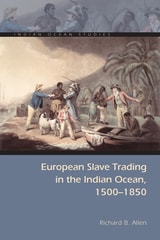
European Slave Trading in the Indian Ocean, 1500–1850
Richard B. Allen
Ohio University Press, 2015
Between 1500 and 1850, European traders shipped hundreds of thousands of African, Indian, Malagasy, and Southeast Asian slaves to ports throughout the Indian Ocean world. The activities of the British, Dutch, French, and Portuguese traders who operated in the Indian Ocean demonstrate that European slave trading was not confined largely to the Atlantic but must now be viewed as a truly global phenomenon. European slave trading and abolitionism in the Indian Ocean also led to the development of an increasingly integrated movement of slave, convict, and indentured labor during the late eighteenth and early nineteenth centuries, the consequences of which resonated well into the twentieth century.
Richard B. Allen’s magisterial work dramatically expands our understanding of the movement of free and forced labor around the world. Drawing upon extensive archival research and a thorough command of published scholarship, Allen challenges the modern tendency to view the Indian and Atlantic oceans as self-contained units of historical analysis and the attendant failure to understand the ways in which the Indian Ocean and Atlantic worlds have interacted with one another. In so doing, he offers tantalizing new insights into the origins and dynamics of global labor migration in the modern world.