Results by title
322 books match the query 'Social Policy' and 9 start with e
Effective Social Science
Eight Cases in Economics, Political Science, and SociologyBernard Barber
Russell Sage Foundation, 1987
Ending Ageism, or How Not to Shoot Old People
Gullette, Margaret Morganroth
Rutgers University Press, 2017
When the term “ageism” was coined in 1969, many problems of exclusion seemed resolved by government programs like Social Security and Medicare. As people live longer lives, today’s great demotions of older people cut deeper into their self-worth and human relations, beyond the reach of law or public policy. In Ending Ageism, or How Not to Shoot Old People, award-winning writer and cultural critic Margaret Morganroth Gullette confronts the offenders: the ways people aging past midlife are portrayed in the media, by adult offspring; the esthetics and politics of representation in photography, film, and theater; and the incitement to commit suicide for those with early signs of “dementia.”
In this original and important book, Gullette presents evidence of pervasive age-related assaults in contemporary societies and their chronic affects. The sudden onset of age-related shaming can occur anywhere—the shove in the street, the cold shoulder at the party, the deaf ear at the meeting, the shut-out by the personnel office or the obtuseness of a government. Turning intimate suffering into public grievances, Ending Ageism, Or How Not to Shoot Old People effectively and beautifully argues that overcoming ageism is the next imperative social movement of our time.
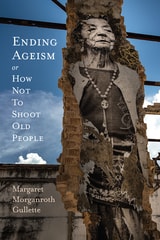
About the cover image:
This elegant, dignified figure--Leda Machado, a Cuban old enough to have seen the Revolution--once the center of a vast photo mural, is now a fragment on a ruined wall. Ageism tears down the structures that all humans need to age well; to end it, a symbol of resilience offers us all brisk blue-sky energy.
“Leda Antonia Machado” from “Wrinkles of the City, 2012.”
Piotr Trybalski / Trybalski.com. Courtesy of the artist.
A Declaration of Grievances
"A Declaration of Grievances" was written by Margaret Morganroth Gullette and is excerpted from her book Ending Ageism, or How Not to Shoot Old People (2017, Rutgers University Press). The poster was designed by Carolyn Kerchof.
- A Declaration of Grievances (in English): https://d3tto5i5w9ogdd.cloudfront.net/wp-content/uploads/2023/01/15175130/A-Declaration-of-Grievances_Eng.pdf
- A Declaration of Grievances (in Spanish): https://d3tto5i5w9ogdd.cloudfront.net/wp-content/uploads/2023/01/15175131/A-Declaration-of-Grievances_Spanish.pdf
- A Declaration of Grievances (in French): https://d3tto5i5w9ogdd.cloudfront.net/wp-content/uploads/2023/01/15175130/A-Declaration-of-Grievances_French.pdf
- A Declaration of Grievances (in German): https://d3tto5i5w9ogdd.cloudfront.net/wp-content/uploads/2023/01/15175131/A-Declaration-of-Grievances_German.pdf
Print the PDF (make sure to click "fit to page") and hang the Declaration up in your home or place of work. Please share this link with other people you know who care about the rights of older persons. Share on social media with the hashtags #ADeclarationOfGrievances and #EndingAgeismGullette.
For more information, an excerpt, links to reviews, and special offers on this book, go to: https://www.rutgersuniversitypress.org/ending-ageism
Related website: (https://www.brandeis.edu/wsrc/scholars/profiles/gullette.html)
Engaging the Intersection of Housing and Health
Volume ThreeEdited by Mina Silberberg
University of Minnesota Press, 2021
Researchers often hope that their work will inform social change. The questions that motivate them to pursue research careers in the first place often stem from observations about gaps between the world as we wish it to be and the world as it is, accompanied by a deep curiosity about how it might be made different. Researchers view their profession as providing important information about what is, what could be, and how to get there. However, if research is to inform social change, we must first change the way in which research is done.
Engaging the Intersection of Housing and Health offers case studies of research that is interdisciplinary, stakeholder-engaged and intentionally designed for “translation” into practice. There are numerous ways in which housing and health are intertwined. This intertwining—which is the focus of this volume—is lived daily by the children whose asthma is exacerbated by mold in their homes, the adults whose mental illness increases their risk for homelessness and whose homelessness worsens their mental and physical health, the seniors whose home environment enhances their risk of falls, and the families who must choose between paying for housing and paying for healthcare.
Equality in the Nordic World
Carsten Jensen
University of Wisconsin Press, 2021
The four types of equality have their origins in unique political compromises made in the twentieth century. The resulting social market economies of these countries affect their growth and levels of equality even today.

Ethical Principles for Social Policy
John Howie
Southern Illinois University Press, 1983
Abortion, euthanasia, racism, sexism, paternalism, the rights of children, the population explosion, and the dynamics of economic growth are examined in the light of ethical principles by leading philosophers in order to suggest reasonable judgments.
Originally prepared for the distinguished Wayne Leys Memorial Lecture Series at Southern Illinois University, Carbondale, the essayists have addressed themselves to the most pressing ethical questions being asked today. William K. Frankena, Professor Emeritus, University of Michigan, in “The Ethics of Respect for Life” argues for a qualified view of moral respect for human personality. From his viewpoint it is always prima facie wrong to shorten or prevent human life, but not always actually wrong as other moral conditions may counter the presumed wrong. The late William T. Blackstone in “Zero Population Growth and Zero Economic Growth” contends that justice will require the production of the maximal level of goods to fulfill basic human needs compatible with the avoidance of ecological catastrophe.
Richard Wasserstrom, Professor of Philosophy at the University of California, Santa Cruz, proposes an assimilationist ideal in “Racism, Sexism, and Preferential Treatment.” Gerald Dworkin, Professor of Philosophy at the University of Illinois, Chicago Circle, dares to ask “Is More Choice Better than Less?” Joel Feinberg, Professor of Philosophy at the University of Arizona, in “The Child’s Right to an Open Future,” offers a defense of “rights-in-trust” of children. Tom L. Beauchamp, Professor of Philosophy and Senior Research Scholar at the Kennedy Institute-Center for Bioethics of Georgetown University, considers the paternalism used to justify social policies in the practice of medicine and insists that it invariably involves a conflict between the ethical principles of beneficence and autonomy.

Everyday Harm
Domestic Violence, Court Rites, and Cultures of ReconciliationMindie Lazarus-Black
University of Illinois Press, 2007
Exposing the powerful contradictions between empowering rights and legal rites
By investigating the harms routinely experienced by the victims and survivors of domestic violence, both inside and outside of law, Everyday Harm studies the limits of what domestic violence law can--and cannot--accomplish. Combining detailed ethnographic research and theoretical analysis, Mindie Lazarus-Black illustrates the ways persistent cultural norms and ingrained bureaucratic procedures work to unravel laws designed to protect the safety of society’s most vulnerable people.
Lazarus-Black’s fieldwork in Trinidad traces a story with global implications about why and when people gain the right to ask the court for protection from violence, and what happens when they pursue those rights in court. Why is itthat, in spite of laws designed to empower subordinated people, so little results from that legislation? What happens in and around courts that makes it so difficult for people to obtain their legally available rights and protections? In the case of domestic violence law, what can such legislation mean for women’s empowerment, gender equity, and protection? How do cultural norms and practices intercept the law?

Evo's Bolivia
Continuity and ChangeBy Linda C. Farthing and Benjamin H. Kohl
University of Texas Press, 2014
In this compelling and comprehensive look at the rise of Evo Morales and Bolivia’s Movimiento al Socialismo (MAS), Linda Farthing and Benjamin Kohl offer a thoughtful evaluation of the transformations ushered in by the western hemisphere’s first contemporary indigenous president. Accessible to all readers, Evo’s Bolivia not only charts Evo’s rise to power but also offers a history of and context for the MAS revolution’s place in the rising “pink tide” of the political left. Farthing and Kohl examine the many social movements whose agendas have set the political climate in Bolivia and describe the difficult conditions the administration inherited. They evaluate the results of Evo’s policies by examining a variety of measures, including poverty; health care and education reform; natural resources and development; and women’s, indigenous, and minority rights. Weighing the positive with the negative, the authors offer a balanced assessment of the results and shortcomings of the first six years of the Morales administration.
At the heart of this book are the voices of Bolivians themselves. Farthing and Kohl interviewed women and men in government, in social movements, and on the streets throughout the country, and their diverse backgrounds and experiences offer a multidimensional view of the administration and its progress so far. Ultimately the “process of change” Evo promised is exactly that: an ongoing and complicated process, yet an important example of development in a globalized world.

Exclusion and Engagement
Social Policy in Latin AmericaEdited by Christopher Abel and Colin M. Lewis
University of London Press, 2002
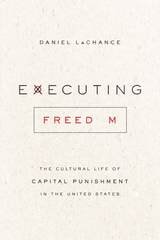
Executing Freedom
The Cultural Life of Capital Punishment in the United StatesDaniel LaChance
University of Chicago Press, 2016
That question is at the heart of Executing Freedom, a powerful, wide-ranging examination of the place of the death penalty in American culture and how it has changed over the years. Drawing on an array of sources, including congressional hearings and campaign speeches, true crime classics like In Cold Blood, and films like Dead Man Walking, Daniel LaChance shows how attitudes toward the death penalty have reflected broader shifts in Americans’ thinking about the relationship between the individual and the state. Emerging from the height of 1970s disillusion, the simplicity and moral power of the death penalty became a potent symbol for many Americans of what government could do—and LaChance argues, fascinatingly, that it’s the very failure of capital punishment to live up to that mythology that could prove its eventual undoing in the United States.