Results by title
70 books match the query 'Social conflict' and 3 start with e
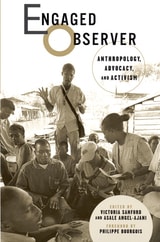
Engaged Observer
Anthropology, Advocacy, and ActivismSanford, Victoria
Rutgers University Press, 2006
Anthropology has long been associated with an ethos of “engagement.” The field’s core methods and practices involve long-term interpersonal contact between researchers and their study participants, giving major research topics in the field a distinctively human face. Can research findings be authentic and objective? Are anthropologists able to use their data to aid the participants of their study, and is that aid always welcome?
In Engaged Observer, Victoria Sanford and Asale Angel-Ajani bring together an international array of scholars who have been embedded in some of the most conflict-ridden and dangerous zones in the world to reflect on the role and responsibility of anthropological inquiry. They explore issues of truth and objectivity, the role of the academic, the politics of memory, and the impact of race, gender, and social position on the research process. Through ethnographic case studies, they offer models for conducting engaged research and illustrate the contradictions and challenges of doing so.
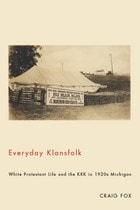
Everyday Klansfolk
White Protestant Life and the KKK in 1920s MichiganCraig Fox
Michigan State University Press, 2011
In 1920s Middle America, the Ku Klux Klan gained popularity not by appealing to the fanatical fringes of society, but by attracting the interest of “average” citizens. During this period, the Klan recruited members through the same unexceptional channels as any other organization or club, becoming for many a respectable public presence, a vehicle for civic activism, or the source of varied social interaction. Its diverse membership included men and women of all ages, occupations, and socio-economic standings. Although surviving membership records of this clandestine organization have proved incredibly rare, Everyday Klansfolk uses newly available documents to reconstruct the life and social context of a single grassroots unit in Newaygo County, Michigan. A fascinating glimpse behind the mask of America’s most notorious secret order, this absorbing study sheds light on KKK activity and membership in Newaygo County, and in Michigan at large, during the brief and remarkable peak years of its mass popular appeal.
Everyday Troubles
The Micro-Politics of Interpersonal ConflictRobert M. Emerson
University of Chicago Press, 2015
To examine these issues, Emerson draws on interviews with college roommates, diaries documenting a wide range of irritation with others, conversations with people caring for family members suffering from Alzheimer’s, studies of family interactions, neighborly disputes, and other personal accounts. He considers how people respond to everyday troubles: in non-confrontational fashion, by making low-visibility, often secretive, changes in the relationship; more openly by directly complaining to the other person; or by involving a third party, such as friends or family. He then examines how some relational troubles escalate toward extreme and even violent responses, in some cases leading to the involvement of outside authorities like the police or mental health specialists.
By calling attention to the range of possible reactions to conflicts in interpersonal relationships, Emerson also reminds us that extreme, even criminal actions often result when people fail to find ways to deal with trouble in moderate, non-confrontational ways. Innovative and insightful, Everyday Troubles is an illuminating look at how we deal with discord in our relationships.