Results by title
72 books match the query 'Social structure' and 4 start with e

Economies of Abandonment
Social Belonging and Endurance in Late LiberalismElizabeth A. Povinelli
Duke University Press, 2011

El Castillo
The Politics of Tradition in an Andalusian TownRichard Maddox
University of Illinois Press, 1993
Maddox argues that we can best understand culture in complex societies by taking into account the ways in which institutionally generated discourses and practices articulate with the informal, improvisational, and commonsense speech and customs that guide the conduct of everyday life. He bases his study on a wide range of published and unpublished materials, including biographies, notarial records, wills, tax and voting lists, historical surveys, records of property transactions and town council meetings, privately held documents, and interviews with men and women of Aracena.
Through a genealogical approach to traditional culture, Maddox demonstrates that traditions repeatedly have been transformed and reinvented in accordance with shifts in relationships of power and in response to changing political and socioeconomic conditions.
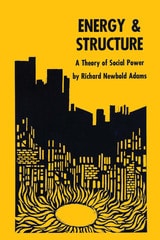
Energy and Structure
A Theory of Social PowerBy Richard Newbold Adams
University of Texas Press, 1975
All social structures are essentially power structures dependent on energy. The concept of power and the role of energy in social organization are crucial and timely concerns, especially in light of the current apprehension about future energy resources. In Energy and Structure, Richard N. Adams argues that social power affects humanity's approach to ecological, economic, and political problems, directing people to seek solutions that are often deceptively shortsighted.
Adams, an anthropologist, proposes that social power is directly derived from control over energy processes. He identifies how power and mentalistic structures constitute fundamental determinants that shape the lives of people at all stages of cultural development, forcing them to accept alternatives often far removed from their desires. His central thesis is that the amount of power in any system varies with the amount of control exercised over the environment and that increasing power and control lead to increasing centralization of decision-making, social marginalization, and environmental despoliation. Thus the more highly developed societies, by virtue of their greater controls, are responsible for the greater ultimate subordination and destruction of human potential, as humanity combines technological advances with a growing inability to exercise good judgment with respect to our own survival.
Energy and Structure begins with an examination of the basic theory of social power—what it is and how it works. Adams defines and differentiates between the concepts of power and control, authority and legitimacy, power domains and levels. He then examines the underlying metatheory of energetic and mentalistic structures and provides an analytic model of the evolution of power, from the primitive band to modern nations. He predicts the emergence of supranational blocs and discusses other future possibilities. Throughout, his theoretical points are solidly supported by examples drawn from a wide range of cultures.
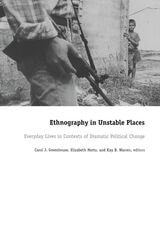
Ethnography in Unstable Places
Everyday Lives in Contexts of Dramatic Political ChangeCarol J. Greenhouse, Elizabeth Mertz, and Kay B. Warren, eds.
Duke University Press, 2002
Using grounded ethnographic detail to explore the challenges to the anthropological imagination that are posed by modern uncertainties, the contributors confront the ambiguities and paradoxes that exist across the spectrum of human cultures and geographies. The collection is framed by introductory and concluding chapters that highlight different dimensions of the book’s interrelated themes—agency and ethnographic reflexivity, identity and ethics, and the inseparability of political economy and interpretivism.
Ethnography in Unstable Places will interest students and specialists in social anthropology, sociology, political science, international relations, and cultural studies.
Contributors. Eve Darian-Smith, Howard J. De Nike, Elizabeth Faier, James M. Freeman, Robert T. Gordon, Carol J. Greenhouse, Nguyen Dinh Huu, Carroll McC. Lewin, Elizabeth Mertz, Philip C. Parnell, Nancy Ries, Judy Rosenthal, Kay B. Warren, Stacia E. Zabusky