Results by title
135 books match the query 'Sociological aspects' and 4 start with e

Embracing Risk
The Changing Culture of Insurance and ResponsibilityEdited by Tom Baker and Jonathan Simon
University of Chicago Press, 2001
For much of the twentieth century, industrialized nations addressed social problems, such as workers' compensation benefits and social welfare programs, in terms of spreading risk. But in recent years a new approach has emerged: using risk both as a way to conceive of and address social problems and as an incentive to reduce individual claims on collective resources.
Embracing Risk explores this new approach from a variety of perspectives. The first part of the book focuses on the interplay between risk and insurance in various historical and social contexts. The second part examines how risk is used to govern fields outside the realm of insurance, from extreme sports to policing, mental health institutions, and international law. Offering an original approach to risk, insurance, and responsibility, the provocative and wide-ranging essays in Embracing Risk demonstrate that risk has moved well beyond its origins in the insurance trade to become a central organizing principle of social and cultural life.
Embracing Risk explores this new approach from a variety of perspectives. The first part of the book focuses on the interplay between risk and insurance in various historical and social contexts. The second part examines how risk is used to govern fields outside the realm of insurance, from extreme sports to policing, mental health institutions, and international law. Offering an original approach to risk, insurance, and responsibility, the provocative and wide-ranging essays in Embracing Risk demonstrate that risk has moved well beyond its origins in the insurance trade to become a central organizing principle of social and cultural life.
[more]

Everynight Life
Culture and Dance in Latin/o AmericaCeleste Fraser Delgado and José Esteban Muñoz, eds.
Duke University Press, 1997
The function of dance in Latin/o American culture is the focus of the essays collected in Everynight Life. The contributors interpret how Latin/o culture expresses itself through dance, approaching the material from the varying perspectives of literary, cultural, dance, performance, queer, and feminist studies. Viewing dance as privileged sites of identity formation and cultural resistance in Latin/o America, Everynight Life translates the motion of bodies into speech, and the gestures of dance into a provocative socio-political grammar.
This anthology looks at many modes of dance—including salsa, merengue, cumbia, rumba, mambo, tango, samba, and norteño—as models for the interplay of cultural memory and regional conflict. Barbara Browning’s essay on capoeira, for instance, demonstrates how dance has been used as a literal form of resistance, while José Piedra explores the meanings conveyed by women of color dancing the rumba. Pieces such as Gustavo Perez Fírmat’s "I Came, I Saw, I Conga’d" and Jorge Salessi’s "Medics, Crooks, and Tango Queens" illustrate the lively scope of this volume’s subject matter.
This anthology looks at many modes of dance—including salsa, merengue, cumbia, rumba, mambo, tango, samba, and norteño—as models for the interplay of cultural memory and regional conflict. Barbara Browning’s essay on capoeira, for instance, demonstrates how dance has been used as a literal form of resistance, while José Piedra explores the meanings conveyed by women of color dancing the rumba. Pieces such as Gustavo Perez Fírmat’s "I Came, I Saw, I Conga’d" and Jorge Salessi’s "Medics, Crooks, and Tango Queens" illustrate the lively scope of this volume’s subject matter.
Contributors. Barbara Browning, Celeste Fraser Delgado, Jane C. Desmond, Mayra Santos Febres, Juan Carlos Quintero Herencia, Josh Kun, Ana M. López, José Esteban Muñoz, José Piedra, Gustavo Perez Fírmat, Augusto C. Puleo, David Román, Jorge Salessi, Alberto Sandoval
[more]
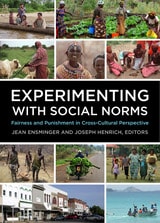
Experimenting with Social Norms
Fairness and Punishment in Cross-Cultural PerspectiveJean Ensminger
Russell Sage Foundation, 2014
Questions about the origins of human cooperation have long puzzled and divided scientists. Social norms that foster fair-minded behavior, altruism and collective action undergird the foundations of large-scale human societies, but we know little about how these norms develop or spread, or why the intensity and breadth of human cooperation varies among different populations. What is the connection between social norms that encourage fair dealing and economic growth? How are these social norms related to the emergence of centralized institutions? Informed by a pioneering set of cross-cultural data, Experimenting with Social Norms advances our understanding of the evolution of human cooperation and the expansion of complex societies. Editors Jean Ensminger and Joseph Henrich present evidence from an exciting collaboration between anthropologists and economists. Using experimental economics games, researchers examined levels of fairness, cooperation, and norms for punishing those who violate expectations of equality across a diverse swath of societies, from hunter-gatherers in Tanzania to a small town in rural Missouri. These experiments tested individuals’ willingness to conduct mutually beneficial transactions with strangers that reap rewards only at the expense of taking a risk on the cooperation of others. The results show a robust relationship between exposure to market economies and social norms that benefit the group over narrow economic self-interest. Levels of fairness and generosity are generally higher among individuals in communities with more integrated markets. Religion also plays a powerful role. Individuals practicing either Islam or Christianity exhibited a stronger sense of fairness, possibly because religions with high moralizing deities, equipped with ample powers to reward and punish, encourage greater prosociality. The size of the settlement also had an impact. People in larger communities were more willing to punish unfairness compared to those in smaller societies. Taken together, the volume supports the hypothesis that social norms evolved over thousands of years to allow strangers in more complex and large settlements to coexist, trade and prosper. Innovative and ambitious, Experimenting with Social Norms synthesizes an unprecedented analysis of social behavior from an immense range of human societies. The fifteen case studies analyzed in this volume, which include field experiments in Africa, South America, New Guinea, Siberia and the United States, are available for free download on the Foundation’s website:www.russellsage.org.
[more]
Explorations in Economic Sociology
Richard Swedberg
Russell Sage Foundation, 1993
Since the mid-1980s, as public discourse has focused increasingly on the troubled economy, many social scientists have argued the need for more analysis of the social relationships that undergird economic life. The original essays in Explorations in Economic Sociology represent the most important work in this renewed field and employ a rich variety of research methods—theoretical, ethnographic, and historical—to illustrate its key concerns. Explorations in Economic Sociology forges innovative social theories of such economic institutions as money, markets, and industry. Although traditional economists have identified markets as driven solely by the forces of supply and demand, social factors frequently intervene. Sales at auction are determined not simply by a seller's personal knowledge of customers. Shareholder attitudes and employee organization influence everything from the way firms borrow money to the way corporate performance is measured. Firms themselves operate in social networks in which trust is a crucial factor in settling the terms for cooperation or competition. Throughout the essays in this volume, the contributors point the way to developing a more healthy economy by fostering productive industrial networks, avoiding disintegration at management levels, and anticipating the consequences of the shift from manufacturing to service industries. Explorations in Economic Sociology is a pioneering work that bridges the gap between social theory and economic analysis and demonstrates the importance of this union in achieving an effective understanding of economic issues. The book should stimulate new interest in economic sociology by bringing together many of its most fundamental voices.
[more]