Results by title
51 books match the query 'Songs and music' and 2 start with e

Ecomusicology
Rock, Folk, and the EnvironmentMark Pedelty
Temple University Press, 2012
Can musicians really make the world more sustainable? Anthropologist Mark Pedelty, joined an eco-oriented band, the Hypoxic Punks, to find out. In his timely and exciting book, Ecomusicology, Pedelty explores the political ecology of rock, from local bands to global superstars. He examines the climate change controversies of U2's 360 Degrees stadium tour—deemed excessive by some—and the struggles of local folk singers who perform songs about the environment. In the process, he raises serious questions about the environmental effects and meanings on music.
Ecomusicology examines the global, national, regional, and historical contexts in which environmental pop is performed. Pedelty reveals the ecological potentials and pitfalls of contemporary popular music, in part through ethnographic fieldwork among performers, audiences, and activists. Ultimately, he explains how popular music dramatically reflects both the contradictions and dreams of communities searching for sustainability.
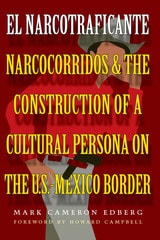
El Narcotraficante
Narcocorridos and the Construction of a Cultural Persona on the U.S.–Mexico BorderBy Mark Cameron Edberg
University of Texas Press, 2004
Since the late 1970s, a new folk hero has risen to prominence in the U.S.-Mexico border region and beyond—the narcotrafficker. Celebrated in the narcocorrido, a current form of the traditional border song known as the corrido, narcotraffickers are often portrayed as larger-than-life "social bandits" who rise from poor or marginalized backgrounds to positions of power and wealth by operating outside the law and by living a life of excess, challenging authority (whether U.S. or Mexican), and flouting all risks, including death. This image, rooted in Mexican history, has been transformed and commodified by the music industry and by the drug trafficking industry itself into a potent and highly marketable product that has a broad appeal, particularly among those experiencing poverty and power disparities. At the same time, the transformation from folk hero to marketable product raises serious questions about characterizations of narcocorridos as "narratives of resistance."
This multilayered ethnography takes a wide-ranging look at the persona of the narcotrafficker and how it has been shaped by Mexican border culture, socioeconomic and power disparities, and the transnational music industry. Mark Edberg begins by analyzing how the narcocorrido emerged from and relates to the traditional corrido and its folk hero. Then, drawing upon interviews and participant-observation with corrido listening audiences in the border zone, as well as musicians and industry producers of narcocorridos, he elucidates how the persona of the narcotrafficker has been created, commodified, and enacted, and why this character resonates so strongly with people who are excluded from traditional power structures. Finally, he takes a look at the concept of the cultural persona itself and its role as both cultural representation and model for practice.