Results by title
53 books match the query 'Southwest' and 3 start with e

Edible and Useful Plants of the Southwest
Texas, New Mexico, and ArizonaBy Delena Tull
University of Texas Press, 2013
All around us there are wild plants useful for food, medicine, and clothing, but most of us don’t know how to identify or use them. Delena Tull amply supplies that knowledge in this book, which she has now expanded to more thoroughly address plants found in New Mexico and Arizona, as well as Texas.
Extensively illustrated with black-and-white drawings and color photos, this book includes the following special features:
- Recipes for foods made from edible wild plants
- Wild teas and spices
- Wild plant dyes, with instructions for preparing the plants and dying wool, cotton, and other materials
- Instructions for preparing fibers for use in making baskets, textiles, and paper
- Information on wild plants used for making rubber, wax, oil, and soap
- Information on medicinal uses of plants
- Details on hay fever plants and plants that cause rashes
- Instructions for distinguishing edible from poisonous berries
- Detailed information on poisonous plants, including poison ivy, oak, and sumac, as well as herbal treatments for their rashes
[more]

Environmentalism and Economic Justice
Two Chicano Struggles in the SouthwestLaura Pulido
University of Arizona Press, 1996
Ecological causes are championed not only by lobbyists or hikers. While mainstream environmentalism is usually characterized by well-financed, highly structured organizations operating on a national scale, campaigns for environmental justice are often fought by poor or minority communities. Environmentalism and Economic Justice is one of the first books devoted to Chicano environmental issues and is a study of U.S. environmentalism in transition as seen through the contributions of people of color. It elucidates the various forces driving and shaping two important examples of environmental organizing: the 1965-71 pesticide campaign of the United Farm Workers and a grazing conflict between a Hispano cooperative and mainstream environmentalists in northern New Mexico. The UFW example is one of workers highly marginalized by racism, whose struggle--as much for identity as for a union contract--resulted in boycotts of produce at the national level. The case of the grazing cooperative Ganados del Valle, which sought access to land set aside for elk hunting, represents a subaltern group fighting the elitism of natural resource policy in an effort to pursue a pastoral lifestyle. In both instances Pulido details the ways in which racism and economic subordination create subaltern communities, and shows how these groups use available resources to mobilize and improve their social, economic, and environmental conditions. Environmentalism and Economic Justice reveals that the environmental struggles of Chicano communities do not fit the mold of mainstream environmentalism, as they combine economic, identity, and quality-of-life issues. Examination of the forces that create and shape these grassroots movements clearly demonstrates that environmentalism needs to be sensitive to local issues, economically empowering, and respectful of ethnic and cultural diversity.
[more]
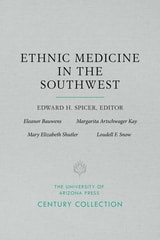
Ethnic Medicine in the Southwest
Edited by Edward H. Spicer; (by) Eleanor Bauwens, Margarita Artschwager Kay, Mary Elizabeth Shutler, and Loudell F. Snow
University of Arizona Press, 1977
Health is a major concern to all people. In this volume, four writers examine the medical arts of Yaqui, Anglo, Black and Mexican American communities to further understand the relationship between alternative and scientific medicine.
Edward H. Spicer's informative Introduction sets the stage for comparing "popular" and "scientific" medicine. "Graduates of medical schools have been taught that their body of knowledge is the one true medical tradition. The world has many medicines and thousands of practitioners who do not believe that "Western" medicine is a universal cure-all. These practitioners may be as certain that what they practice is the one true medical tradition," says Spicer. In the communities studied, the belief is that illnesses may be caused by overwork, withcraft or sin, and treatment may include herbs, prayer, or massage. Practitioners are successful and respected although they are not licenses in the legal sense.
In these alternative medical traditions, "Western" medicine may find a key to new growth and effectiveness. Ethnic Medicine in the Southwest is a fascinating look at commonly practiced arts that will interest not only ethnic and health services specialists but all those interested in cultural traditions.
[more]