Results by title
382 books match the query 'Southwest (AZ, NM, OK, TX)' and 6 start with e
Early Puebloan Occupations at Tesuque By-Pass and in the Upper Rio Grande Valley
Charles H. McNutt
University of Michigan Press, 1969
East Texas Lumber Workers
An Economic and Social Picture, 1870-1950By Ruth A. Allen
University of Texas Press, 1961
In 1950 a million Texans—more than a tenth of the entire population of the state—lived in a region where one family in every two earned less than $2,000 a year. Composing that region are the thirty-two counties of northeastern Texas in which the lumber industry is concentrated. In eleven of these counties, 70 percent of family incomes were less than $2,000.
Until 1930 the Texas lumber industry furnished employment for more workers than any other manufacturing in the state. Though displaced in that year by oil refining, it still ranks near the top in the number of workers it hires. The aim of this study is to show how these people whose economic life has been dominated by a single industry have fared for eighty years in comparison with their fellow Texans and with lumber workers in the Pacific Northwest and the Lakes states.
Texas lumber workers have always been in many ways a peculiar people, conditioned by their historical roots, by isolation from the mainstream of national life, and by the deeply rural nature of their environment. A typical group portrait would show two of each three persons to be adult white males. One of three would be African American. It would not show any women. Here and there a face would bear the marks of alien birth. Most of the figures, however, would be natives not only of America but of East Texas.
In family background, in work experience, and in social and economic environment these people have been uniquely homogeneous. In the early 1950s the Congressional Committee on the Economic Report of the President designated the area as one of “deep poverty” and pinpointed it as one which had failed notably to reach the level of living achieved by the state and the nation. Its economic status has been lower than that of any other group in Texas except household servants, and its education level has been well below that of the state and nation and increasingly below the level of acceptance in any jobs other than those requiring a minimum of training and competence. The immediate past has shown not only no improvement but a positive deterioration.
Drawing upon personal investigation and state and federal reports, the author has put the contemporary situation in a historical setting. Her delineation is principally in terms of figures that weave a social fabric from which definite patterns emerge—insecure wages, illiteracy and inefficient production, unsuccessful attempts to achieve effective organization. Though the book is directed primarily toward those who should feel concern at its revelations, it also suggests a wealth of untapped sources for the ethnographer and the folklorist.
Edward Abbey
A LifeJames M. Cahalan
University of Arizona Press, 2001
It separates fact from fiction, showing that much of the myth surrounding Abbey—such as his birth in Home, Pennsylvania, and later residence in Oracle, Arizona—was self-created and self-perpetuated. It also shows that Abbey cultivated a persona both in his books and as a public speaker that contradicted his true nature: publicly racy and sardonic, he was privately reserved and somber. Author James Cahalan studied all of Abbey’s works and private papers and interviewed many people who knew him—including the models for characters in The Brave Cowboy and The Monkey Wrench Gang—to create a complete picture of the writer’s life. He examines Abbey’s childhood roots in the East and his love affair with the West, his personal relationships and tempestuous marriages, and his myriad jobs in continually shifting locations—including sixteen national parks and forests.
He also explores Abbey’s writing process, his broad intellectual interests, and the philosophical roots of his politics. For Abbey fans who assume that his “honest novel,” The Fool’s Progress, was factual or that his public statements were entirely off the cuff, Cahalan’s evenhanded treatment will be an eye-opener.
More than a biography, Edward Abbey: A Life is a corrective that stands the test of time, showing that Abbey was neither simply a countercultural cowboy hero nor an unprincipled troublemaker, but instead a complex and multifaceted person whose legacy continues to be appreciated. The book contains thirty photographs, capturing scenes ranging from Abbey’s childhood to his burial site.

Ella Elgar Bird Dumont
An Autobiography of a West Texas PioneerEdited by Tommy J. Boley
University of Texas Press, 1988
A crack shot, expert skinner and tanner, seamstress, sculptor, and later writer—a list that only hints at her intelligence and abilities—Ella Elgar Bird Dumont was one of those remarkable women who helped tame the Texas frontier. First married at sixteen to a Texas Ranger, she followed her husband to Comanche Indian country in King County, where they lived in a tepee while participating in the final slaughter of the buffalo. Living off the land until the frontier was opened for ranching, Ella and Tom Bird typified the Old West ideals of self-sufficiency and generosity, with a hesitancy to complain about the hard life in the late 1800s.
Yet, in one important way, Ella Dumont was unsuited for life on the frontier. Endowed with an instinctive desire and ability to carve and sculpt, she was largely prevented from pursuing her talents by the responsibilities of marriage and frontier life and later, widowhood with two small children. Even though her second marriage, to Auguste Dumont, made life more comfortable, the realities of her existence still prevented the fulfillment of her artistic longings.
Ella Bird Dumont’s memoir is rich with details of the frontier era in Texas, when Indian depredations were still a danger for isolated settlers, where animals ranged close enough to provide dinner and a new pair of gloves, and where sheer existence depended on skill, luck, and the kindness of strangers. The vividness and poignancy of her life, coupled with the wealth of historical material in the editor’s exhaustive notes, make this Texas pioneer’s autobiography a very special book.
Environmental City
People, Place, Politics, and the Meaning of Modern AustinBy William Scott Swearingen, Jr.
University of Texas Press, 2010
As Austin grew from a college and government town of the 1950s into the sprawling city of 2010, two ideas of Austin as a place came into conflict. Many who promoted the ideology of growth believed Austin would be defined by economic output, money, and wealth. But many others thought Austin was instead defined by its quality of life. Because the natural environment contributed so much to Austin's quality of life, a social movement that wanted to preserve the city's environment became the leading edge of a larger movement that wanted to retain a unique sense of place. The "environmental movement" in Austin became the political and symbolic arm of the more general movement for place.
This is a history of the environmental movement in Austin—how it began; what it did; and how it promoted ideas about the relationships between people, cities, and the environment. It is also about a deeper movement to retain a sense of place that is Austin, and how that deeper movement continues to shape the way Austin is built today. The city it helped to create is now on the forefront of national efforts to rethink how we build our cities, reduce global warming, and find ways that humans and the environment can coexist in a big city.
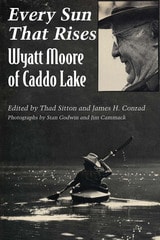
Every Sun That Rises
Wyatt Moore of Caddo LakeEdited by Thad Sitton and James H. Conrad
University of Texas Press, 1985
“What I done and what I been accused of covers everything, you put ’em both together.” Wyatt Moore of Caddo Lake exaggerates, but perhaps not very much. During his long life at Caddo Lake, Moore was at various times a boat operator, commercial fisherman, boat builder, farmer, fishing and hunting camp operator, guide, commercial hunter, trapper, raftsman, moonshiner, oil field worker, water well driller, and mechanical jack-of-all-trades. Still, he always found time for his lifelong study of the natural and human history of Caddo Lake. Here, in words as fresh and forceful as the day they were uttered, is his tale.
Moore, who was given the gift of a unique story to tell and great power to tell it, was the historical interpreter of his strange homeland of Caddo Lake. Twenty-three miles long, some forty thousand acres at high water, stretching across two Texas counties and one Louisiana parish, Caddo Lake’s fresh waters merge into a labyrinthine swamp punctuated by inlets, holes, and geological oddities like Goat Island, Whistleberry Slough, Whangdoodle Pass, and the Devil’s Elbow. Here among these lost reminders of steamboats and old bateau men is Moore’s world.
Born in 1901 at Karnack, Texas, Moore grew up in a time when kids wore button shoes and in a place where pigs and chickens roamed the backyard. He drank his first whiskey at age eight, gigged fish, trapped, and hunted for pearls as a boy, and grew up to an easy assurance on the lake that comes only to those long accustomed to its ways. A walking library of the history of Caddo Lake, Moore delved into almost every nook and corner of it, and wherever he went, whatever he did, he sought to learn more about his subect. Sought out by writers and journalists—among them James Michener and Bill Moyers—because of his laconic wit and remarkable command of the region’s story, Moore became known as a resource as precious as the lake itself. Moore’s story is eloquently introduced by Thad Sitton in an opening essay that chronicles the history of Caddo Lake. Striking photographs of Moore at home and at work on the lake beautifully amplify his life story, and an exuberant word-and-picture essay of Moore expertly building the traditional boat of the region, a bateau, reinforces the vivid image we have of this remarkable man.