59 books match the query 'Southwestern States' and 4 start with e
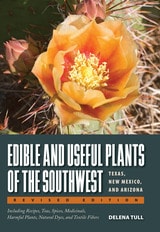
cover of Edible and Useful Plants of the Southwest: Texas, New Mexico, and Arizona

Edible and Useful Plants of the Southwest

Texas, New Mexico, and Arizona

By Delena Tull

University of Texas Press, 2013

All around us there are wild plants useful for food, medicine, and clothing, but most of us don’t know how to identify or use them. Delena Tull amply supplies that knowledge in this book, which she has now expanded to more thoroughly address plants found in New Mexico and Arizona, as well as Texas.

Extensively illustrated with black-and-white drawings and color photos, this book includes the following special features:

  • Recipes for foods made from edible wild plants
  • Wild teas and spices
  • Wild plant dyes, with instructions for preparing the plants and dying wool, cotton, and other materials
  • Instructions for preparing fibers for use in making baskets, textiles, and paper
  • Information on wild plants used for making rubber, wax, oil, and soap
  • Information on medicinal uses of plants
  • Details on hay fever plants and plants that cause rashes
  • Instructions for distinguishing edible from poisonous berries
  • Detailed information on poisonous plants, including poison ivy, oak, and sumac, as well as herbal treatments for their rashes
[more]
cover of Environmentalism and Economic Justice: Two Chicano Struggles in the Southwest

Environmentalism and Economic Justice

Two Chicano Struggles in the Southwest

Laura Pulido

University of Arizona Press, 1996

Ecological causes are championed not only by lobbyists or hikers. While mainstream environmentalism is usually characterized by well-financed, highly structured organizations operating on a national scale, campaigns for environmental justice are often fought by poor or minority communities. Environmentalism and Economic Justice is one of the first books devoted to Chicano environmental issues and is a study of U.S. environmentalism in transition as seen through the contributions of people of color. It elucidates the various forces driving and shaping two important examples of environmental organizing: the 1965-71 pesticide campaign of the United Farm Workers and a grazing conflict between a Hispano cooperative and mainstream environmentalists in northern New Mexico. The UFW example is one of workers highly marginalized by racism, whose struggle--as much for identity as for a union contract--resulted in boycotts of produce at the national level. The case of the grazing cooperative Ganados del Valle, which sought access to land set aside for elk hunting, represents a subaltern group fighting the elitism of natural resource policy in an effort to pursue a pastoral lifestyle. In both instances Pulido details the ways in which racism and economic subordination create subaltern communities, and shows how these groups use available resources to mobilize and improve their social, economic, and environmental conditions. Environmentalism and Economic Justice reveals that the environmental struggles of Chicano communities do not fit the mold of mainstream environmentalism, as they combine economic, identity, and quality-of-life issues. Examination of the forces that create and shape these grassroots movements clearly demonstrates that environmentalism needs to be sensitive to local issues, economically empowering, and respectful of ethnic and cultural diversity.
[more]
cover of Exploring Lost Borders: Critical Essays On Mary Austin

Exploring Lost Borders

Critical Essays On Mary Austin

Melody Graulich

University of Nevada Press, 1999
This is the first book-length collection of essays on Mary Austin's work that covers the range of her writing in varied genres. Austin is revealed as a writer wrestling with issues that continue to challenge us today, including water in the arid West; social and environmental justice as it relates to indigenous peoples, women, and the working class; and the consequences of rigidly hierarchical thinking for western lands and people.
[more]
cover of Extinct Lands, Temporal Geographies: Chicana Literature and the Urgency of Space

Extinct Lands, Temporal Geographies

Chicana Literature and the Urgency of Space

Mary Pat Brady

Duke University Press, 2002

A train station becomes a police station; lands held sacred by Apaches and Mexicanos are turned into commercial and residential zones; freeway construction hollows out a community; a rancho becomes a retirement community—these are the kinds of spatial transformations that concern Mary Pat Brady in Extinct Lands, Temporal Geographies, a book bringing together Chicana feminism, cultural geography, and literary theory to analyze an unusual mix of Chicana texts through the concept of space. Beginning with nineteenth-century short stories and essays and concluding with contemporary fiction, this book reveals how Chicana literature offers a valuable theoretics of space.

The history of the American Southwest in large part entails the transformation of lived, embodied space into zones of police surveillance, warehouse districts, highway interchanges, and shopping malls—a movement that Chicana writers have contested from its inception. Brady examines this long-standing engagement with space, first in the work of early newspaper essayists and fiction writers who opposed Anglo characterizations of Northern Sonora that were highly detrimental to Mexican Americans, and then in the work of authors who explore border crossing. Through the writing of Sandra Cisneros, Cherríe Moraga, Terri de la Peña, Norma Cantú, Monserrat Fontes, Gloria Anzaldúa, and others, Brady shows how categories such as race, gender, and sexuality are spatially enacted and created—and made to appear natural and unyielding. In a spatial critique of the war on drugs, she reveals how scale—the process by which space is divided, organized, and categorized—has become a crucial tool in the management and policing of the narcotics economy.

[more]