Results by title
100 books match the query 'Sovereignty' and 6 start with e
Earthly Plenitudes
A Study on Sovereignty and LaborBruno Gullì
Temple University Press, 2016
Gullì first reviews approaches to sovereignty by philosophers as varied as Gottfried Leibniz and Georges Bataille, and then looks at concrete examples where the alliance of sovereignty and capital cracks under the potency of living labor. He examines contingent academic labor as an example of the super-exploitation of labor, which has become a global phenomenon, and as such, a clear threat to the sovereign logic of capital. Gullì also looks at disability to assert that a new measure of humanity can only be found outside the schemes of sovereignty, productivity, efficiency, and independence, through care and caring for others, in solidarity and interdependence.
Embodiments
From the Body to the Body PoliticJames R. Mensch
Northwestern University Press, 2009
Mensch begins his inquiry by developing a philosophical anthropology based on this concept. He then applies the results of his investigation to the relations of power, authority, freedom, and sovereignty in public life. This involves confronting a line of interpretation, stretching from Hobbes to Agamben, which sees violence as both initiating and preserving the social contract. To contest this interpretation, Mensch argues against its presupposition, which is to equate freedom with sovereignty over others. He does so by understanding political freedom in terms of embodiment—in particular, in terms of the finitude and interdependence that our embodiment entails. Freedom, conceived in these terms, is understood as the gift of others. As a function of our dependence on others, it cannot exist apart from them. To show how public space and civil society presuppose this interdependence is the singular accomplishment of Embodiments. It accomplishes a phenomenological grounding for a new type of political philosophy.
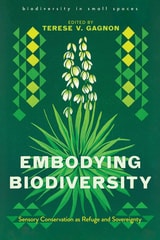
Embodying Biodiversity
Sensory Conservation as Refuge and SovereigntyTerese V. Gagnon
University of Arizona Press, 2024
Harnessing a myriad of methodologies and research spanning multiple continents, this volume delves into the power of everyday forms of biodiversity conservation, motivated by sensory and embodied engagement with plants. Through an array of interdisciplinary contributions, the authors argue that the vast majority of biodiversity conservation worldwide is carried out not by large-scale, hierarchical initiatives but by ordinary people who cultivate sensory-motivated, place-based bonds with plants.
Acknowledging the monumental role of everyday champions in tending biodiversity, the contributors write that this caretaking is crucial to countering ecological harm and global injustice stemming from colonial violence and racial capitalism.
Contributors
Mike Anastario
Ally Ang
Antonia Barreau
Julián Caviedes
Chen Chen
Evelyn Flores
Terese V. Gagnon
José Tomás Ibarra
Fred L. Joiner
Gary Nabhan
Virginia D. Nazarea
Shannon A. Novak
Valentina Peveri
Emily Ramsey
Yasuaki Sato
Justin Simpson
David E. Sutton
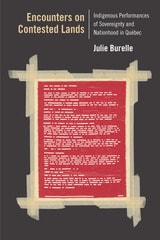
Encounters on Contested Lands
Indigenous Performances of Sovereignty and Nationhood in QuébecJulie Burelle
Northwestern University Press, 2019
Winner, 2020 Ann Saddlemyer Award
Finalist, ATHE Outstanding Book Award for 2020
Mention Spéciale, Société québécoise d'études théâtrale
In Encounters on Contested Lands, Julie Burelle employs a performance studies lens to examine how instances of Indigenous self-representation in Québec challenge the national and identity discourses of the French Québécois de souche—the French-speaking descendants of white European settlers who understand themselves to be settlers no more but rather colonized and rightfully belonging to the territory of Québec.
Analyzing a wide variety of performances, Burelle brings together the theater of Alexis Martin and the film L'Empreinte, which repositions the French Québécois de souche as métis, with protest marches led by Innu activists; the Indigenous company Ondinnok's theater of repatriation; the films of Yves Sioui Durand, Alanis Obomsawin, and the Wapikoni Mobile project; and the visual work of Nadia Myre. These performances, Burelle argues, challenge received definitions of sovereignty and articulate new ones while proposing to the province and, more specifically, to the French Québécois de souche, that there are alternative ways to imagine Québec's future and remember its past.
The performances insist on Québec's contested nature and reframe it as animated by competing sovereignties. Together they reveal how the "colonial present tense" and "tense colonial present" operate in conjunction as they work to imagine an alternative future predicated on decolonization. Encounters on Contested Lands engages with theater and performance studies while making unique and needed contributions to Québec and Canadian studies, as well as to Indigenous and settler-colonial studies.
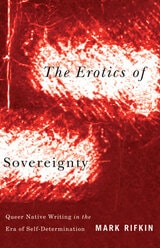
Erotics of Sovereignty
Queer Native Writing in the Era of Self-DeterminationMark Rifkin
University of Minnesota Press, 2012
In 1970 the Nixon administration inaugurated a new era in federal Indian policy. No more would the U.S. government seek to deny and displace Native peoples or dismantle Native governments; from now on federal policy would promote “the Indian’s sense of autonomy without threatening his sense of community.”
In The Erotics of Sovereignty, Mark Rifkin offers a telling perspective on what such a policy of self-determination has meant and looks at how contemporary queer Native writers use representations of sensation to challenge official U.S. accounts of Native identity. Rifkin focuses on four Native writers—Qwo-Li Driskill (Cherokee), Deborah Miranda (Esselen), Greg Sarris (Graton Rachería), and Chrystos (Menominee)—approaching their fiction and poetry as forms of political theory.
Rifkin shows how the work of these queer or two-spirit Native writers affirms the significance of the erotic as an exercise of individual and community sovereignty. In this way, we come to see how their work contests the homophobic, sexist, and exclusivist policies and attitudes of tribal communities as well as those of the nation-state.
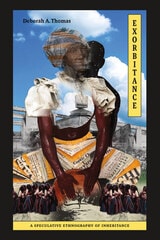
Exorbitance
A Speculative Ethnography of InheritanceDeborah A. Thomas
Duke University Press, 2025