Results by title
244 books match the query 'Study' and 8 start with e
Earthly Plenitudes
A Study on Sovereignty and LaborBruno Gullì
Temple University Press, 2016
Gullì first reviews approaches to sovereignty by philosophers as varied as Gottfried Leibniz and Georges Bataille, and then looks at concrete examples where the alliance of sovereignty and capital cracks under the potency of living labor. He examines contingent academic labor as an example of the super-exploitation of labor, which has become a global phenomenon, and as such, a clear threat to the sovereign logic of capital. Gullì also looks at disability to assert that a new measure of humanity can only be found outside the schemes of sovereignty, productivity, efficiency, and independence, through care and caring for others, in solidarity and interdependence.
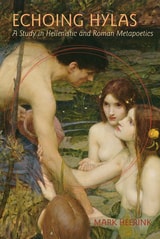
Echoing Hylas
A Study in Hellenistic and Roman MetapoeticsMark Heerink
University of Wisconsin Press, 2015
In Echoing Hylas, Mark Heerink argues that the story of Hylas—a famous episode of the Argonauts' voyage—was used by poets throughout classical antiquity to reflect symbolically on the position of their poetry in the literary tradition. Certain elements of the story, including the characters of Hylas and Hercules themselves, functioned as metaphors of the art of poetry. In the Hellenistic age, for example, the poet Theocritus employed Hylas as an emblem of his innovative
bucolic verse, contrasting the boy with Hercules, who symbolized an older, heroic-epic tradition. The Roman poet Propertius further developed and transformed Theocritus's metapoetical allegory by turning Heracles into an elegiac lover in pursuit of an unattainable object of affection. In this way, the myth of Hylas became the subject of a dialogue among poets across time, from the Hellenistic age to the Flavian era. Each poet, Heerink demonstrates, used elements of the myth to claim his own place in a developing literary tradition.
With this innovative diachronic approach, Heerink opens a new dimension of ancient metapoetics and offers many insights into the works of Apollonius of Rhodes, Theocritus, Virgil, Ovid, Valerius Flaccus, and Statius.
Educational and Psychological Testing
A Study of the Industry and its PracticesMartin Holeman
Russell Sage Foundation, 1972
Eight Words for the Study of Expressive Culture
Edited by Burt Feintuch
University of Illinois Press, 2003
No matter where we are--in academic institutions, in cultural agencies, at home, or in a casual conversation--these are words we use when we talk about creative expression in its cultural contexts. Eight Words for the Study of Expressive Culture is a thoughtful, interdisciplinary examination of the keywords that are integral to the formulation of ideas about the diversity of human creativity, presented as a set of essays by leading folklorists.
Many of us use these eight words every day. We think with them. We teach with them. Much of contemporary scholarship rests on their meanings and implications. They form a significant part of a set of conversations extending through centuries of thought about creativity, meaning, beauty, local knowledge, values, and community. Their natural habitats range across scholarly disciplines from anthropology and folklore to literary and cultural studies and provide the framework for other fields of practice and performance as well.
Eight Words for the Study of Expressive Culture is a much-needed study of keywords that are frequently used but not easily explained. Anchored by Burt Feintuch’s cogent introduction, the book features essays by Dorothy Noyes, Gerald L. Pocius, Jeff Todd Titon, Trudier Harris, Deborah A. Kapchan, Mary Hufford, Henry Glassie, and Roger D. Abrahams.
Elite Oral History Discourse
A Study of Cooperation and CoherenceEva M. McMahan
University of Alabama Press, 1989
Over the past thirty years, oral history has found increasing favor among social scientists and humanists, with scholars “rediscovering” the oral interview as a valuable method for obtaining information about the daily realities and historical consciousness of people, their histories, and their culture. One primary issue is the question of how the communicative performances of the interviewer and narrator jointly influence the interview. Using methods of conversation/discourse analysis, the author describes the collaborative processes that enable interviewers and narrators to interact successfully in the interview context.
Ethnographic Contributions to the Study of Endangered Languages
Edited by Tania Granadillo and Heidi A. Orcutt-Gachiri
University of Arizona Press, 2011
To combat this, indigenous and scholarly communities around the world have undertaken various efforts, from archiving and lexicography to the creation of educational and cultural programs. What works in one community, however, may not work in another. Indeed, while the causes of language endangerment may be familiar, the responses to it depend on “highly specific local conditions and opportunities.” In keeping with this premise, the editors of this volume insist that to understand language endangerment, “researchers and communities must come to understand what is happening to the speakers, not just what is happening to the language.” The eleven case studies assembled here strive to fill a gap in the study of endangered languages by providing much-needed sociohistorical and ethnographic context and thus connecting specific language phenomena to larger national and international issues.
The goal is to provide theoretical and methodological tools for researchers and organizers to best address the specific needs of communities facing language endangerment. The case studies here span regions as diverse as Kenya, Siberia, Papua New Guinea, Mexico, Venezuela, the United States, and Germany. The volume includes a foreword by linguistic anthropologist Jane Hill and an afterword by poet and linguist Ofelia Zepeda.

Eucharistic Presence
A Study in the Theology of DisclosureRobert Sokolowski
Catholic University of America Press, 1994
Expelled to a Friendlier Place
A Study of Effective Alternative SchoolsMartin Gold and David W. Mann
University of Michigan Press, 1984