Results by title
454 books match the query 'Study and teaching (Higher)' and 18 start with e
ENACTing Change
A Handbook for Teaching Advocacy and Civic EngagementKathleen Cole, Robert W. Glover, Richard J. Meagher, and Katharine A. Owens
Brandeis University Press, 2025
ENACT: The Educational Network for Active Civic Transformation aims to teach college students about democracy through engagement with the state legislative process. Built on the values of knowledge, cooperation, justice, and integrity, ENACT is a national, intercollegiate nonpartisan network. The program empowers students to be active participants in democratic processes by connecting with policymakers and community organizations, conducting research and analysis, and informing public policy with evidence and expertise.
ENACTing Change introduces teachers to the philosophy and practice of the ENACT model—which includes workshops, courses, an online network, as well as pilot projects and other initiatives—while providing detailed guidance on how to incorporate the model into their courses, regardless of discipline or educational settings. The book offers instructors recommendations for developing and teaching courses that engage in state-level policy advocacy with a focus on learning outcomes. ENACTing Change takes instructors through each step of the course design process, from how to build the relationships needed to teach the class to the next steps for students to work in the community after ENACT.
Economies of Writing
Revaluations in Rhetoric and CompositionBruce Horner
Utah State University Press, 2016
Economies of Writing advances scholarship on political economies of writing and writing instruction, considering them in terms of course subject, pedagogy, technology, and social practice. Taking the "economic" as a necessary point of departure and contention for the field, the collection insists that writing concerns are inevitably participants in political markets in their consideration of forms of valuation, production, and circulation of knowledge with labor and with capital.
Approaching the economic as plural, contingent, and political, chapters explore complex forces shaping the production and valuation of literacies, languages, identities, and institutions and consider their implications for composition scholarship, teaching, administration, and public rhetorics. Chapters engage a range of issues, including knowledge transfer, cyberpublics, graduate writing courses, and internationalized web domains.
Economies of Writing challenges dominant ideologies of writing, writing skills, writing assessment, language, writing technology, and public rhetoric by revealing the complex and shifting valuations of writing practices as they circulate within and across different economies. The volume is a significant contribution to rhetoric and composition’s understanding of and ways to address its seemingly perennial unease about its own work.
Contributors: Anis Bawarshi, Deborah Brandt, Jenn Fishman, T. R. Johnson, Jay Jordan, Kacie Kiser, Steve Lamos, Donna LeCourt, Rebecca Lorimer Leonard, Samantha Looker, Katie Malcolm, Paul Kei Matsuda, Joan Mullin, Jason Peters, Christian J. Pulver, Kelly Ritter, Phyllis Mentzell Ryder, Tony Scott, Scott Wible, Yuching Jill Yang, James T. Zebroski

Ed School
A Brief for Professional EducationGeraldine Jonçich Clifford and James W. Guthrie
University of Chicago Press, 1988
Drawing on case studies of leading schools of education, the authors offer a bold, controversial agenda for reform: ed schools must reorient themselves toward teachers and away from the quest for prestige in academe; they must also adhere to national professional standards, abandon the undergraduate education major, and reject the Ph.D. in education in favor of the Ed.D.

Educating Economists
David Colander and Reuven Brenner, Editors
University of Michigan Press, 1992
Educating the New Southern Woman
Speech, Writing, and Race at the Public Women's Colleges, 1884-1945David Gold and Catherine L. Hobbs
Southern Illinois University Press, 2014
From the end of Reconstruction through World War II, a network of public colleges for white women flourished throughout the South. Founded primarily as vocational colleges to educate women of modest economic means for life in the emerging “new” South, these schools soon transformed themselves into comprehensive liberal arts–industrial institutions, proving so popular that they became among the largest women’s colleges in the nation. In this illuminating volume, David Gold and Catherine L. Hobbs examine rhetorical education at all eight of these colleges, providing a better understanding of not only how women learned to read, write, and speak in American colleges but also how they used their education in their lives beyond college.
With a collective enrollment and impact rivaling that of the Seven Sisters, the schools examined in this study—Mississippi State College for Women (1884), Georgia State College for Women (1889), North Carolina College for Women (1891), Winthrop College in South Carolina (1891), Alabama College for Women (1896), Texas State College for Women (1901), Florida State College for Women (1905), and Oklahoma College for Women (1908)—served as important centers of women’s education in their states, together educating over a hundred thousand students before World War II and contributing to an emerging professional class of women in the South. After tracing the establishment and evolution of these institutions, Gold and Hobbs explore education in speech arts and public speaking at the colleges and discuss writing instruction, setting faculty and departmental goals and methods against larger institutional, professional, and cultural contexts. In addition to covering the various ways the public women’s colleges prepared women to succeed in available occupations, the authors also consider how women’s education in rhetoric and writing affected their career choices, the role of race at these schools, and the legacy of public women’s colleges in relation to the history of women’s education and contemporary challenges in the teaching of rhetoric and writing.
The experiences of students and educators at these institutions speak to important conversations among scholars in rhetoric, education, women’s studies, and history. By examining these previously unexplored but important institutional sites, Educating the New Southern Woman provides a richer and more complex history of women’s rhetorical education and experiences.

Embedded Librarians
Moving Beyond One-Shot InstructionCassandra Kvenild
Assoc of College & Research Libraries, 2011

Embedding Librarianship In Learning Management Systems
Beth E. Tumbleson
American Library Association, 2013
Embodied Literacies
Imageword and a Poetics of TeachingKristie S. Fleckenstein
Southern Illinois University Press, 2003
Embodied Literacies: Imageword and a Poetics of Teaching is a response to calls to enlarge the purview of literacy to include imagery in its many modalities and various facets. Kristie S. Fleckenstein asserts that all meaning, linguistic or otherwise, is a result of the transaction between image and word. She implements the concept of imageword—a mutually constitutive fusion of image and word—to reassess language arts education and promote a double vision of reading and writing. Utilizing an accessible fourfold structure, she then applies the concept to the classroom, reconfiguring what teachers do when they teach, how they teach, what they teach with, and how they teach ethically.
Fleckenstein does not discount the importance of text in the quest for literacy. Instead, she places the language arts classroom and teacher at the juncture of image and word to examine the ways imagery enables and disables the teaching of and the act of reading and writing. Learning results from the double play of language and image, she argues. Helping teachers and students dissolve the boundaries between text and image, the volume outlines how to see reading and writing as something more than words and language and to disestablish our definitions of literacy as wholly linguistic.
Embodied Literacies: Imageword and a Poetics of Teaching comes at a critical time in our cultural history. Echoing the opinion that postmodernity is a product of imagery rather than textuality, Fleckenstein argues that we must evolve new literacies when we live in a culture saturated by images on computer screens, televisions, even billboards. Decisively and clearly, she demonstrates the importance of incorporating imagery—which is inextricably linked to our psychological, social, and textual lives—into our epistemologies and literacy teaching.
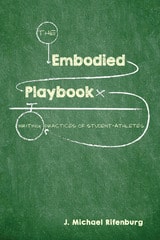
Embodied Playbook
Writing Practices of Student-AthletesJ. Michael Rifenburg
Utah State University Press, 2018
The Embodied Playbook discovers a new approach to understanding student literacy in a surprising place: the university athletics department. Through analysis of a yearlong case study of the men’s basketball team at the University of North Georgia, J. Michael Rifenburg shows that a deeper and more refined understanding of how humans learn through physical action can help writing instructors reach a greater range of students.
Drawing from research on embodiment theory, the nature and function of background knowledge, jazz improvisation, and other unexpected domains, The Embodied Playbook examines a valuable but unexplored form of literacy: the form used by student-athletes when learning and using scripted plays. All students’ extracurricular prior knowledge is vital for the work they undertake in the classroom, and student-athletes understand the strengths and constraints of written text much as they understand the text of game plays: through embodying text and performing it in a competitive space. The book focuses on three questions: What are plays and what do they do? How do student-athletes learn plays? How can teachers of composition and rhetoric better connect with student-athletes?
The Embodied Playbook reveals the literacy of the body as a rich and untapped resource for writing instruction. Given the numbers of students who are involved in athletics, whether intramural, community-related, or extracurricular, Rifenburg’s conclusions hold important implications not only for how we define literacy but also for how writing programs can serve all of their students most effectively.
Emerging Writing Research from the Middle East-North Africa Region
Lisa Arnold
University Press of Colorado, 2017
While events in the Middle East-North Africa region dominate world news, it is an area little understood by the rest of the world—not only historically, politically, and culturally but also within the discipline of Rhetoric and Composition and Second Language Writing. The editors and contributors to this collection share scholarship that addresses how writing programs and writing-across-the-curriculum initiatives—in the region and outside of it—are responding to the increasing globalization of higher education and contributing to international discussions about World Englishes and other language varieties as well as translingual approaches to writing and writing pedagogy.
Contributors: Samer Annous, James P. Austin, William DeGenaro, Rula Diab, Michele Eodice, Juheina Fakhreddine, Aneta Hayes, Tom Highley, Amy Hodges, Rima Iskandarani, Najla Jarkas, Holly Johnson, Brenda Kent, Malakeh Raif Khoury-Khayat, Nasser Mansour, Ryan T. Miller, Maureen O’Day Nicolas, Saman Hussein Omar, Silvia Pessoa, Mysti Rudd, Zane Siraj Sinno, Michael Telafici, Connie Kendall Theado, Martha Townsend, Hacer Hande Uysal, Margaret Willard-Traub
Empathy and the Other
Difference, Connection, and the Teaching of WritingLisa Blankenship
Utah State University Press, 2026
Empathy and the Other: Difference, Connection, and the Teaching of Writing focuses on the theoretical basis for empathy as a pedagogical concern, adding to important conversations happening in writing studies about how to foster empathetic understanding and practices for teachers and students. It offers ways for higher education classrooms to become sites for the cultivation of a critical form of empathy that can help address the most important challenges of our time.
Drawing on the study of empathy in rhetorical theory and related fields, teacher-scholars from a variety of institutions and backgrounds offer pedagogical rationales and approaches for fostering empathetic, inclusive, and antiracist pedagogies centered around five key themes related to empathetic teaching: difference, citizenship, storytelling, assessment, and process. A reflective and critical approach to empathetic teaching—as presented by the authors in this collection—can begin to address forces of social division, particularly in the ways we read and write about others. Teaching grounded in empathetic principles can offer students ways of relating to one another across cultural, religious, class, ethnic, political, and ideological differences.
Empathy and the Other is a companion volume to Enacting Empathy: Stories and Strategies from the Writing Classroom, which features vignettes and praxis pieces focused on classroom experiences and reflections on teaching empathy. The two collections may stand alone or be read together and are of great interest to writing teachers and graduate students invested in social justice in the classroom.
Enacting Empathy
Stories and Strategies from the Writing ClassroomLisa Blankenship
Utah State University Press, 2026
Featuring vignettes and praxis pieces focused on classroom experiences and reflections on teaching empathy, Enacting Empathy: Stories and Strategies from the Composition Classroom provides inspiration and consideration of how and why teachers might adopt an emphasis on empathy. Contributors locate empathy in the particulars of writing assignments, classroom discussions, responses to students, interpretations of texts, and connections with communities.
The challenges and means of understanding one another—as we encounter one another in words, images, and texts—are a central focus of the writing classroom. Teaching for and about empathy has become only more important as we have experienced increased social division, greater recognition and attention to identity, and an emphasis on attending to personal experiences and stories as part of larger efforts to support social justice. With its possibilities for critical reflection and revision, writing is a key tool for developing empathy. Empathy likewise can make us more present, accountable, and socially engaged in our writing. This collection explores how empathy might best be put into practice in the composition classroom, featuring teaching resources, assignment designs, and reflections on empathy and teaching writing for diverse institutional contexts.
The first edited collection in at least thirty years to present strategies for teaching empathy in composition classrooms, Enacting Empathy is a companion volume to Empathy and the Other: Difference, Connection, and the Teaching of Writing, which focuses on the theoretical basis for empathy as a pedagogical concern. The two volumes may stand alone or be read together and are of great interest to writing teachers and graduate students invested in social justice in the classroom.
Engineering Manhood
Race and the Antebellum Virginia Military InstituteJonson Miller
Lever Press, 2020
English Majors at Work
Career and Life PathwaysHelene Meyers
Rutgers University Press, 2027
English Majors at Work: Career and Life Pathways details the professional superpowers—the many marketable skills—gained from studying literature, creative writing, film, and popular culture. It prepares English majors to know themselves and their worth so that they can feed their bodies and souls in rapidly changing 21st century economies. Written for prospective and current English majors as well as recent grads, the book shows that skills associated with the major--innovative thinking, excellent written communication, and the ability to read people, rooms, and data---can sustain lifelong successful careers. It also provides real talk about internships, networking, and graduate school. In keeping with a major that focuses on storytelling and analysis, each chapter concludes with a lively discussion of a relevant literary or media text. English Majors at Work is an essential guide for literature students as well as the professors, career services professionals, and parents who advise them.

Envisioning Brazil
A Guide to Brazilian Studies in the United StatesEdited by Marshall C. Eakin and Paulo Roberto de Almeida
University of Wisconsin Press, 2005
Envisioning Brazil is a comprehensive and sweeping assessment of Brazilian studies in the United States. Focusing on synthesis and interpretation and assessing trends and perspectives, this reference work provides an overview of the writings on Brazil by United States scholars since 1945.
"The Development of Brazilian Studies in the United States," provides an overview of Brazilian Studies in North American universities. "Perspectives from the Disciplines" surveys the various academic disciplines that cultivate Brazilian studies: Portuguese language studies, Brazilian literature, art, music, history, anthropology, Amazonian ethnology, economics, politics, and sociology. "Counterpoints: Brazilian Studies in Britain and France" places the contributions of U.S. scholars in an international perspective. "Bibliographic and Reference Sources" offers a chronology of key publications, an essay on the impact of the digital age on Brazilian sources, and a selective bibliography.

European Higher Education, Social Responsibility, and the Local Democratic Mission
Sjur Bergan
Temple University Press, 2025
Bergan outlines the political and institutional complexity of European universities. He explains how history, cultural traditions, and national identities impact education across Europe. He also describes the roles of the Council of Europe and U.S. higher education in the development of a transatlantic cooperation on the democratic mission of higher education. Other chapters explore education programs for developing and maintaining democracy and human rights, pragmatic and creative ways that European universities are working with their local communities, and the development of education opportunities for refugees.
Ultimately, Bergan’s book explores not only the local democratic mission of higher education as it has developed in Europe, but also how it could continue to develop, and why it is important it does so.
In the series Higher Education, Place, and Social Responsibility.
Evolving Paradigms in Interpreter Education
Elizabeth A. Winston
Gallaudet University Press, 2013
This volume brings together a cadre of world-renowned interpreting educators and researchers who conduct a rich exploration of paradigms, both old and new, in interpreter education. They review existing research, explicate past and current practices, and call for a fresh look at the roots of interpreter education in anticipation of the future. Expert commentary accompanies each chapter to provide a starting point for reflection on and discussion of the growing needs in this discipline.
Volume coeditor Christine Monikowski begins by considering how interpreter educators can balance their responsibilities of teaching, practice, and research. Her chapter is accompanied by commentary about the capacity to “academize” what has been thought of as a semi-profession. Helen Tebble shares research on medical interpreting from an applied linguistic perspective. Terry Janzen follows with the impact of linguistic theory on interpretation research methodology. Barbara Shaffer discusses how interpreting theory shapes the interpreter’s role. Elizabeth A. Winston, also a volume coeditor, rounds out this innovative collection with her chapter on infusing evidence-based teaching practices into interpreting education. Noted interpreter educators and researchers also provide an international range of insights in this collection, including Rico Peterson, Beppie van den Bogaerde, Karen Bontempo, Ian Mason, Ester Leung, David Quinto-Pozos, Lorraine Leeson, Jemina Napier, Christopher Stone, Debra Russell, and Claudia Angelelli.
Expanding historical counsciousness
the development of the Holocaust Educational FoundationAnita. Weiner
Northwestern University Press, 2003