Results by title
105 books match the query 'Sustainable development' and 7 start with e

Earth in Our Care
Ecology, Economy, and SustainabilityMaser, Chris
Rutgers University Press, 2009
So writes Chris Maser in this compelling study of three interactive spheres of the ecosystem: atmosphere (air), litho-hydrosphere (rock that comprises the restless continents and the water that surrounds them), and biosphere (all life sandwiched in between).
Rich in detail and insightful analogies, Earth in Our Care addresses key issues including land-use policies, ecological restoration, forest management, local living, and sustainability thinking. Exploring our interconnectedness with the Earth, Maser examines today's problems and, more importantly, provides solutions for the future.

Eco-Sufficiency and Global Justice
Women Write Political EcologyEdited by Ariel Salleh
Pluto Press, 2009
As the twenty-first century faces a crisis of democracy and sustainability, this book attempts to bring academics and alternative globalisation activists into conversation.
Through studies of global neoliberalism, ecological debt, climate change, and the ongoing devaluation of reproductive and subsistence labour, these uncompromising essays by internationally distinguished women thinkers expose the limits of current scholarship in political economy, ecological economics, and sustainability science.
The book introduces groundbreaking theoretical concepts for talking about humanity-nature links and will be a challenging read for activists and for students of political economy, environmental ethics, global studies, sociology, women's studies, and critical geography.
Economics of Research and Innovation in Agriculture
Edited by Petra Moser
University of Chicago Press, 2021
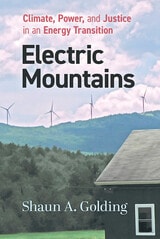
Electric Mountains
Climate, Power, and Justice in an Energy TransitionShaun A. Golding
Rutgers University Press, 2021
Committed environmentalists in one of North America’s most progressive regions desperately wanted energy policies that address the climate crisis. For many of them, wind turbines on Northern New England’s iconic ridgelines symbolize the energy transition that they have long hoped to see. For others, however, ridgeline wind takes on a very different meaning. When weighing its costs and benefits locally and globally, some wind opponents now see the graceful structures as symbols of corrupted energy politics.
This book derives from several years of research to make sense of how wind turbines have so starkly split a community of environmentalists, as well as several communities. In doing so, it casts a critical light on the roadmap for energy transition that Northern New England’s ridgeline wind projects demarcate. It outlines how ridgeline wind conforms to antiquated social structures propping up corporate energy interests, to the detriment of the swift de-carbonizing and equitable transformation that climate predictions warrant. It suggests, therefore, that the energy transition of which most of us are a part, is probably not the transition we would have designed ourselves, if we had been asked.
Environmentalism and Economic Justice
Two Chicano Struggles in the SouthwestLaura Pulido
University of Arizona Press, 1996

Environmentality
Technologies of Government and the Making of SubjectsArun Agrawal
Duke University Press, 2005
Agrawal brings environment and development studies, new institutional economics, and Foucauldian theories of power and subjectivity to bear on his ethnographical and historical research. He visited nearly forty villages in Kumaon, where he assessed the state of village forests, interviewed hundreds of Kumaonis, and examined local records. Drawing on his extensive fieldwork and archival research, he shows how decentralization strategies change relations between states and localities, community decision makers and common residents, and individuals and the environment. In exploring these changes and their significance, Agrawal establishes that theories of environmental politics are enriched by attention to the interconnections between power, knowledge, institutions, and subjectivities.
Exploring Degrowth
A Critical GuideVincent Liegey
Pluto Press, 2020
As politicians and corporations obsess over growth objectives, the degrowth movement demands that we must slow down the economy by transforming our economies, our politics and our cultures to live within the Earth's limits.
This book navigates the practice and strategies of the movement, looking at its strengths and weaknesses. Covering horizontal democracy, local economies and the reduction of work, it shows us why degrowth is a compelling and realistic project.