Results by title
129 books match the query 'Technique' and 2 start with e

Engraving the Savage
The New World and Techniques of CivilizationMichael Gaudio
University of Minnesota Press, 2008
In 1585, the British painter and explorer John White created images of Carolina Algonquian Indians. These images were collected and engraved in 1590 by the Flemish publisher and printmaker Theodor de Bry and were reproduced widely, establishing the visual prototype of North American Indians for European and Euro-American readers.
In this innovative analysis, Michael Gaudio explains how popular engravings of Native American Indians defined the nature of Western civilization by producing an image of its “savage other.” Going beyond the notion of the “savage” as an intellectual and ideological construct, Gaudio examines how the tools, materials, and techniques of copperplate engraving shaped Western responses to indigenous peoples. Engraving the Savage demonstrates that the early visual critics of the engravings attempted-without complete success-to open a comfortable space between their own “civil” image-making practices and the “savage” practices of Native Americans-such as tattooing, bodily ornamentation, picture-writing, and idol worship. The real significance of these ethnographic engravings, he contends, lies in the traces they leave of a struggle to create meaning from the image of the American Indian.
The visual culture of engraving and what it shows, Gaudio reasons, is critical to grasping how America was first understood in the European imagination. His interpretations of de Bry’s engravings describe a deeply ambivalent pictorial space in between civil and savage-a space in which these two organizing concepts of Western culture are revealed in their making.
Michael Gaudio is assistant professor of art history at the University of Minnesota.
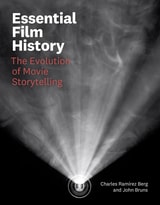
Essential Film History
The Evolution of Movie StorytellingCharles Ramírez Berg and John Bruns
University of Texas Press, 2026
A guide to the fundamentals of understanding film history, filmmaking, and film appreciation.
Film is not just a medium; it is also a language—and a global one at that. Essential Film History describes how this language emerged and how it has matured over the course of more than 125 years. Beginning with the experiments of the late nineteenth century, and tracking the development of cinematic storytelling, commercial distribution, and audience reception into the era of digital recording, Charles Ramírez Berg and John Bruns offer a comprehensive course in both the history and artistry of film.
Essential Film History breaks cinematic language into three core components: image, sound, and narrative. Between the 1890s and 1940s, this audiovisual language both consolidated and spread, becoming comprehensible worldwide. Since then, filmmakers have adapted and extended the language of cinema to suit an ever-growing range of aesthetic and narrative projects, from documentaries and full-length animation to avant-garde and made-for-TV movies. Covering major figures, studios, and events as well as key technological and sociopolitical developments, Essential Film History is an indispensable guide to the evolution of cinematic style.