Results by title
248 books match the query 'Theology' and 11 start with e
Eighty-three Different Questions
Saint Augustine
Catholic University of America Press, 1982
Enriching Our Vision of Reality
Theology and the Natural Sciences in DialogueAlister McGrath
Templeton Press, 2017
“It’s a pleasure to read an introduction to science and Christian belief that is both erudite and accessible. McGrath’s new book is rich with personal examples, biographies of famous scientists and theologians, and effective refutations of their detractors. This invitation to move forward from a bifurcated to an expansive view of reality is recommended for all who seek an ‘integrated understanding’ of science and Christian faith.” —Philip Clayton, editor of The Oxford Handbook of Religion and Science
In this exceptional volume, leading theologian Alister McGrath writes for scientists with an interest in theology, and Christians and theologians who are aware of the importance of the natural sciences. A scene-setting chapter explores the importance of the human quest for intelligibility. The focus then moves to three leading figures who have stimulated discussion about the relationship between science and theology in recent years: Charles Coulson, an Oxford professor of theoretical chemistry who was also a prominent Methodist lay preacher; Thomas F. Torrance, perhaps the finest British theologian of the twentieth-century; and John Polkinghorne, a theoretical physicist and theologian.
The final section of the book features six “parallel conversations” between science and theology, which lay the groundwork for the kind of enriched vision of reality the author hopes to encourage. Here, we are inspired to enjoy individual aspects of nature while seeking to interpret them in the light of deeper revelations about our gloriously strange universe.
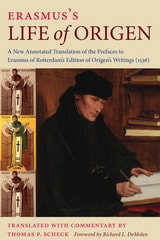
Erasmus's Life of Origen
Thomas P. Scheck
Catholic University of America Press, 2016
Eric Voegelin and the Problem of Christian Political Order
Jeffrey C. Herndon
University of Missouri Press, 2007
Although some critics of Eric Voegelin’s later work have faulted his failure to deal with the historical Jesus and to address the implications of Christianity for social and political life, the recent publication of Voegelin’s History of Political Ideas has allowed a more complete assessment of his position regarding the Christian political order. This book addresses that criticism through an analysis of Voegelin’s early work.
In Eric Voegelin and the Problem of Christian Political Order, Jeffrey C. Herndon analyzes the development of Voegelin’s thought regarding the origins of Christianity in the person of Jesus, the development of the church in the works of Paul, and the relationship between an immanent institutional order symbolizing the divine presence and the struggle for social and political order. Focusing on the tension between a spiritual phenomenon based on Pauline faith and the institutionalization of that experience in the church, Herndon offers one of the first examinations of the relationship of the History of Political Ideas to Voegelin’s larger body of work.
In his wide-ranging study, Herndon explores Voegelin’s examination of the problem of Christian political order from the inception of Christianity through the Great Reformation. He also presents a clarification of Voegelin’s theory of civilizational foundation and of Voegelin’s philosophy of history with regard to Christianity and Western political order.
Herndon addresses not only the nagging problem in Voegelin scholarship regarding his relationship with the historical Jesus but also the “Pauline compromises with the world” that enabled Christianity to become the instrument by which the West was civilized. He also shows that Voegelin’s interpretation of the historical pressures released by the Great Reformation is important to an understanding of his later work regarding the negative effect of Christian symbols in the creation of ideological disorder.
Eric Voegelin and the Problem of Christian Political Order clarifies issues in Voegelin studies regarding the intersection between political theory and Christian concerns, addressing the relation of religious experience to the public sphere of political life in the West and helping to explain Voegelin’s contention that the death of the spirit is the price of progress. It offers scholars a perspective heretofore lacking in Voegelin scholarship and a clearer view of Voegelin’s understanding of the Christian dispensation and its influence on the course of Western development, history, and philosophy.
Erotic Attunement
Parenthood and the Ethics of Sensuality between UnequalsCristina L. H. Traina
University of Chicago Press, 2011
Heightened awareness of the problem of sexual abuse has led to deep anxiety over adults touching children—in nearly any context. Though our society has moved toward increasingly strict enforcement of this taboo, studies have shown that young children need regular human contact, and the benefits of breastfeeding have been widely extolled. Exploring the complicated history of love, desire, gender, sexuality, parenthood, and inequality, Erotic Attunement probes the disquieting issue of how we can draw a clear line between natural affection toward children and perverse exploitation of them.
Cristina L. H. Traina demonstrates that we cannot determine what is wrong about sexual abuse without first understanding what is good about appropriate sensual affection. Pondering topics such as the importance of touch in nurturing children, the psychology of abuse and victimhood, and recent ideologies of motherhood, she argues that we must expand our philosophical and theological language of physical love and make a distinction between sexual love and erotic love. Taking on theological and ethical arguments over the question of sexuality between unequals, she arrives at the provocative conclusion that it can be destructive to completely bar eroticism from these relationships.
Erring
A Postmodern A/theologyMark C. Taylor
University of Chicago Press, 1984
"Many have felt the need for a study which would explicate in coherent and accessible fashion the principal tenets of deconstruction, with particular attention to their theological implications. This need the author has addressed in a most impressive manner. The book's effect upon contemporary discussion is apt to be, and deserves to be, far-reaching."—Walter Lowe, Journal of Religion
Essays in Jewish Thought
Nahum Glatzer
University of Alabama Press, 2009
An exploration of the ideas that have shaped Jewish faith, culture, and identity.
In Essays in Jewish Thought, renowned scholar Nahum N. Glatzer offers a thoughtful and illuminating exploration of the intellectual, spiritual, and cultural traditions that have shaped Judaism across centuries. Drawing upon his deep knowledge of Jewish history, philosophy, theology, and literature, Glatzer examines the ideas, texts, and personalities that have influenced Jewish religious life and identity from antiquity to the modern era.
Through a collection of insightful essays, readers encounter enduring questions concerning faith, ethics, revelation, community, and the relationship between tradition and modernity. Glatzer's scholarship highlights the richness and diversity of Jewish thought while demonstrating how Jewish thinkers have engaged with changing historical circumstances and universal human concerns. His clear and accessible writing makes complex philosophical and theological concepts approachable without sacrificing intellectual depth.
Essays in Jewish Thought provides a valuable introduction to key themes in Jewish intellectual history and offers fresh perspectives for both newcomers and seasoned students of Judaism. The volume serves as a meaningful resource for understanding the foundations of Jewish belief, practice, and cultural continuity. Ideal for courses in Jewish studies, religious studies, theology, and philosophy, this collection remains an important contribution to the study of one of the world's most enduring religious and intellectual traditions.
Ethics from a Theocentric Perspective, Volume 1
Theology and EthicsJames M. Gustafson
University of Chicago Press, 1983
Ethics from a Theocentric Perspective, Volume 2
Ethics and TheologyJames M. Gustafson
University of Chicago Press, 1984
"Breadth and subtlety, wisdom and insight . . . Gustafson is a first-rate theologian."—Commonweal
"The two-volume work, now complete, will be a benchmark for discussions of Christian ethics for years to come. With it Gustafson becomes one of the thinkers by whom others can, by agreement or divergence, define their own ethics."—Roger L. Shinn, Christianity and Crisis
"Gustafson's theocentrism is an original and creative contribution to modern ethical discussion."—Douglas Sturm, Ethics

Eucharistic Presence
A Study in the Theology of DisclosureRobert Sokolowski
Catholic University of America Press, 1994
Eusebius of Emesa
Church and Theology in the Mid-Fourth CenturyRobert E. Winn
Catholic University of America Press, 2011