Results by title
82 books match the query 'Tourism' and 4 start with e
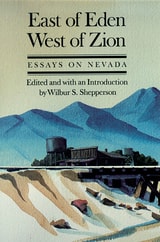
East Of Eden, West Of Zion
Essays On NevadaWilbur S. Shepperson
University of Nevada Press, 1989
A collection of essays in which a dozen historians and novelists present their impressions and concerns about "end of the century Nevada." Human expectations and illusions are seen as a backdrop for today's Nevada as a new human frontier. As an overview of Nevada society, this study deals with culture as well as economics, with tradition as well as rapid population growth. The essayists inquire whether the friction between acquisition and preservation, quick wealth and refined sensitivity, will build a more humane and enlightened society.
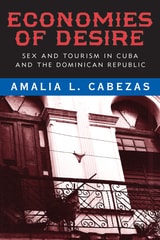
Economies of Desire
Sex and Tourism in Cuba and the Dominican RepublicAmalia L. Cabezas
Temple University Press, 2009
Is a native-born tour guide who has sex with tourists—in exchange for dinner or gifts or cash—merely a prostitute or gigolo? What if the tourist continues to send gifts or money to the tour guide after returning home? As this original and provocative book demonstrates, when it comes to sex—and the effects of capitalism and globalization —nothing is as simple as it might seem.
Based on ten years of research, Economies of Desire is the first ethnographic study to examine the erotic underpinnings of transnational tourism. It offers startling insights into the commingling of sex, intimacy, and market forces in Cuba and the Dominican republic, two nations where tourism has had widespread effects. In her multi-layered analyses, amalia cabezas reconceptualizes our understandings of informal economies (particularly "affective economies"), "sex workers," and “sexual tourism,” and she helps us appreciate how money, sex and love are intertwined within the structure of globalizing capitalism.
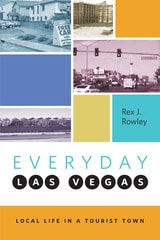
Everyday Las Vegas
Local Life in a Tourist TownRex J. Rowley
University of Nevada Press, 2014
Rowley considers such topics as why people move to Las Vegas, the nature of their work and personal lives, the impact of growth and rapid change, and interaction with the overwhelmingly touristic side of the city. He also considers the benefits and perils of living in a nonstop twenty-four-hour city rich in entertainment options and easy access to gambling, drugs, and other addictions. His examination includes the previously unstudied role of neighborhood casinos patronized by locals rather than tourists and the impact that a very mobile population has on schools, churches, and community life.
Rowley considers the very different ways people perceive a place as insiders or outsiders, a dichotomy that arises when tourism is a mainstay of the local economy. His work offers insights into what Las Vegas can teach us about other cities and American culture in general. It also contributes to our understanding of how people relate to places and how the personality of a place influences the lives of people who live there.
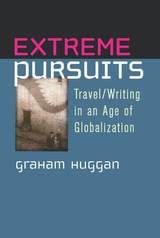
Extreme Pursuits
Travel/Writing in an Age of GlobalizationGraham Huggan
University of Michigan Press, 2009
Recent figures suggest that there will be 1.6 billion arrivals at world airports by the year 2020. Extreme Pursuits looks at the new conditions of global travel and the unease, even paranoia, that underlies them---at the opportunities they offer for alternative identities and their oscillation between remembered and anticipated states. Graham Huggan offers a provocative account of what is happening to travel at a time characterized by extremes of social and political instability in which adrenaline-filled travelers appear correspondingly determined to take risks. It includes discussions of the links between tourism and terrorism, of contemporary modes of disaster tourism, and of the writing that derives from these; but it also confirms the existence of more responsible forms of travel/writing that demonstrate awareness of a chronically endangered world.
Extreme Pursuits is the first study of its kind to link travel writing explicitly with structural changes in the global tourist industry. The book makes clear that travel writing can no longer take refuge in the classic distinctions (traveler versus tourist, foreigner versus native) on which it previously depended. Such distinctions---which were dubious in the first place---no longer make sense in an increasingly globalized world. Huggan argues accordingly that the category "travel writing" must include experimental ethnography and prose fiction; that it should concern itself with other kinds of travel practices, such as those related to Holocaust deportation and migrant labor; and that it should encompass representations of travelers and "traveling cultures" that appear in popular media, especially TV and film.
Graham Huggan is Professor of Commonwealth and Postcolonial Literatures at the University of Leeds. He is the coauthor, with Patrick Holland, of Tourists with Typewriters: Critical Reflections on Contemporary Travel Writing (University of Michigan Press) and coauthor, with Helen Tiffin, of Postcolonial Ecocriticism (Routledge).
Illustration: "Shadow Wall," 2006 © Shaun Tan.