Results by title
89 books match the query 'Transgender Studies' and 3 start with e
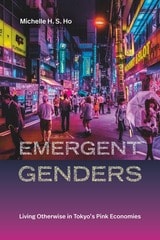
Emergent Genders
Living Otherwise in Tokyo's Pink EconomiesMichelle H. S. Ho
Duke University Press, 2025
In Emergent Genders, Michelle H. S. Ho traces the genders manifesting alongside Japanese popular culture in Akihabara, an area in Tokyo renowned for the fandom and consumption of anime, manga, and games. Drawing on ethnographic fieldwork in josō and dansō cafe-and-bars, establishments where male-to-female and female-to-male crossdressing is prevalent, Ho shows how their owners, employees, and customers creatively innovate what she calls emergent genders—new practices, categories, and ways of being stemming from the simultaneous fracturing, contestations, and (re)imaginations of older forms of gender and sexual variance in Japan. Such emergent genders initiate new markets for alternative categories of expression and subjectivity to thrive in a popular cultural hub like Akihabara instead of Tokyo’s gay and lesbian neighborhood of Shinjuku Ni-chōme. By rethinking identitarian models of gender and sexuality, reconfiguring the significance of capitalism for trans studies and queer theory, and decentering theoretical frameworks incubated in a predominantly United States academic context, Ho offers new ways of examining how trans and gender nonconforming individuals may survive and flourish under capitalism.
[more]
Envisioning African Intersex
Challenging Colonial and Racist Legacies in South African MedicineAmanda Lock Swarr
Duke University Press, 2023
Since the 1600s, travelers, scientists, and doctors have claimed that “hermaphroditism” and intersex are disproportionately common among black South Africans. In Envisioning African Intersex Amanda Lock Swarr debunks this claim by interrogating contemporary intersex medicine and demonstrating its indivisibility from colonial ideologies and scientific racism. Tracing the history of racialized research that underpins medical and scientific premises of gendered bodies, Swarr analyzes decolonial actions by intersex South Africans from the 1990s to the present, centering the work of organizers such as Sally Gross, the first openly intersex activist in Africa and a global pioneer of intersex legislation. Swarr also explores African social media activism that advocates for intersex justice and challenges the mistreatment of South African Olympian Caster Semenya. Throughout, Swarr shows how activists displace doctors’ impositions to fashion self-representation. By unseating colonial visions of gender, intersex South Africans are actively disrupting medical violence, decolonizing gender binaries, and inciting policy changes.
All author royalties from Envisioning African Intersex will be donated to Intersex South Africa.
All author royalties from Envisioning African Intersex will be donated to Intersex South Africa.
[more]

Everyday Violence
The Public Harassment of Women and LGBTQ PeopleSimone Kolysh
Rutgers University Press, 2021
Everyday Violence is based on ten years of scholarly rage against catcalling and aggression directed at women and Lesbian, Gay, Bisexual, Transgender and Queer (LGBTQ) people of New York City. Simone Kolysh recasts public harassment as everyday violence and demands an immediate end to this pervasive social problem. Analyzing interviews with initiators and recipients of everyday violence through an intersectional lens, Kolysh argues that gender and sexuality, shaped by race, class, and space, are violent processes that are reproduced through these interactions in the public sphere. They examine short and long-term impacts and make inroads in urban sociology, queer and trans geographies, and feminist thought. Kolysh also draws a connection between public harassment, gentrification, and police brutality resisting criminalizing narratives in favor of restorative justice. Through this work, they hope for a future where women and LGBTQ people can live on their own terms, free from violence.
[more]