Results by title
94 books match the query 'Transnationalism' and 2 start with e
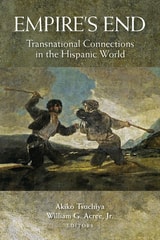
Empire's End
Transnational Connections in the Hispanic WorldAkiko Tsuchiya
Vanderbilt University Press, 2015
The fall of the Spanish Empire: that period in the nineteenth century when it lost its colonies in Spanish America and the Philippines. How did it happen? What did the process of the "end of empire" look like? Empire's End considers the nation's imperial legacy beyond this period, all the way up to the present moment. In addition to scrutinizing the political, economic, and social implications of this "end," these chapters emphasize the cultural impact of this process through an analysis of a wide range of representations—literature, literary histories, periodical publications, scientific texts, national symbols, museums, architectural monuments, and tourist routes—that formed the basis of transnational connections and exchange. The book breaks new ground by addressing the ramifications of Spain's imperial project in relation to its former colonies, not only in Spanish America, but also in North Africa and the Philippines, thus generating new insights into the circuits of cultural exchange that link these four geographical areas that are rarely considered together.
Empire's End showcases the work of scholars of literature, cultural studies, and history, centering on four interrelated issues crucial to understanding the end of the Spanish empire: the mappings of the Hispanic Atlantic, race, human rights, and the legacies of empire.
Empire's End showcases the work of scholars of literature, cultural studies, and history, centering on four interrelated issues crucial to understanding the end of the Spanish empire: the mappings of the Hispanic Atlantic, race, human rights, and the legacies of empire.
[more]
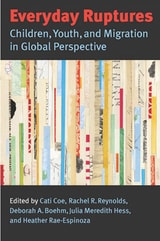
Everyday Ruptures
Children, Youth, and Migration in Global PerspectiveCati Coe
Vanderbilt University Press, 2011
When people--whether children, youth, or adults--migrate, that migration is often perceived as a rupture, with people separated by great distances and for extended periods of time. But for migrants and those affected by migration, the everyday persists, and migration itself may be critical to the continuation of social life. Everyday Ruptures illuminates the wide-ranging continuities and disruptions in the experiences of children around the world, those who participate in and those who are affected by migration.
The book is organized around four themes:
• how children's agency is affected by institutions, families, and beliefs
• how families and individuals create and maintain kin ties in conditions of rupture
• how emotion and affect are linked to global divisions and flows
• how the actions of states create ruptures and continuities
[more]