Results by title
349 books match the query 'Violence' and 9 start with e
Economies of Violence
Transnational Feminism, Postsocialism, and the Politics of Sex TraffickingJennifer Suchland
Duke University Press, 2015
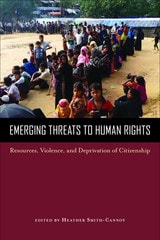
Emerging Threats to Human Rights
Resources, Violence, and Deprivation of CitizenshipHeather Smith-Cannoy
Temple University Press, 2019
As widespread environmental degradation threatens the basic human rights of a large proportion of the world’s population, we are also confronting the worst migration crisis in the modern era. Emerging Threats to Human Rights searches among the interrelated causes of these overlapping crises. The editor and contributors to this timely anthology assess how environmental resources, state violence, and the deprivation of nationality/citizenship are linked to gain a better understanding of how human rights abuses intersect with patterns of migration.
As some refugees flee violence at home, they arrive in an asylum country only to experience violence at the hands of the native population. Likewise, those denied citizenship rights in their country become vulnerable to human traffickers and other rights violations when they flee.
Bringing together scholars of resource dilemmas, violence, and citizenship as well as lawyers and human rights practitioners, Emerging Threats to Human Rights begins by identifying the core causes of human rights violations confronting our world today. Chapters also consider whether and to what extent these emerging threats to human rights serve as drivers of displacement.
Enemies of All Humankind
Fictions of Legitimate ViolenceSonja Schillings
Dartmouth College Press, 2016
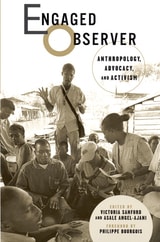
Engaged Observer
Anthropology, Advocacy, and ActivismSanford, Victoria
Rutgers University Press, 2006
Anthropology has long been associated with an ethos of “engagement.” The field’s core methods and practices involve long-term interpersonal contact between researchers and their study participants, giving major research topics in the field a distinctively human face. Can research findings be authentic and objective? Are anthropologists able to use their data to aid the participants of their study, and is that aid always welcome?
In Engaged Observer, Victoria Sanford and Asale Angel-Ajani bring together an international array of scholars who have been embedded in some of the most conflict-ridden and dangerous zones in the world to reflect on the role and responsibility of anthropological inquiry. They explore issues of truth and objectivity, the role of the academic, the politics of memory, and the impact of race, gender, and social position on the research process. Through ethnographic case studies, they offer models for conducting engaged research and illustrate the contradictions and challenges of doing so.

Entanglements, or Transmedial Thinking about Capture
Rey Chow
Duke University Press, 2012
These questions are dispersively heterologous yet mutually implicated. This paradoxical character of their discursive relations is what Rey Chow intends with the word "entanglements," by which she means, first, an enmeshment of topics: the mediatized image in modernist reflexivity; captivation and identification; victimhood; the place of East Asia in globalized Western academic study. Beyond enmeshment, she asks, can entanglements be phenomena that are not defined by affinity or proximity? Might entanglements be about partition and disparity rather than about conjunction and similarity?
Across medial forms (including theater, film, narrative, digitization, and photographic art), and against more popular trends of declaring things and people to be in flux, Chow proposes conceptual frames that foreground instead aesthetic, ontological, and sentient experiences of force, dominance, submission, fidelity, antagonism, masochism, letting-go, and the attraction to self-annihilation. Boundary, trap, capture, captivation, sacrifice, and mimesis: these riveting terms serve as analytic pressure points in her readings, articulating perversity, madness, and terror to pursuits of freedom.

Ethics in the Gutter
Empathy and Historical Fiction in ComicsKate Polak
The Ohio State University Press, 2017
This book’s most important questions surround how we receive and interpret representations of history, considering the ways in which what we think we know about historical atrocities can be at odds with the convoluted circumstances surrounding violence. Beginning with a new look at Watchmen, and including examinations of such popular series as Scalped and Hellblazer as well as Bayou and Deogratias, the book questions how graphic narratives create an alternative route by which to understand large-scale violence. Ethics in the Gutter explores how graphic narrative representations of violence can teach readers about the possibilities and limitations of empathy and ethics.
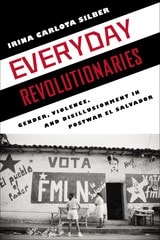
Everyday Revolutionaries
Gender, Violence, and Disillusionment in Postwar El SalvadorIrina Carlota Silber
Rutgers University Press, 2011
Winner of the 2013 International Latino Book Awards in the Best First Book, Nonfiction category
Everyday Revolutionaries provides a longitudinal and rigorous analysis of the legacies of war in a community racked by political violence. By exploring political processes in one of El Salvador's former war zones-a region known for its peasant revolutionary participation-Irina Carlota Silber offers a searing portrait of the entangled aftermaths of confrontation and displacement, aftermaths that have produced continued deception and marginalization.
Silber provides one of the first rubrics for understanding and contextualizing postwar disillusionment, drawing on her ethnographic fieldwork and research on immigration to the United States by former insurgents. With an eye for gendered experiences, she unmasks how community members are asked, contradictorily and in different contexts, to relinquish their identities as "revolutionaries" and to develop a new sense of themselves as productive yet marginal postwar citizens via the same "participation" that fueled their revolutionary action. Beautifully written and offering rich stories of hope and despair, Everyday Revolutionaries contributes to important debates in public anthropology and the ethics of engaged research practices.
Exemplary Violence
Rewriting History in Colonial ColombiaAlberto Villate-Isaza
Bucknell University Press, 2021
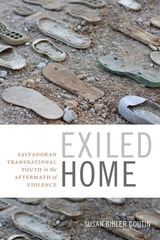
Exiled Home
Salvadoran Transnational Youth in the Aftermath of ViolenceSusan Bibler Coutin
Duke University Press, 2016