53 books match the query 'Voting' and 4 start with e
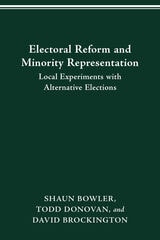
cover of ELECTORAL REFORM AND MINORITY REPRESENTATION: LOCAL EXPERIMENTS WITH ALTERNATIVE ELECTIONS

ELECTORAL REFORM AND MINORITY REPRESENTATION

LOCAL EXPERIMENTS WITH ALTERNATIVE ELECTIONS

SHAUN BOWLER

The Ohio State University Press, 2003

Questions of minority representation have long plagued the U.S. voting systems. The standard election often leaves political, racial, or ethnic minorities with little chance of being represented. Race-conscious districting remains the primary policy tool used for providing representation of racial and ethnic minorities in the United States—and it continues to generate tremendous conflict. Can alternatives to race-conscious, single-member districts offer benefits that extend beyond simply providing descriptive representations of minorities?

This study examines one such “semi-proportional” representation election system: Cumulative Voting (CV). For over a decade, scores of local U.S. governments have been elected by Cumulative Voting. This provides us with the ability to examine the effects of CV elections over time. Moreover, the use of CV in the United States allows us to compare politics in places that adopted CV to highly similar places that did not. Electoral Reform and Minority Representation shares evidence that CV elections can produce minority representation that matches levels generated with the drawing of race-conscious “majority-minority” districting. It also offers evidence that the quality of democratic processes in CV communities is in several ways higher that those under districts.

Given America’s growing racial and ethnic diversity, and given successful legal challenges that limit the use of race-conscious districting Electoral Reform and Minority Representation suggests that Cumulative Voting may be a better way to achieve minority representation in U.S. politics.
[more]
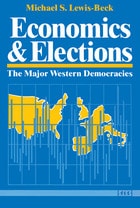
cover of Economics and Elections: The Major Western Democracies

Economics and Elections

The Major Western Democracies

Michael S. Lewis-Beck

University of Michigan Press, 1990
Does a government’s fate at the ballot box hinge on the state of the economy? Is it inflation, unemployment, or income that makes the difference? What triggers economic voting for or against the incumbent – do voters look at their pocketbooks, or at the national accounts? Do economic voters “punish” rulers for bad times, but fail to “reward” them for the good times? Are voter’s judgments based on past economic performance or future policy promises? These are some of the questions considered by Michael Lewis-Beck in this major cross-national study of the effect of economic conditions on voting behavior in the Western European democracies and the United States.
 
[more]
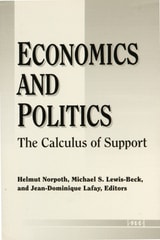
cover of Economics and Politics: The Calculus of Support

Economics and Politics

The Calculus of Support

Helmut Norpoth, Michael S. Lewis-Beck, and Jean-Dominique Lafay, Editors

University of Michigan Press, 1991
How do voters weigh economic concerns in their calculus of partisan choice in voting booths and opinion polls? How do voters arrive at their perceptions of economic conditions and assign responsibility for them to incumbent governments? And when do people go beyond electoral reactions in expressing their sentiments about economic well-being?The contributors to Economics and Politics employ sophisticated methods of analysis to isolate the effects of specific economic conditions such as unemployment and inflation. While some look at the effects of aggregate data on the electorate taken as a whole, others examine individual perceptions of economic conditions gleaned from survey data. The contributors, from several European countries as well as the United States, consider the relationships between economics and politics both cross-nationally and individually in West Germany, the United States, France, Britain, and Italy.Taken together, these contributions present the most comprehensive comparative assessment of economic influence on mass political behavior. The crucial role of strategic politicians, intervening in the economy as well as in public evaluations of the economy, receives considerable attention; so do interventions such as wars and political turnover. In sorting out economic facts and assigning responsibility to politicians amid such uncertainty, the publics of Western democracies display considerable sophistication.
[more]
cover of Electoral Democracy

Electoral Democracy

Michael B. MacKuen and George Rabinowitz, Editors

University of Michigan Press, 2003

Electoral Democracy pushes the boundaries of our current understanding of democratic politics and government. Some of the most distinguished scholars in the discipline were asked to write about a topic of continuing interest to their ongoing research programs. The fruit of their efforts incorporates the best of contemporary work on public opinion and democracy. Taking different perspectives, the authors assess the nature of citizens' political beliefs and values and then consider the ways that those views connect with elite policy-making. The combined set of essays provides the reader a good view of current research, suggests novel theoretical advances, and in the end invites a renewed interest in the quality and durability of electoral democracy.
Michael B. MacKuen is Burton Craige Professor of Political Science at the University of North Carolina. George Rabinowitz is Burton Craige Professor of Political Science at the University of North Carolina.
[more]