Results by title
388 books match the query 'War' and 7 start with e
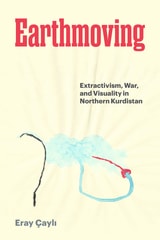
Earthmoving
Extractivism, War, and Visuality in Northern KurdistanEray Çayli
University of Texas Press, 2025
Focuses on contemporary art and media to examine the role of visuals in environmental violence and war in Northern Kurdistan.
Extractivism—exploiting the earth for resources—has long driven racial capitalism and colonialism. And yet, how does extractivism operate in a world where ecological and humanitarian sensibilities are unprecedentedly widespread? Eray Çaylı argues it does so by mobilizing these sensibilities in new ways. Extractivism is no longer only about moving the earth—displacing peoples, fossils, minerals, and waters—but also leaving those who witness this violent displacement sentimentally moved.
Earthmoving conceptualizes this duality. Derived from Çaylı’s years-long work in Northern Kurdistan, home to the world’s largest stateless nation—rendered stateless by colonial policies since the nineteenth century—Earthmoving focuses on the 2010s, a decade that began with peace talks between Turkey and the Kurdish liberation movement but ended with war. The decade saw extractivism intensify in the region and images of its harm proliferate across art and media. Together with contemporary artists, Çaylı shows that images challenge extractivism both by making its harm visible and by fostering self-reflexive and reciprocal collaboration that breaks with its valuation of the colonized and the racialized only in quantifiable and marketable terms.

Economic Behaviour in Adversity
Jack Hirshleifer
University of Chicago Press, 1988
Part I, "Disaster and Recovery," contains previously unpublished studies of major historical catastrophes, among them the Black Death of the fourteenth century, the Civil War in Russia that followed the Bolshevik revolution, and the mass bombing of Germany and of Japan during World War II. Accompanying the historical studies are several analytical papers that interpret the disaster experience.
The essays in Part II, "Cooperation and Conflict," represent innovative theoretical analyses based on a common theme—that cooperation and conflict are alternative strategies whereby individuals, groups, and different forms of social organization struggle with one another for evolutionary survival. Ultimately, these essays indicate, the political economy of the human species is an instance of Darwin's "economy of nature."

Embracing Arms
Cultural Representation of Slavic and Balkan Women in WarYana Hashamova
Central European University Press, 2012
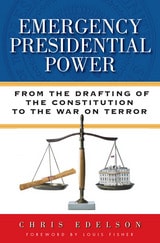
Emergency Presidential Power
From the Drafting of the Constitution to the War on TerrorChris Edelson; Foreword by Louis Fisher
University of Wisconsin Press, 2013
Winner, Crader Family Book Prize in American Values, Department of History and Crader Family Endowment for American Values, Southeast Missouri State University

Empire State-Building
War and Welfare in Kenya, 1925–1952Joanna Lewis
Ohio University Press, 2001
This history of administrative thought and practice in colonial Kenya looks at the ways in which white people tried to engineer social change.
It asks four questions:
- Why was Kenya’s welfare operation so idiosyncratic and spartan compared with that of other British colonies?
- Why did a transformation from social welfare to community development produce further neglect of the very poor?
- Why was there no equivalent to the French tradition of community medicine?
- If there was a transformatory element of colonial rule that sought to address poverty, where and why did it fall down?
The answers offer revealing insight into the dynamics of rule in the late colonial period in Kenya.
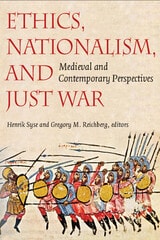
Ethics, Nationalism, and Just War
Medieval and Contemporary PerspectivesHenrik Syse
Catholic University of America Press, 2007

Extinction Song
John James
Tupelo Press, 2026
Extinction Song begins with a tender depiction of early parenthood, as the speaker cradles his newborn son while imagining a dystopian climate future. The poems open into a broader consideration of overlapping and interrelated systems, from the confines of received knowledge to the closed circuit of ideology to the circularity of pollutive environmental cycles. Attentive to the levels of sound and of visual architecture, these poems highlight both destruction and unseen possibilities. By turns meditative and probing, and sometimes slyly funny, Extinction Song unwinds the perils and the joys of our precarious climate future.