106 books match the query 'Western' and 4 start with e

cover of Emotional Bodies: The Historical Performativity of Emotions

Emotional Bodies

The Historical Performativity of Emotions

Edited by Dolores Martín Moruno and Beatriz Pichel

University of Illinois Press, 2019

What do emotions actually do? Recent work in the history of emotions and its intersections with cultural studies and new materialism has produced groundbreaking revelations around this fundamental question. In Emotional Bodies, contributors pick up these threads of inquiry to propose a much-needed theoretical framework for further study of materiality of emotions, with an emphasis on emotions' performative nature. Drawing on diverse sources and wide-ranging theoretical approaches, they illuminate how various persons and groups—patients, criminals, medieval religious communities, revolutionary crowds, and humanitarian agencies—perform emotional practices. A section devoted to medical history examines individual bodies while a section on social and political histories studies the emergence of collective bodies.

Contributors: Jon Arrizabalaga, Rob Boddice, Leticia Fernández-Fontecha, Emma Hutchison, Dolores Martín-Moruno, Piroska Nagy, Beatriz Pichel, María Rosón, Pilar León-Sanz, Bertrand Taithe, and Gian Marco Vidor.
[more]
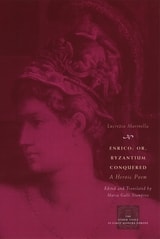
cover of Enrico; or, Byzantium Conquered: A Heroic Poem

Enrico; or, Byzantium Conquered

A Heroic Poem

Lucrezia Marinella

University of Chicago Press, 2009

Lucrezia Marinella (1571–1653) is, by all accounts, a phenomenon in early modernity: a woman who wrote and published in many genres, whose fame shone brightly within and outside her native Venice, and whose voice is simultaneously original and reflective of her time and culture. In Enrico; or, Byzantium Conquered, one of the most ambitious and rewarding of her numerous narrative works, Marinella demonstrates her skill as an epic poet.
 

Now available for the first time in English translation, Enrico retells the story of the conquest of Byzantium in the Fourth Crusade (1202–04). Marinella intersperses historical events in her account of the invasion with numerous invented episodes, drawing on the rich imaginative legacy of the chivalric romance. Fast-moving, colorful, and narrated with the zest that characterizes Marinella’s other works, this poem is a great example of a woman engaging critically with a quintessentially masculine form and subject matter, writing in a genre in which the work of women poets was typically shunned.
[more]
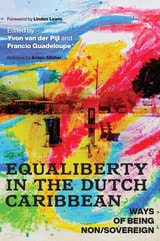
cover of Equaliberty in the Dutch Caribbean: Ways of Being Non/Sovereign

Equaliberty in the Dutch Caribbean

Ways of Being Non/Sovereign

Yvon van der Pijl

Rutgers University Press, 2022
Equaliberty in the Dutch Caribbean is a collection of essays that explores fundamental questions of equality and freedom on the non-sovereign islands of the Dutch Caribbean. Drawing on in-depth ethnographic research, historical and media analysis, the study of popular culture, and autoethnographic accounts, the various contributions challenge conventional assumptions about political non/sovereignty. While the book recognizes the existence of nationalist independence movements, it opens a critical space to look at other forms of political articulation, autonomy, liberty, and a good life. Focusing on all six different islands and through a multitude of voices and stories, the volume engages with the everyday projects, ordinary imaginaries, and dreams of equaliberty alongside the work of independistas and traditional social movements aiming for more or full self-determination. As such, it offers a rich and powerful telling of the various ways of being in and belonging to our contemporary postcolonial world.
[more]
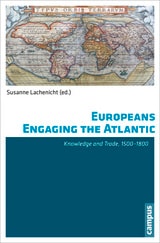
cover of Europeans Engaging the Atlantic: Knowledge and Trade, 1500-1800

Europeans Engaging the Atlantic

Knowledge and Trade, 1500-1800

Edited by Susanne Lachenicht

Campus Verlag, 2014

Europeans Engaging the Atlantic offers innovative perspectives on historical European knowledge concerning the “New World” and on trade and commerce therewith. In so doing, it enhances our understanding of how, when, and why early modern Europeans made sense of the Atlantic world, and how they tried to connect with Atlantic trade and commerce. Featuring case studies that discuss these issues from the sixteenth to the eighteenth centuries, this volume explores both the degree to which the Atlantic was (or was not) part of the European worldview—or just one part of a worldview with many centers of interest—and how European engagement with the Atlantic world evolved.
[more]