Results by title
1677 books match the query 'Archaeology' and 59 start with e
Excavations in Southwest Utah
UUAP 76C. Melvin Aikens
University of Utah Press, 1965
Expanding Archaeology
Axel E. Nielsen
University of Utah Press, 1995
Expanding Archaeology is the first attempt to define behavioral archaeology comprehensively and to establish its place among competing theoretical frameworks. Among other objectives, this volume demonstrates that a behavioral approach—the study of material objects regardless of time or space to describe and explain human behavior—provides a means whereby religion, gender, and other seemingly unknowable elements of prehistory can be inferred through systematic, empirical analysis.
Expanding Archaeology begins with three retrospective analyses by J. Jefferson Reid, William Rathje, and Michael Schiffer, followed by seven case studies exploring various avenues offered by this approach. A third section contains five critiques that serve as a counterpoint to the behavioral approach. Although the editors do not suggest that behavioral archaeology should be the universal archaeology, they do suggest that this approach permits pre-historians to expand into new areas of investigation.
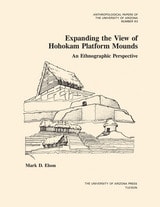
Expanding the View of Hohokam Platform Mounds
An Ethnographic PerspectiveMark D. Elson
University of Arizona Press, 1998
Using this information, he develops a number of important new generalizations about how people used mounds. Elson then applies these data to the study of a prehistoric settlement system in the eastern Tonto Basin of Arizona that contained five platform mounds. He argues that the mounds were used variously as residences and ceremonial facilities by competing descent groups and were an indication of hereditary leadership. They were important in group integration and resource management; after abandonment they served as ancestral shrines. Elson's study provides a fresh approach to an old puzzle and offers new suggestions regarding variability among Hohokam populations. Its innovative use of comparative data and analyses enriches our understanding of both Hohokam culture and other ancient societies.

Expedition of Hernando de Soto West of the Mississippi, 1541–1543
Proceedings of the de Soto Symposia, 1988 and 1990Gloria Young
University of Arkansas Press, 1999
Back by popular demand and new in paperback, this spirited collection of nearly twenty papers celebrates the 450th anniversary of Hernando de Soto’s epic expedition across the Southeast and West.
Originally presented at two symposia conducted by the University Museum at the University of Arkansas, the collection offers an array of viewpoints and diverse approaches to de Soto scholarship. Archaeologists, anthropologists, historians, museum curators, and folklorists all contribute to this lively debate on the Spanish explorer and his travels.
The book focuses on research that challenges traditional interpretation of de Soto’s entrada and travel route, particularly after the expedition crossed the Mississippi River. David H. Dye hypothesizes a route across the river and the alluvial plain by linking the narrative accounts with geography and archaeological knowledge. Phyllis A. Morse asserts that the Parkin site is the location of the capital of Casqui, one of the polities visited by de Soto. Charles M. Hudson repostulates his version of the expedition route, which in 1988 severely challenged the De Soto Commission theory of 1939. Ann M. Early redraws the trail in the uplands of the Ouachita Mountains And Frank E. Schambach tests the possibility that the expedition wandered through Caddoan territory in east Texas after de Soto’s death.
Several chapters examine the Native Americans whom de Soto and his expedition encountered in their journey; other contributions provide a fresh look at the chronicles of the expedition that have survived. What emerges is a redrawn map of de Soto’s exploration—and a deeper understanding of the impact of European contact on the New World.
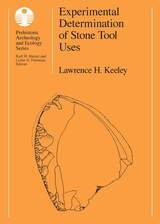
Experimental Determination of Stone Tool Uses
A Microwear AnalysisLawrence H. Keeley
University of Chicago Press, 1980
The most important discovery arising from Keeley's research was that, at magnifications of 100x to 400x, there was a high correlation between the detailed appearance of microwear polishes formed on tool edges and the general category of material worked by that edge. For example, different and distinctive types of microwear polish were formed during use on wood, bone, hide, meat, and soft plant material. These correlations between microwear polish and worked material were independent of the method of use (cutting, sawing, scraping, and so on). In combining evidence of polish type with other traces of use, Keeley was able to make precise reconstructions of tool functions. This book includes the results of a "blind test" of Keeley's functional interpretations which revealed remarkable agreement between the actual and inferred use of the tools tested.
Keeley applied his method of microwear analysis to artifacts from three excavation sites in Britain—Clacton-on-the-sea, Swanscombe, and Hoxne. His research suggests new hypotheses concerning such Paleolithic problems as inter-assemblage variability, the function of Acheulean hand axes, sidescrapers, and chopper-cores and points the way to future research in Stone Age studies.
Explorations in Behavioral Archaeology
William H. Walker and James M. Skibo
University of Utah Press, 2015
Behavioral archaeology, defined as the study of people-object interactions in all times and places, emerged in the 1970s, in large part because of the innovative work of Michael Schiffer and colleagues. This volume provides an overview of how behavioral archaeology has evolved and how it has affected the field of archaeology at large.
The contributors to this volume are Schiffer’s former students, from his first doctoral student to his most recent. This generational span has allowed for chapters that reflect Schiffer’s research from the 1970s to 2012. They are iconoclastic and creative and approach behavioral archaeology from varied perspectives, including archaeological inference and chronology, site formation processes, prehistoric cultures and migration, modern material culture variability, the study of technology, object agency, and art and cultural resources. Broader questions addressed include models of inference and definitions of behavior, study of technology and the causal performances of artifacts, and the implications of artifact causality in human communication and the flow of behavioral history.
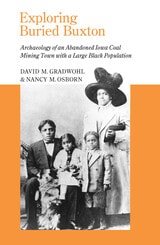
Exploring Buried Buxton
Archaeology of an Abandoned Iowa Coal Mining Town with a Large Black PopulationDavid M. Gradwohl
University of Iowa Press, 1984
Few sources before have dealt with the archaeology of African American settlements outside the Atlantic seaboard and the southern states. This book describes in detail the archaeological investigations conducted at the town site of Buxton, Iowa, a coal mining community inhabited by a significantly large population of blacks between 1900 and 1925.
David Gradwohl and Nancy Osborn present the archaeology of Buxton from “the group up” to articulate the material remains with the data acquired from archival studies and oral history interviews. They also examine the broader significance of the Buxton experience in terms of those who lived there and their children and grandchildren who have heard about Buxton all their lives.
Exploring Cause and Explanation
Historical Ecology, Demography, and Movement in the American SouthwestCynthia L. Herhahn
University Press of Colorado, 2016
Each thematic section is introduced by an established author who sets the framework for the chapters that follow. Some contributors adopt regional perspectives in which both classical regions (the central San Juan or lower Chama basins) and peripheral zones (the Alamosa basin or the upper San Juan) are represented. Chapters are also broad temporally, ranging from the Younger Dryas Climatic interval (the Clovis-Folsom transition) to the Protohistoric Pueblo world and the eighteenth-century ethnogenesis of a unique Hispanic identity in northern New Mexico. Others consider methodological issues, including the burden of chronic health afflictions at the level of the community and advances in estimating absolute population size. Whether emphasizing time, space, or methodology, the authors address the processes, steps, and interactions that affect current understanding of change or stability of cultural traditions.
Exploring Cause and Explanation considers themes of perennial interest but demonstrates that archaeological knowledge in the Southwest continues to expand in directions that could not have been predicted fifty years ago.
Contributors: Kirk C. Anderson, Jesse A. M. Ballenger, Jeffery Clark, J. Andrew Darling, B. Sunday Eiselt, Mark D. Elson, Mostafa Fayek, Jeffrey R. Ferguson, Severin Fowles, Cynthia Herhahn, Vance T. Holliday, Sharon Hull, Deborah L. Huntley, Emily Lena Jones, Kathryn Kamp, Jeremy Kulisheck, Karl W. Laumbach, Toni S. Laumbach, Stephen H. Lekson, Virginia T. McLemore, Frances Joan Mathien, Michael H. Ort, Scott G. Ortman, Mary Ownby, Mary M. Prasciunas, Ann F. Ramenofsky, Erik Simpson, Ann L. W. Stodder, Ronald H. Towner
Exploring the Mesoamerican Subterranean Realm
James E. Brady
University Press of Colorado, 2025
The volume expands the study of caves to focus on the broader realm of subterranean space, introducing the concept of the constructed subterranean, a space in which the Maya deliberately created sacred landmarks through excavation. Chapters critically examine chultuns, previously thought to be subterranean storage chambers, and sascaberas, previously considered mines, demonstrating that the traditional archaeological models are deeply flawed. A wealth of data on both features is used to envision a new sacred landscape filled with thousands of subterranean sacred landmarks. Natural caves are also examined; a survey conducted around the ancient site of Yaxchilan considers the obvious importance of large stalagmites set up in the site core as monuments. Long-distance pilgrimages to these caves fundamentally reevaluates the nature of pilgrimage and reveals an economic and political importance that structured settlement and activities around the pilgrimage sites. Finally, evidence is analyzed to show that the human bones recovered from Midnight Terror Cave, Belize, were the result of human sacrifice.
Dealing equally with the archaeology of both natural and constructed subterranean spaces, Exploring the Mesoamerican Subterranean Realm challenges preconceived notions of these spaces and their meanings, dramatically shifting the field’s focus and extending the understanding of the critical importance of this “dark side” of archaeology.